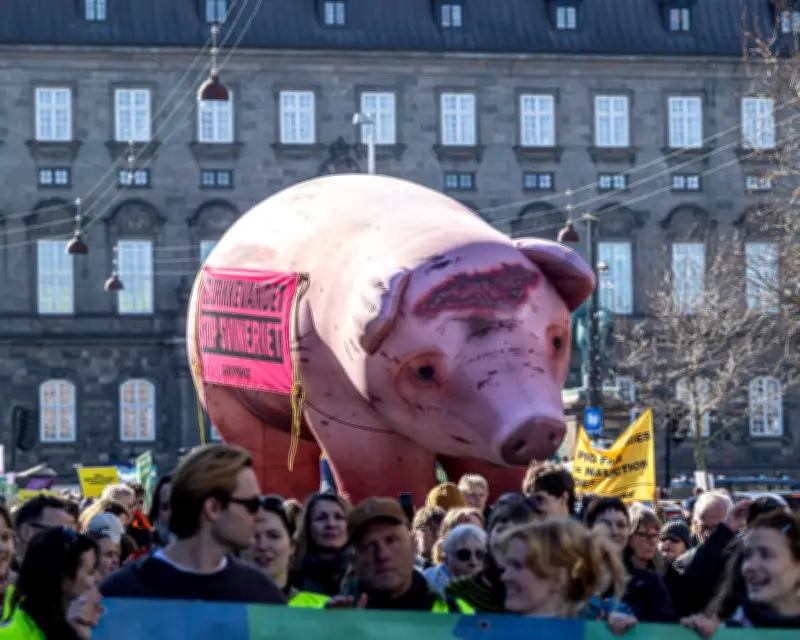
Protesters in Copenhagen days before the March election, where pig farming became the dominant campaign issue.
How campaigners beat industrial farming in Denmark’s ‘pig election’
Mette Frederiksen’s new government promises overhaul for people – and animals – in home of ultra-intensive farming

Like all new prime ministers, when Mette Frederiksen secured a third consecutive term as Denmark’s head of government this week, she promised her administration would take steps to “improve the everyday lives” of the country’s inhabitants. Unlike most new prime ministers, however, she specified that her left-leaning coalition’s policy programme would be not just for “the people who are in Denmark and the generations to come” but also “for the animals”.
For the home of Danish bacon, an ultra-intensive farming country that produces about 30m piglets a year – against roughly 60,000 human babies – it was a huge moment: a Danish government, seeking existential reform of Denmark’s most iconic industry. It was also the culmination of two years of focused campaigning by animal welfare, environmentalist and residents’ groups that turned March’s ballot into what became known as “the pig election” – and won a comprehensive victory.
Britta Riis, the head of Animal Protection Denmark, one of the primary actors in the campaign, said: “I hardly dare say it, but we got more than we asked for. We made pig farming a top political issue. And we’ve won immediate, and systemic, change.”
Pigs are to Denmark roughly what cars are to Germany and wine to France. But activists have long campaigned against the extreme breeding practices on the country’s vast, ultra-intensive industrial farms. On average, sows in Denmark wean more than 37 piglets a year, and those in the top 10% of farms nearly 43. That’s far more than other intensive pig producers such as the Netherlands, which manages 31 piglets per sow. In Denmark, sows, which usually have 14 teats, routinely produce up to 20 piglets a litter.
Campaigners say pushing an animal’s biology to produce more offspring than it can physically feed causes not only severe physical stress but also an unacceptable mortality rate: roughly 9m piglets die every year in Denmark, more than 25,000 a day. Danish farms also routinely cut the tails off about 95% of surviving piglets to prevent tail-biting caused by stress and confinement in tightly packed pens, while sows are often locked into restrictive farrowing crates where they cannot move.
But animal welfare is not the only issue. Nearly 25% of Denmark’s landmass is used to produce feed for pigs, according to an Aarhus University study – and as a result, toxic pesticide residues are present in 56% of drinking water catchment points. Vast quantities of manure are also spread on the fields around farms that can hold up to 25,000 pigs, leaching toxic nitrates into the groundwater.
Christian Fromberg, from Greenpeace Denmark, said: “It’s pure corporate capture. Denmark’s big meat exporters and the industrial farming sector have treated our shared water supply like a private, unregulated sewer for decades. Polluted drinking water is the other huge problem with intensive pig farming in Denmark.”
Worst-hit is Aalborg, in northern Denmark, in an area of intensive agriculture known as “the nitrate belt”. The municipality took the Danish government to court in February over nitrate levels in its surface and groundwater that have exceeded legal limits for decades. It said the state had failed to take promised measures, forcing the municipality to invest in a drinking water treatment plant that would cost it DKr1.1bn (€147m or £127m) to build and operate over 30 years.
People living near pig farms have long complained of the stench, saying they cannot open windows, dry laundry or enjoy their gardens, as well as the toxic effect on local ponds and rivers and the impossibility of selling their homes. Riis said: “All these problems have been building for a long time. We’ve campaigned on the animal welfare issue for years, but nothing changed. The difference, this time, was that we intensified our efforts, we focused on pigs and we worked together.”

Dozens of newspaper articles, three shocking TV documentaries on the main public broadcaster, TV2, and a book by an undercover journalist followed, all highlighting what Riis called the “brutal” conditions for animals on industrial pig farms. On the back of evidence in one documentary, three powerful figures in the sector were reported to the police by the Animal Protection Agency for “clear violations” of welfare laws, including the head of the Danish Council on Food and Agriculture trade lobby.
A citizens’ initiative demanding reform garnered the 50,000 signatures necessary to prompt a parliamentary debate with 72 hours, a record. Slowly but surely the issue gained public awareness, support and, finally, political traction. Three weeks before the election, the Animal Protection Agency, the Danish Society for Nature Conservation, Greenpeace Denmark and the National Association against Pig Factories joined forces. The “Alliance for a pig election” was launched by the NGOs along with four left-wing parties to seek a “showdown with an industry that has huge costs for our country in terms of climate, nature, environment, social cohesion and animal welfare”.
In the days before the 24 March vote, pig farming became the dominant campaign issue, featuring heavily in candidates’ televised debates. Riis said: “Eventually the Social Democrats [led by Frederiksen], even parts of the right, saw the point. It just took off.” By the time it came to vote, 53% of Danes were telling pollsters that animal welfare would definitely influence how they cast their ballots, while 95% were demanding urgent action to protect the country’s drinking water.
Frederiksen’s Social Democrat-led coalition includes two of the parties in the pig election alliance – the Green Left and the Social Liberals – while a third, the Red-Green Alliance, will provide the parliamentary backing necessary for a majority. Part of the price of their backing is in the new government’s programme, announced this week. It includes pledges to end routine tail docking and extreme breeding, and give sows and piglets more space to move. In terms of systemic change, a special commission will be tasked with comprehensively restructuring the entire sector.
The stated intention is to shift the industry away from ultra-intensive, confined, export-driven factory farming towards a low-density, sustainable, domestic-facing model. Communities will get the power to prevent new factory farms and the expansion of existing ones, and the nitrate limit in drinking water will be radically reduced from 50mg a litre to 6mg, in line with expert recommendations. In perhaps the biggest change of all, for the first time in 130 years Denmark will not have an agriculture minister. In their place will be a minister for nature and animal welfare, with the agriculture portfolio split between that department and four others.
It heralds, campaigners say, a fundamental shift in priorities – and an almighty challenge that may test whether a modern, globalised economy can balance economic prosperity with systemic protections for the natural world. Denmark is the world’s sixth-largest pork exporter. The Council on Food and Agriculture insists that Danish pig farms meet EU space requirements, legal welfare standards are observed and manure disposal is managed responsibly. The lobby has also warned that any big reduction in pig production would have major economic consequences for the country, including job losses. The battle over how far greener agricultural rules can and should be enforced promises to be fierce.
For the time being, though, Riis and Fromberg are savouring their wins. “At the moment, we’re pretty pleased,” said Fromberg. “I think it’s fair to say that on paper at least, this is the greenest government Denmark has ever seen.” Riis said hard campaigning and a laser focus on facts – including presenting a financial argument solid enough to convince the political right – had played their part. “At the end of the day, though, this was citizens saying: we have had enough.”