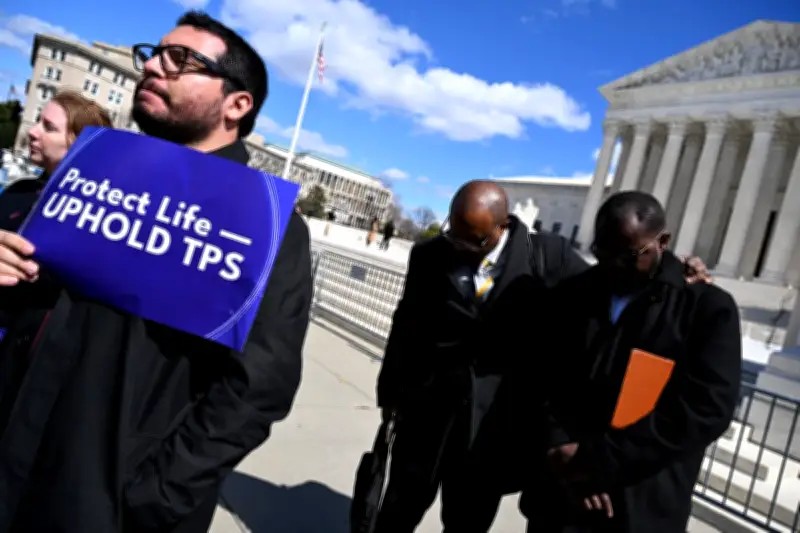
The Supreme Court's recent immigration rulings have sparked alarm among legal experts, who warn that the decisions fundamentally undermine constitutional protections and expand executive authority at the expense of judicial oversight. The rulings, handed down in late June, address key aspects of immigration enforcement and due process, with critics arguing they set a dangerous precedent for future cases.
Key Rulings and Their Implications
In two separate cases, the Court ruled in favor of the government's broad discretion in immigration matters. The first decision upheld a policy that allows expedited removal of certain undocumented immigrants without a hearing, while the second limited judicial review of detention decisions. According to constitutional law professor Sarah Johnson of Georgetown University, these rulings represent a significant shift in the balance of power. 'The Court has effectively given the executive branch unchecked authority over immigration enforcement, stripping away basic due process protections that have been cornerstones of our legal system,' Johnson said.
The expedited removal ruling, which applies to individuals who cannot prove they have been in the country for more than two years, eliminates the requirement for an immigration judge to review each case. Previously, such removals were limited to those apprehended within 100 miles of the border and within 14 days of entry. The expansion means that people living in the interior of the country for up to two years can now be deported without ever seeing a judge.

Impact on Immigrant Communities
Advocacy groups have condemned the decisions, warning of widespread fear and uncertainty. 'These rulings will have a chilling effect on immigrant communities, making people afraid to report crimes or seek medical help,' said Maria Lopez, executive director of the National Immigrant Justice Center. 'The Court has endorsed a system that prioritizes speed over fairness, and that is deeply troubling.'
Data from the Department of Homeland Security indicates that approximately 400,000 people could be affected annually by the expanded expedited removal policy. Critics argue that many of these individuals may have valid asylum claims or other protections, but will be deported without the opportunity to present their cases.
Legal and Political Reactions
The rulings have also drawn sharp criticism from Democratic lawmakers, who have pledged to introduce legislation to restore due process protections. Senator Elizabeth Warren called the decisions 'an assault on the rule of law' and vowed to push for comprehensive immigration reform. Meanwhile, the Biden administration has expressed disappointment but acknowledged the need to comply with the Court's decisions. In a statement, White House Press Secretary Karine Jean-Pierre said the administration is 'reviewing the rulings and will work to mitigate their impact to the fullest extent possible under the law.'
Legal challenges are expected to continue, with civil liberties organizations already preparing lawsuits on narrower grounds. The American Civil Liberties Union (ACLU) announced it would challenge the detention ruling, arguing that it violates the Immigration and Nationality Act. 'We will not stand by while the Court eviscerates the rights of immigrants,' said ACLU legal director David Cole.
Broader Implications for the Judiciary
Beyond immigration, experts say the rulings signal a broader trend of the Court deferring to executive power in areas of national security and border control. 'This is part of a larger pattern where the Court is reluctant to second-guess the executive on matters it deems inherently political,' said law professor Michael Green of Harvard University. 'The danger is that this deference will extend to other areas, eroding checks and balances.'
The decisions come as the Court's conservative majority continues to shape key areas of law. With two of the three rulings decided along ideological lines (6-3), the divide on the bench is stark. Justice Sonia Sotomayor, dissenting in the expedited removal case, wrote that the majority 'abdicates its responsibility to protect individual rights' and 'hands the executive a blank check.'

As the nation grapples with these changes, immigrant rights advocates are mobilizing to provide legal assistance and raise awareness. 'We are in a new era of immigration enforcement,' Lopez said. 'Our work is more critical than ever.'