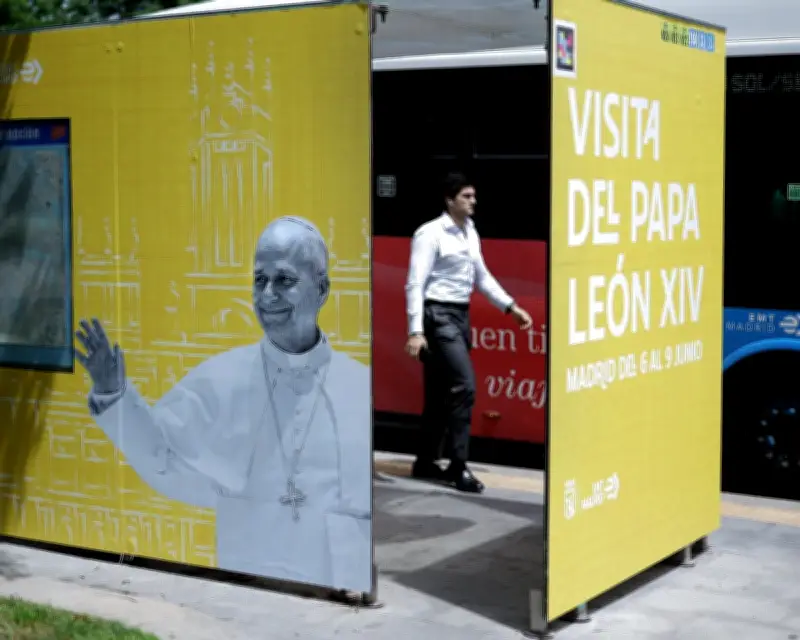
As Pope Leo XIV prepares to land in Madrid on Saturday morning, his presence already permeates the Spanish capital. The smiling face of the first US pontiff adorns posters, buses, travel cards, and metro screens, appearing between advertisements for sunscreen and banking offers.
At Plaza de Cibeles, a massive stage for Sunday's mass, expected to draw up to a million worshippers, is under construction. Banners along the Paseo del Prado welcome the pope and urge the faithful to 'lift up your eyes,' quoting the Gospel of John.
Excitement Amidst Declining Religiosity
Despite a sharp decline in Catholicism—only 56.1% of Spaniards now identify as Catholic, down from 71.7% in 2011—the visit generates palpable excitement. Notably, the number of young Catholics (ages 15-29) rose from 31.6% in 2020 to 45% last year, offering hope to the pontiff.

The political landscape is far more polarized than during Pope Benedict XVI's 2011 visit. Issues like housing, immigration, and corruption allegations have created a tense atmosphere.
Carefully Curated Itinerary
Leo's seven-day trip includes Madrid, Barcelona, and the Canary Islands, blending official meetings, pastoral events, and personal encounters. He will meet King Felipe, Queen Letizia, and Prime Minister Pedro Sánchez, inaugurate the Jesus Christ tower at Sagrada Familia, and spend time with homeless people and migrants.
On Thursday, he visits the port of Arguineguín in Gran Canaria to speak with migrants who risked the Atlantic route from Africa. At least 1,172 people died on this route last year.
Alignment with Sánchez's Policies
The pope's focus on migrant rights aligns with Sánchez's socialist government, which defends migration's economic and social benefits and is regularizing at least 500,000 undocumented migrants. After a Vatican meeting, Sánchez called Leo a 'moral compass in the fight against injustice' and praised their shared 'humanist vision of migration.'
This stance draws criticism from the far-right Vox party, which opposes regularization. Vox leader Santiago Abascal once proposed deporting up to 8 million people of foreign origin, later backtracking. Abascal recently criticized bishops for supporting migrant care, urging them to 'leave their palaces' and see immigration's impact on Spaniards.
Political Implications
Vox's lukewarm response to the papal visit is significant. Its 'Spaniards first' policies influence the conservative People's Party (PP), forecast to win next year's election but likely needing Vox's support. Vox has re-entered regional coalitions with the PP, pushing 'national priority' policies favoring Spaniards in housing and benefits.
The visit could boost Spain's international profile, already elevated by Sánchez's pro-immigration stance, criticism of Israel's Gaza war, and rebukes of Trump's Iran attacks. A full-page tourist board ad in The Guardian, showing Sagrada Familia, reads: 'We build peace. Good things are happening in Spain.'
For Sánchez, the pope's visit reinforces his immigration policies, puts the PP in an awkward spot due to its ties with Vox, and may divert attention from corruption allegations. His brother David Sánchez is on trial for influence-peddling, and his wife Begoña Gómez faces charges including embezzlement. Both deny wrongdoing, as does former PM José Luis Rodríguez Zapatero, under investigation for influence peddling. Police also probe allegations of a socialist party team thwarting investigations.
For now, attention shifts to the 70-year-old American pontiff, whose message transcends politics.