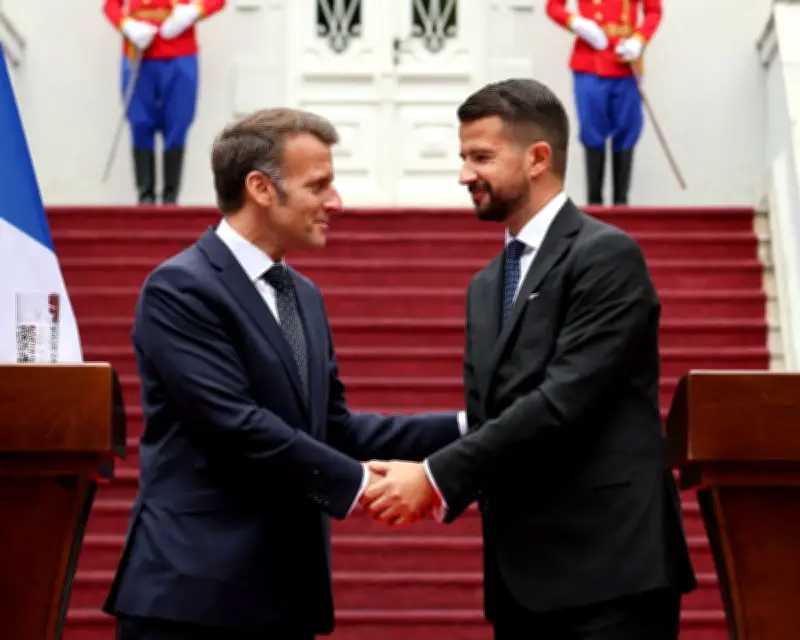
European leaders will gather in Montenegro on Friday to demonstrate that six western Balkan countries have a genuine path to joining the European Union, despite internal divisions over enlargement strategy. The summit, held in the coastal resort of Tivat, will bring together over 30 leaders, including French President Emmanuel Macron, German Chancellor-in-waiting Friedrich Merz, Italian Prime Minister Giorgia Meloni, and European Commission President Ursula von der Leyen.
The talks will focus on integrating the six Balkan nations—Montenegro, Albania, North Macedonia, Kosovo, Bosnia and Herzegovina, and Serbia—more deeply into the EU single market as a stepping stone to full membership. European Council President António Costa emphasized the EU's commitment, stating earlier this week in Sarajevo that enlargement is a "geostrategic interest for Europe" and an "investment in peace, stability, and security."
Geopolitical Context
The summit occurs as Russia and China vie for influence in the region. Costa described the EU's offer as "real," matching the opportunity for enlargement. The meeting follows Hungary's decision to drop its veto over Ukraine's EU talks, allowing Kyiv and Moldova to open negotiations on the rule of law and democratic standards later this month. Ukraine and Moldova were fast-tracked to candidate status after Russia's 2022 invasion, but EU institutions are keen to reassure western Balkan countries they are not being left behind.

Montenegro Leads the Way
Montenegro, aiming to become the EU's 28th state by 2028, is the most advanced candidate. Existing members have proposed safeguards to prevent new joiners from blocking decisions, as happened with Hungary's Viktor Orbán. Albania is next in line, though some EU governments question its progress against organized crime. North Macedonia, Kosovo, and Bosnia and Herzegovina face internal and external disputes, while Serbia is seen as drifting away under President Aleksandar Vučić, who has cracked down on protesters and refused to align with EU sanctions on Russia.
Faruk Bašić, a researcher at the Brussels Institute for Geopolitics, noted that the war in Ukraine has reframed enlargement as a strategic priority. "The geopolitical urgency is unprecedented," he said, contrasting it with the traditional process of aligning with EU values before joining.
Divisions Over Ukraine
EU leaders are split on Ukraine's accession timeline. A German proposal for associate membership—representation without voting rights—has drawn criticism from Kyiv and some member states. Berlin views it as a generous step to accelerate Ukraine's path, but a senior EU diplomat called it a "substitute" that could make full membership "almost impossible." Despite these assurances, some states remain reluctant, notably France.
One EU official highlighted progress, such as the first meeting of a technical group drafting Montenegro's accession treaty last month, calling it "extremely real" and starting a clock for the next enlargement.
Tangible Benefits
Sources caution against expecting major announcements on membership talks Friday, focusing instead on practical improvements. Before the summit, the EU council approved talks to end mobile roaming charges in the western Balkans, extending the "roam like at home" policy. While no launch date is set, it would allow citizens to use calls, texts, and data without extra fees across the European Economic Area and the six Balkan countries.
This initiative is part of a broader strategy to integrate the region into the EU single market, including joining the single euro payments area for harmonized electronic payments.
The summit underscores the EU's determination to counter Russian and Chinese influence while offering a credible path to membership for the western Balkans, even as internal debates over Ukraine's rapid candidacy persist.