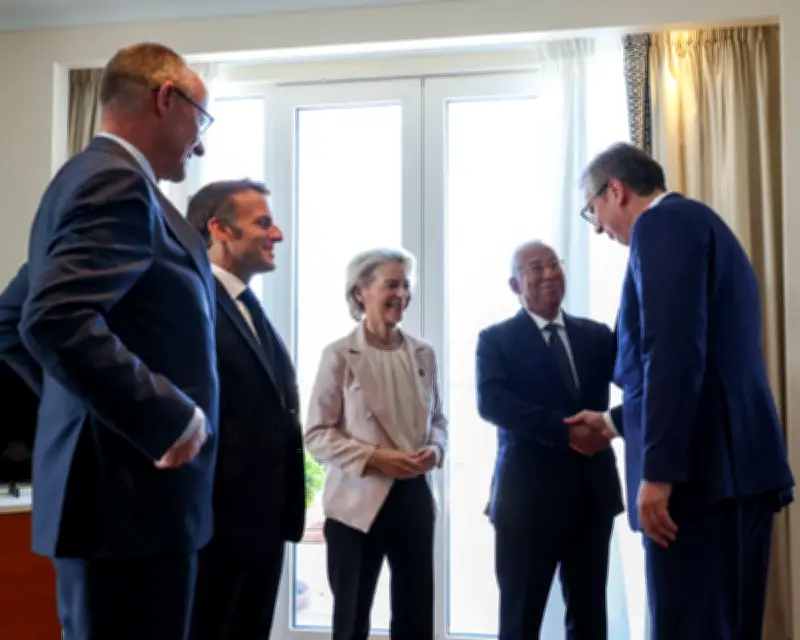
European Union leaders have declared that the bloc must demonstrate its willingness and ability to admit new members, while accelerating the enlargement process. This statement came during a summit with counterparts from six Western Balkan countries aspiring to join the EU.
"The European Union has to show that it is capable of enlarging and willing to enlarge, and we want to discuss that here," German Chancellor Friedrich Merz told reporters on Friday at the summit in Tivat, a coastal town in Montenegro.
Merz Highlights EU's Shortcomings
Merz emphasised that there are "a whole range of questions we must answer together, but above all it must be clear that this part of Europe belongs within the EU's future." He noted that the fact no new members had joined in 13 years revealed "shortcomings" within the bloc.

European Commission President Ursula von der Leyen, who attended the summit alongside Merz, French President Emmanuel Macron, and Italian Prime Minister Giorgia Meloni, stressed the need "to make the enlargement process faster and more credible."
Montenegro's Aspirations
Montenegrin President Jakov Milatović, whose country of 630,000 people is furthest along in its EU membership bid and hopes to join by 2028, welcomed the leaders. The issue of enlargement has gained urgency due to Russia's war in Ukraine, with Kyiv eager to join the EU and EU officials arguing that expansion is necessary to counter foreign influence.
Since Russia's full-scale invasion in February 2022, Ukraine and Moldova have joined the queue of candidate countries, alongside Albania, Bosnia, Kosovo, North Macedonia, Montenegro, and Serbia. However, the accession process remains lengthy and complex, involving years of negotiations and legal reforms, requiring unanimous approval from all 27 EU members at each stage.
Gradual Integration Proposal
France and Germany used the Tivat meeting to promote the concept of "gradual integration" into the bloc. "Together with Germany, we have proposed a strengthened gradual integration process," Macron told reporters. This could allow a country that aligns with the EU on certain criteria to participate in specific EU formats, such as European Council meetings.
The idea of "halfway" integration is gaining traction. Serbian President Aleksandar Vučić and Albanian Prime Minister Edi Rama recently called for faster single market and Schengen zone integration for new members in exchange for no veto rights.
The Guardian reported last week that EU officials were considering denying new members veto powers for several years to avoid a repeat of the bloc's experience with Hungary's Viktor Orbán, who frequently blocked EU decisions. Merz also suggested granting Ukraine a new "associate member" status, allowing Ukrainian officials to attend EU summits and ministerial meetings without voting rights, as an interim step toward full membership.
Geopolitical Importance
Macron emphasised that enlargement "is very important from a geopolitical point of view, because this region is also where Europe's independence is at stake in terms of energy, security and migration routes."
The lengthy joining process has led to declining support for EU membership in some Balkan countries. In Serbia, which maintains close ties with Moscow, public support has fallen below 50%.
Brussels has long stated that the six Balkan states would join together, but Montenegro and Albania are now seen as frontrunners. Officials indicated that no major steps are expected at the summit, with the focus on how the EU can improve people's lives in the region.