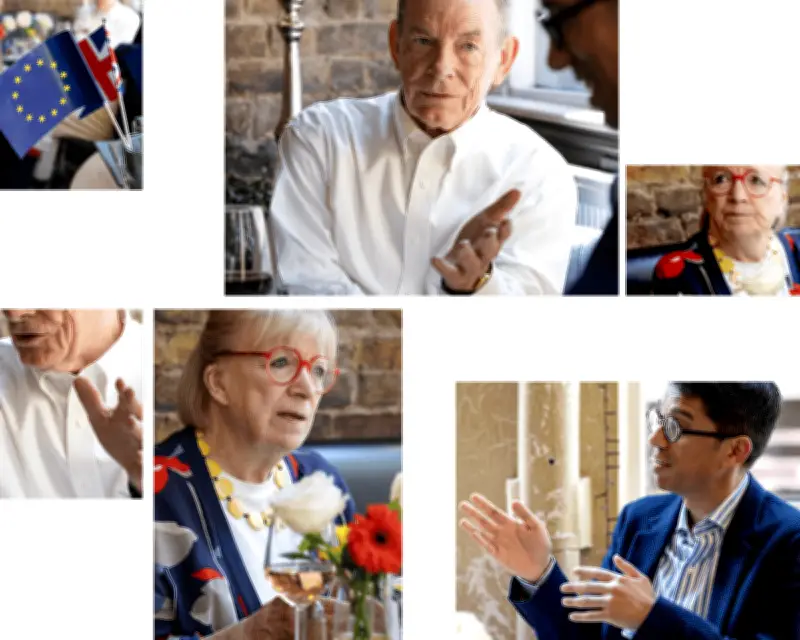
Ten years after the historic Brexit referendum, three Guardian columnists—Aditya Chakrabortty, Polly Toynbee, and Simon Jenkins—gathered to reflect on the vote's lasting impact. They debated whether leaving the European Union has made Britain richer or more racist, and examined how the union is faring without its membership.
The Vote: Anger, Confusion, and Racism
Aditya Chakrabortty recalled three distinct memories from that period: the sense of anger, confusion in Westminster, and a quick curdling into base racism. He reported from south Wales and northeast England, then returned to London, noting that one group spoke of anger and frustration while the other focused on facts. On the morning of the vote, he woke at 4am thinking David Cameron would step down, and by 6am his editor confirmed it. That weekend, a friend in east London heard a man shout, "We've got our country back, and now I'm going to burn down that mosque."
Polly Toynbee spent referendum day at a Labour phone bank campaigning for remain. Calling Nottinghamshire, every response was "Out, out, out. I want my country back. I want control. Get rid of the foreigners." She saw it as a painful divide between young middle-class students in London and angry people in places they had never visited. She went to bed feeling terrible, despite earlier confidence.

Simon Jenkins was originally a Eurosceptic, opposing joining the EU as a bureaucratic common market. But once in, he became pro-Europe, realizing the alternative was worse. On vote day, he was in Germany at a conference at Humboldt University. European journalists expressed deep concern about Britain leaving. Two said simultaneously, "You will be leaving us in charge." Jenkins then understood Brexit was not just about Britain and Europe, but the future of Europe.
The Deal: A Lack of Planning
Chakrabortty noted that leave campaigners like Michael Gove, Nigel Farage, and Boris Johnson had no clue what to do. The Treasury and Bank of England had no plan B, leaving the country with no trade or fiscal policy for years. "The truth of the matter was that Brexit was a highly technical decision," he said.
Jenkins pleaded with believers to clarify whether they meant soft or hard Brexit, or leaving the European community entirely, but they had no answer. Toynbee blamed the hardest possible Brexit on Jeremy Corbyn, who refused to join remainers in critical House of Commons votes, allowing Boris Johnson to embarrass Theresa May.
Chakrabortty acknowledged Corbyn did not play a blinder, but noted Labour was exercised by the anti-establishment nature of the vote. Palling up with Tories like Rory Stewart for a soft Brexit would not have looked good.
Attitudes to the EU and Migration Now
Jenkins found it encouraging that the debate has become more technical and less emotional, focusing on trade, student exchange, and food barriers. Some racism has receded, he argued.
Toynbee pointed out that polls show the public now supports swapping freedom of movement for easier trade, and freedom of movement feels less bad. She noted that after Brexit, the "wrong" people from outside Europe arrived, contrary to expectations.
Chakrabortty disagreed with Jenkins, arguing that Brexit made extremism mainstream, especially on race. He cited Nigel Farage setting the terms of political debate, routine statements in Westminster that would have been ostracized a decade ago, and rightwing press publishing borderline hate speech. The Australian-style points system brought Commonwealth workers into social care and IT, but some say these are the "wrong kind of people" based on skin colour.
Toynbee agreed, noting that care workers from Albania versus Nigeria are treated differently purely based on skin colour.
Our Future with the EU
Jenkins questioned whether Britain should move to rejoin the EU or proceed step by step—rejoining Erasmus, sorting out food-import regulations—to effectively half-join in a few years.
Toynbee hoped a new prime minister would remove red lines and negotiate openly. She followed an industrial valve-maker in Bristol who had to change from the European CE mark to a British one, then was told it wasn't necessary—an appalling experience. She urged speaking positively about EU rules and regulations.

Chakrabortty warned that tiptoeing back through laws feels anti-democratic, a charge remain lobbyists still face. A big study claimed a 6-8% hit to GDP from Brexit, enormous compared to current debates over 0.1% growth. The hit came from uncertainty felt by businesses like the valve manufacturer. From a democratic and commercial view, the argument must be clear about what is being signed up to.
Jenkins called for a major research exercise to examine arguments and economic predictions, making it an argument about facts leading to negotiation. Toynbee emphasized emotive stories about shops closing and the danger from Russia, a dangerous enemy to Europe and the UK. She felt entirely vindicated by what they wrote in the Guardian: "Don't do this, it'll be a terrible mistake—not just an economic mistake, but a political mistake, an emotional mistake. Now we're just beginning to recover and maybe we can put that decade to rest."