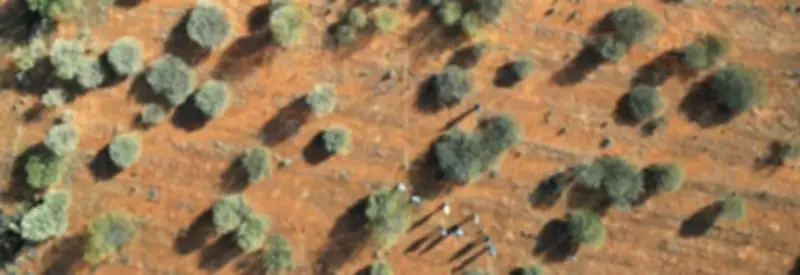
Trees regrowing on a human-induced regeneration plot. Cris Brack, Author provided (no reuse)
Are Australia’s carbon farming schemes just hot air? Hardly – forests are regrowing almost everywhere
Published: June 8, 2026 6.08am AEST
Trees take carbon dioxide from the air and turn it into wood, storing it for decades. This is why Australian authorities have made forest regeneration eligible for carbon credits. The largest carbon farming scheme is known as human-induced regeneration. Here, land owners and managers support forests to return on once-forested land. Every tonne of carbon dioxide soaked up by regrowing trees is worth one Australian carbon credit, about A$37.50. The scheme has around 42 million hectares of land on its books. But only a third of this area is eligible for carbon credits, as the land has to be assessed as likely to regenerate into forest under changed management.

In recent years, some projects have come under fire. Researchers have suggested there’s not enough regeneration or that regeneration would have happened anyway. But independent assessment of these claims suggest these concerns are overblown. As someone responsible for formally reviewing almost 100 of these projects since 2023, I have visited many sites and verified the data. Overall, I found these projects were being managed well – and forests are regrowing.
How does carbon farming work?
Under the rules, the area can’t have been forested for at least a decade before the project starts. It must have a high likelihood of becoming forested and richer in carbon through regeneration. If left alone, trees will naturally regrow unless something stops them. Grazing by livestock, feral animals and sometimes native animals is the biggest barrier. Many regeneration projects are in semi-arid areas with limited water. If water is made freely available for livestock, it can lead to surging numbers of kangaroos, wallabies and other native animals that eat regenerating saplings. This is why one method of limiting grazing is removing artificial watering points. Fencing is another method. Australian and international researchers have found trees and vegetation on degraded land usually regenerate better when behind fences, though not always.
Does it work?
Australian authorities define a forest as an area dominated by trees over two metres tall, with existing or potential taller trees covering 20% or more of the area. Participants have to prove forests of local tree species exist in the surrounding area, show the land can support forest and that there are sources of seeds. They also have to show evidence the area could be considered forest 20 years or so after the project begins. Before carbon farmers can earn credits, the evidence they supply is audited and reviewed by teams of independent experts. As one of these experts, I have reviewed a great deal of evidence and been on site when data was collected by independent ecologists to confirm how accurate tree cover estimates are. They’re not perfect. But they are very good. If regeneration is too slow or fails, the area can be removed from the scheme. To date, about 6% of the land considered likely to regenerate has been taken off the scheme. Put another way, that means forests are actually regrowing on 94% of the land considered likely to regenerate.
How human-induced regeneration projects are assessed and audited.

Is criticism warranted?
Prominent critics have questioned the link between stopping grazing and regenerating forest. If this critique was accurate, it would mean there was no permanent boost to forests by ending grazing. They argue instead in favour of only giving carbon credits to projects where trees are actively planted on previously cleared land. The problem is, planting is relatively expensive and can be limited in scope. Planting also requires great care in tree species selection and genetics. By contrast, removing pressure and allowing forests to naturally regenerate avoids these issues. Natural regeneration can also work in areas where planting and tree management would be expensive. The critics used national-scale maps of woody vegetation to argue tree cover on some projects was falling short. But as other experts have pointed out, these criticisms don’t stack up. The maps and models they rely on underestimate tree cover, compared to local and precise data gathered by aircraft with high-resolution scanning lasers. When regeneration areas are independently assessed using similar gold standard methods, almost all show clear signs of regenerating forest.
Trees in this carbon farming area are regrowing fast enough to be considered forest within 20 years. Cris Brack, Author provided (no reuse)
Where does this leave us?
Worldwide, there are very real and well documented problems with carbon credit schemes intended to protect or restore forests. This is why it’s important to scrutinise Australia’s human-induced regeneration scheme and others like it. But not all criticisms are valid. The good news is, gold standard data gathered by participants cross-checked with regular on the ground audits and reviews show the scheme is largely working. Regeneration can be slow, even after livestock have been removed. Some heavily degraded areas may not regenerate at all. But overall, it is leading to more forests and more carbon stored. Under Australia’s carbon credit rules, all methods of producing credits expire after ten years. As a result, the human-induced regeneration scheme closed to new participants in 2023. Policymakers are working on new nature-based solutions to store carbon and boost wildlife on privately managed land. But for the foreseeable future, forests will quietly regrow on huge tracts of land – and their successes and failures will be tracked and measured to make sure Australia has more trees than it would have otherwise.