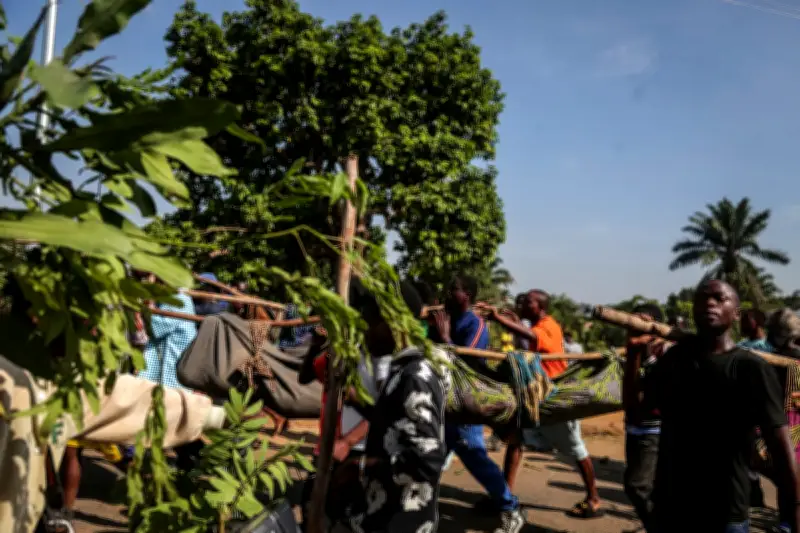
Rebel attacks in eastern Democratic Republic of the Congo have killed more than 30 people over recent days, worsening the challenge of containing an ongoing Ebola outbreak. The violence, concentrated around the city of Beni in North Kivu province, has displaced residents and caused three confirmed Ebola patients to flee treatment centers.
Deadly Raids in North Kivu
At least 10 people were massacred in early Wednesday raids on three villages near Beni: Matete, Mamuli, and Kitoho. The Allied Democratic Forces (ADF), a militia linked to the Islamic State, is blamed for the attacks. Community leader Isaac Kavalami reported that homes and motorcycles were set ablaze, and civilians were kidnapped, with the total number of victims still unknown.
Just before midnight Saturday, the ADF entered Beni, which has been under military administration since 2021. Attackers beheaded and shot residents, causing panic and sending hundreds fleeing into the bush. Witnesses reported over 20 men, women, and children killed, with dozens missing. Resident Mumbere Sivya described hearing screams and fleeing in terror, only to find neighbors beheaded the next morning.

Ebola Response Hampered
The military governor of North Kivu stated Tuesday that three Ebola patients fled Beni treatment centers after the Saturday attack. The violence and fear are complicating efforts to combat the 17th Ebola epidemic in the DRC since 1976. As of Wednesday, 344 cases and 60 deaths have been recorded across North Kivu, South Kivu, and Ituri provinces.
Civil society activist Albert Lusenge, who lost 20 family members to ADF attacks, noted that Ebola kills differently than decapitation, making it hard to convince devastated communities to support Ebola response. Community leaders warned that people fleeing violence risk spreading the disease, as containment measures are impossible during flight.
Ongoing Conflict and Civilian Toll
The ADF has intensified attacks on civilians and the Congolese army in Beni region. Civil society groups estimate about 10,000 civilians killed by the group since 2014. The militia is also accused of atrocities in neighboring Uganda. Large-scale army campaigns from 2005 to 2014 failed to eradicate the ADF, and a joint Congolese-Ugandan operation began in 2021.
Researcher Reagan Miviri of thinktank Ebuteli explained that civilian killings serve as a deterrent, as the ADF responds to military pressure by massacring civilians. The group operates in small, hard-to-detect units in forested terrain, evading surveillance. Miviri noted that operations aim to push the ADF from the Ugandan border, but civilians continue to die.
Government Response and Expert Warnings
The Kinshasa government condemned the killings and reaffirmed that fighting the ADF remains an absolute priority. Miviri warned that insecurity risks reigniting mistrust toward Ebola response teams, as seen during the 2018-2020 epidemic that killed nearly 2,300 people. Health workers may refuse to operate in volatile areas, and communities may question why Ebola mobilizes more resources than anti-massacre efforts.
Last week, WHO Director-General Tedros Adhanom Ghebreyesus emphasized that insecurity in Ituri seriously hampers Ebola response, making patient isolation and trust-building impossible while attacks continue.