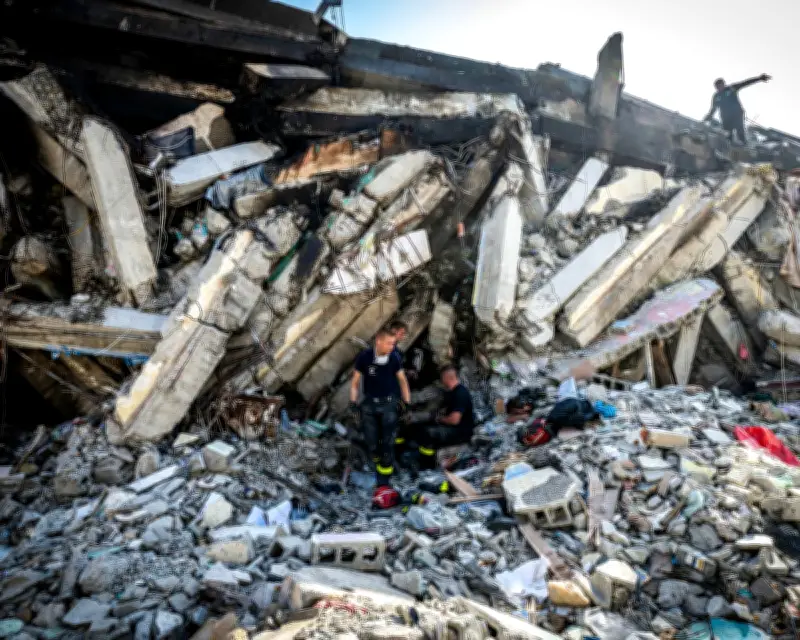
A powerful earthquake struck Venezuela on Tuesday, killing at least 10 people and injuring 200 others, according to the country's vice president. The 7.3-magnitude quake, centered near the coastal city of Cumana, has caused widespread damage, collapsing buildings and triggering landslides. This disaster tests both the capacity of the Venezuelan state to respond and US President Donald Trump's promises to help the region.
Impact and Immediate Response
The earthquake, which struck at 11:30 am local time, was felt as far away as Caracas, where buildings swayed and residents fled into the streets. In Cumana, a city of 500,000 people, at least 50 buildings collapsed, including a hospital and several schools. Rescue workers are digging through rubble in search of survivors. Vice President Delcy Rodríguez confirmed the death toll and said that 200 people have been treated for injuries, with many in serious condition.
President Nicolás Maduro declared a state of emergency in the affected states of Sucre, Monagas, and Anzoátegui. He said that the military and emergency services have been deployed to assist with rescue and relief efforts. However, the government's response has been hampered by the country's ongoing economic crisis, which has led to shortages of fuel, medicine, and heavy equipment.

Trump's Promise and Geopolitical Context
US President Donald Trump, who has been a vocal critic of the Maduro government and has imposed sanctions on Venezuela, offered US assistance. In a statement, Trump said, 'The United States stands ready to help the people of Venezuela in this time of need. We have offered our assistance to the Venezuelan government and hope they will accept it.' This promise is seen as a test of Trump's willingness to provide humanitarian aid despite his administration's harsh stance against the Maduro regime.
Critics have questioned whether the US offer is genuine or merely a political gesture. 'Trump has repeatedly called for the overthrow of the Maduro government, so it's hard to take his offer of aid at face value,' said John Smith, a Latin America analyst at the Council on Foreign Relations. 'The real test will be whether the US actually delivers assistance without political strings attached.'
State Capacity and the Humanitarian Crisis
The earthquake exacerbates an already dire humanitarian situation in Venezuela. The country is suffering from hyperinflation, food and medicine shortages, and a collapse of public services. The government's ability to respond to a major natural disaster is severely limited. 'The Venezuelan state is in no condition to handle a crisis of this magnitude,' said Maria Lopez, a researcher at Human Rights Watch. 'The government lacks the resources and infrastructure to provide adequate relief to the affected population.'
International aid has been slow to arrive. The United Nations has pledged $10 million in emergency assistance, but distribution remains a challenge due to logistical and political obstacles. The Maduro government has been accused of politicizing aid, demanding that assistance be channeled through state institutions rather than independent organizations.
Trump's Promises Under Scrutiny
Trump's offer of aid comes as he faces criticism for his administration's handling of the crisis. The US has imposed sanctions on Venezuela's oil industry and has recognized opposition leader Juan Guaidó as the country's legitimate president. These actions have been condemned by the Maduro government as interference in its internal affairs.
Whether Trump follows through on his promise to provide aid will have significant implications for US-Venezuela relations and for the region. 'If Trump delivers on his promise, it could open a door for dialogue,' said Smith. 'If not, it will be seen as another example of empty rhetoric from a president who has made many promises to Latin America but has delivered little.'
The earthquake has also raised questions about the preparedness of Venezuela's infrastructure. The country sits on several fault lines and has a history of seismic activity, but building codes are poorly enforced. Many structures are old and not designed to withstand strong earthquakes. 'This disaster was predictable,' said Lopez. 'The government has failed to invest in earthquake-resistant construction and emergency preparedness.'

Looking Ahead
As rescue efforts continue, the focus is on providing immediate relief to the affected communities. The international community is closely watching how both the Venezuelan government and the US respond. The earthquake is a test of state capacity and of Trump's promises to the region. The outcome could shape the future of US-Venezuela relations and the broader geopolitical landscape in Latin America.