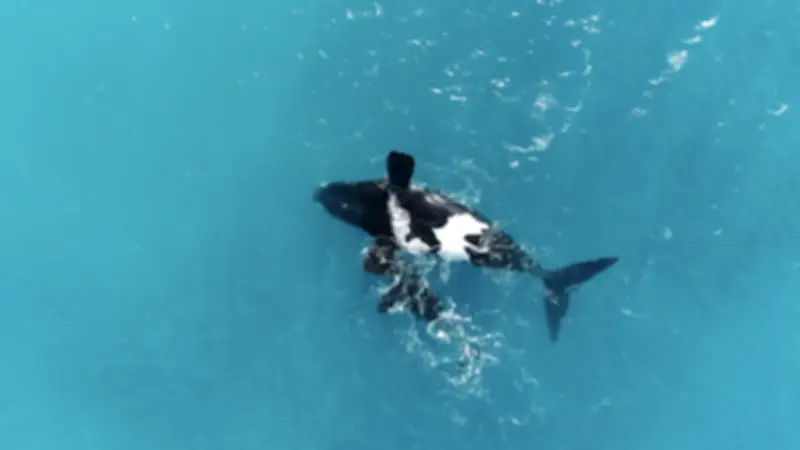
Southern right whales (Eubalaena australis) resting upside-down are not sick or injured, but are likely healthy mothers carefully managing their energy reserves, according to new research published in the journal Mammalian Biology.
Each winter, these ocean giants migrate from the Southern Ocean and Antarctica to Australia's southern shores to breed, give birth and rest. Observers may see them floating upside-down at the surface, a behaviour not reported in other large whales.
The Energetic Balancing Act
Southern right whales are capital breeders: they feed intensively for half the year on their feeding grounds, then migrate up to 6,000 kilometres to calving grounds in Australia, where they do not eat. Mothers with newborns require the most energy, needing to conserve enough to return to feeding grounds while producing milk for their calf.

To study this, researchers from Aarhus University and other institutions used drones to film whales along the Great Australian Bight. Hundreds of flights yielded hours of footage showing nursing and resting behaviours.
Upside-Down Resting Observed Only in Mothers
The upside-down resting behaviour was observed only in mothers with newborn calves and one late-pregnant female, not in other adults, juveniles or calves. It occurred in 25% of mothers observed, for about 19% of the time they were followed.
Lead author Dr. Fredrik Christiansen said, "This behaviour may be linked to the energetic demands of reproduction. When mothers rest upside-down, the calf cannot reach the mammary slits, giving the mother a break from nursing when she is low on energy."
Cooling and Vulnerability
Another possible reason is thermoregulation. Unlike some whales, southern right whales lack a dorsal fin, which helps control temperature by exposing blood vessels to cool air. By lying upside-down with belly and pectoral fins exposed, mothers increase skin contact with the sea breeze, helping them cool down.
However, this position leaves them vulnerable. Rotating back upright is difficult for a whale weighing up to 40 tonnes, taking longer to breathe or escape threats like boats. As southern right whale populations are still recovering from historical whaling, understanding such behaviours informs protection efforts.
Advice for Observers
Dr. Christiansen advises, "If you see a southern right whale resting upside-down this winter, give it space and do not disturb it. These animals are undertaking one of the most energetically demanding periods of their lives. Take a moment to appreciate this unique behaviour."