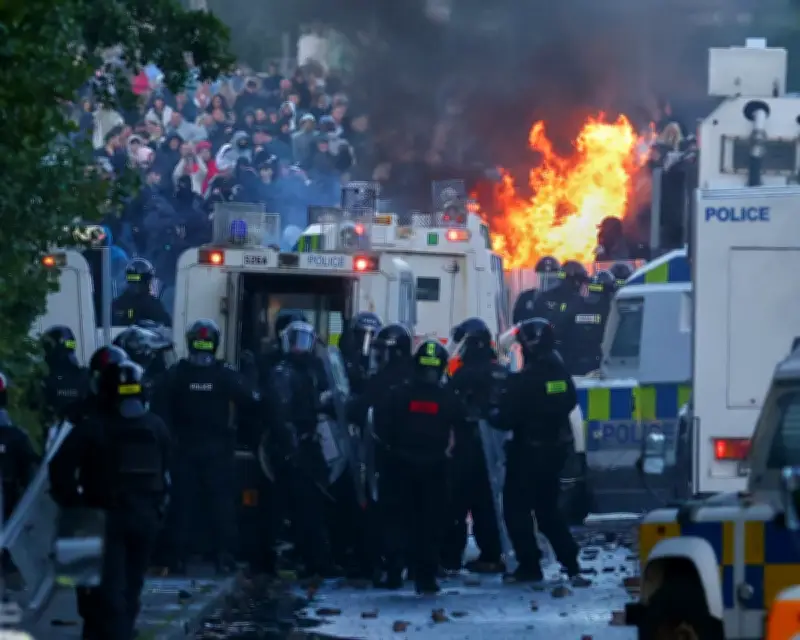
Violent clashes erupted in Belfast over the weekend, leaving several people injured and exposing what many describe as a broken political system in Northern Ireland. The scenes, which included stone-throwing, petrol bombs, and clashes with police, have reignited fears of a return to the sectarian violence that plagued the region for decades.
What Happened in Belfast?
On Friday evening, tensions boiled over in the Ardoyne area of north Belfast, a flashpoint for sectarian conflict. Groups of young people, some masked, threw bricks and fireworks at police officers, who responded with water cannons and plastic bullets. At least 10 officers were injured, and several arrests were made. The violence continued into the weekend, with disturbances in other parts of the city.
The immediate trigger appears to be a dispute over a parade by the Protestant Orange Order, a loyalist group, which was rerouted away from a nationalist area. However, community leaders say the underlying causes are deeper, rooted in political paralysis and growing disillusionment among young people.

Political Context: A Broken System
Northern Ireland has been without a functioning government since February 2022, when the Democratic Unionist Party (DUP) collapsed the power-sharing executive in protest over post-Brexit trade arrangements. The DUP has refused to return to Stormont unless the Northern Ireland Protocol, which created a trade border in the Irish Sea, is scrapped. Meanwhile, Sinn Fein, the nationalist party that won the most seats in the 2022 assembly election, has been unable to form a government without DUP participation.
This political vacuum has left communities without effective governance, exacerbating social and economic problems. Joblessness, housing shortages, and cuts to public services have fueled frustration, particularly among young people who feel they have no stake in the peace process. “The Good Friday Agreement was a historic achievement, but it is now being hollowed out by political brinkmanship,” said Dr. Patricia O'Neill, a political scientist at Queen's University Belfast.
Community Reactions
Local leaders have condemned the violence but also expressed sympathy for the underlying grievances. “We cannot pretend these young people don't exist,” said Father Michael Sheehan, a priest in Ardoyne. “They feel abandoned by politicians on both sides. We need to give them hope, not just condemn them.”
On the loyalist side, some community workers argue that the DUP's hardline stance has alienated working-class Protestants who feel their identity is under threat. “The protocol has created a sense of betrayal,” said William Johnston, a community activist in east Belfast. “But violence only makes things worse.”
Call for Reform
The clashes have prompted renewed calls for political reform. The Irish and British governments have urged the parties to return to negotiations, but progress remains elusive. Some analysts argue that the power-sharing model itself needs overhaul, with more inclusive mechanisms to prevent one party from blocking the entire system.
Meanwhile, the violence is a stark reminder that the peace process is not irreversible. “The Good Friday Agreement was never meant to be the end of the story,” said Dr. O'Neill. “It was a foundation. But if the politicians don't build on it, the foundation will crumble.”
As Belfast recovers from the weekend's events, the question remains: can Northern Ireland's leaders find a way out of the deadlock, or will the streets continue to bear the cost of political failure?