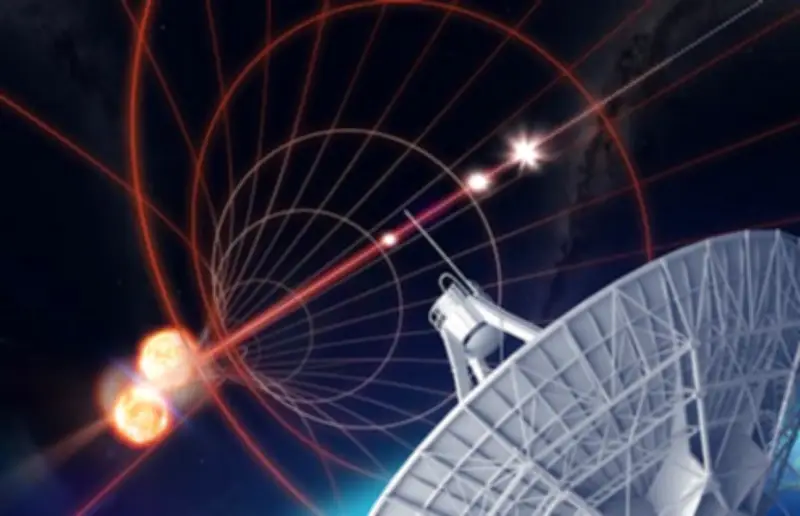
A cataclysmic collision in space has provided new clues on astronomy's biggest stalemate: the Hubble tension. In a study published in The Astrophysical Journal, researchers have developed a new approach to pin down the Hubble constant, the fundamental property describing how fast the universe is expanding. By re-examining gravitational waves from the dramatic collision of two neutron stars, known as GW170817, the team believes they have produced the most precise measurement of the Hubble constant to date using the gravitational wave method.
Why the Hubble Constant Matters
Knowing the universe's expansion rate is fundamental for astronomers. It sets the cosmic scale for measurements, enabling determination of the true distance and size of astrophysical objects. More profoundly, it reveals how the universe began and how it could end. Given its importance, scientists have been trying to measure the Hubble constant with several methods. According to the standard theory of how the universe evolves, all methods should find the same answer.
For years, the various methods appeared to broadly agree, but with large margins of error. Within the last couple of decades, astronomers have made great strides to increase precision and reduce uncertainty. Some teams achieved precise measurements using leftover light from the Big Bang, known as the distant universe method. Others used light from much nearer objects, such as pulsating stars and supernovae, for nearby universe measurements.

The Hubble Tension
Shockingly, these two sets of high-precision measurements disagree by a lot. The distant universe measurement puts the Hubble constant at 67–68 km/s per megaparsec, while the near universe result is higher – around 72–74 km/s per megaparsec. This discrepancy is the Hubble tension. Despite intense scrutiny, nobody has found any mistakes in either method. Alternatively, our understanding of how the universe evolves may be missing something fundamental, requiring new physics to resolve it.
To settle this cosmic debate, new and independent methods of measuring the Hubble constant are highly sought after. Gravitational waves offer an entirely independent way to measure the expansion of the universe. These large ripples in the fabric of space-time are produced when extremely dense objects – such as black holes or neutron stars – collide.
Enter Gravitational Waves
The first gravitational waves were detected from colliding black holes just over a decade ago. In 2017, scientists made history when they detected gravitational waves from a neutron star collision, labelled GW170817. Unlike a black hole collision, it produced a glow of light, enabling astronomers to identify the nearby galaxy where it occurred. By combining that information with the gravitational wave signal, researchers could make a new measurement of the Hubble constant based directly on Einstein's theory of gravity.
However, the measurement was not as precise as those that make up the Hubble tension. In fact, it fell right in between the competing measurements, much to everyone's frustration. Over the last nine years, astronomers have worked to improve the precision of the GW170817 measurement. The best results came from tracking the aftermath of the collision using a worldwide network of radio telescopes. When the two neutron stars collided and merged, they produced an ultra-fast jet of charged particles. The telescopes revealed the motion and structure of this jet's afterglow. This data reduced the uncertainty, but the measurements remained consistent with both sides of the Hubble tension.
What the New Study Found
In the new study, researchers found several ways to improve on earlier analyses, including more sophisticated models, improved statistical techniques, and a careful treatment of key sources of uncertainty. By reanalysing the extraordinarily precise telescope observations of the merger's aftermath in greater detail, they found that models commonly used in earlier studies struggled to match the data. This has produced what they believe is the most accurate Hubble constant measurement yet from GW170817: 61–70 km/s per megaparsec.

Intriguingly, the result agrees more closely with measurements from the distant universe than those based on the nearby universe – despite the method also relying on the nearby universe. This suggests there may not be something wrong with our understanding of the universe. Instead, the tension may arise from subtle calibration issues affecting other nearby universe methods.
The result is still four times less precise than the leading nearby-universe measurements. More neutron star collisions will need to be detected to definitively settle the Hubble tension using gravitational waves. Such events are rare, so it may be a while – but for now, this study provides an important new clue in one of astronomy's biggest problems.