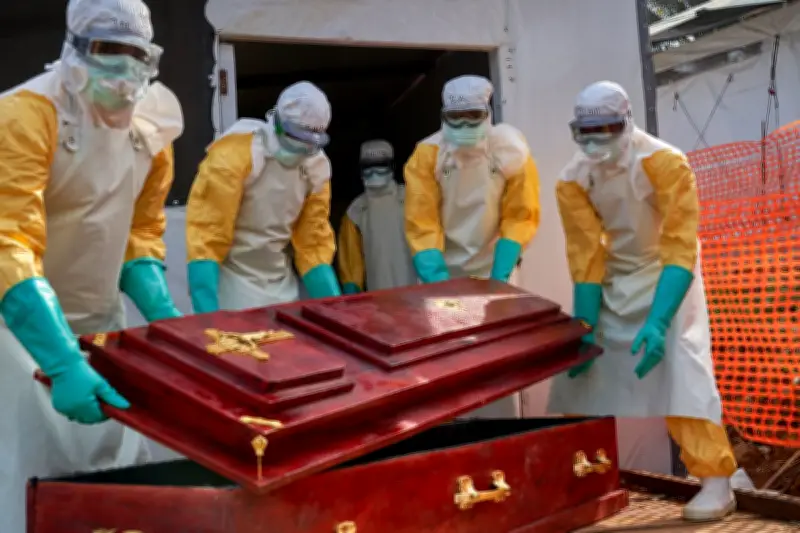
Elon Musk's dismantling of the US Agency for International Development (USAID) last year has come under renewed scrutiny as the Democratic Republic of the Congo (DRC) grapples with an Ebola outbreak. Experts say the cuts, carried out through Musk's short-lived Department of Government Efficiency (Doge), have hindered the response and resulted in preventable deaths.
Musk's Cuts and the Ebola Outbreak
Musk admitted to 'accidentally' cutting Ebola detection and response programs. Jeremy Konyndyk, a former top USAID official who oversaw the agency's Ebola response in 2014-2015 and now heads Refugees International, said, 'This is one of the reasons why there was not enough surveillance and preparedness for the outbreak of Ebola.' Davide Rasella, a research professor at the Catalan Institution for Research and Advanced Studies and head of the Global Health Impact Assessment and Evaluation Group at ISGlobal in Spain, echoed this, stating that if global health programs hadn't been slashed, the outbreak would have been detected much earlier.
Impact on Global Health
The cuts have affected global health, nutrition, and education worldwide. A Lancet study estimated that if USAID were abolished entirely, there would be 14 million deaths, including 4.5 million child deaths. When Democratic Congressman Ro Khanna cited the study, Musk threatened to sue. Rasella, one of the study's authors, stood by the estimates, saying, 'He uses science for launching rockets. When we speak about public health and global health, we use the same statistical mathematical tools that we use to launch rockets into space.'

Deaths Already Occurring
Konyndyk emphasized that people are already dying in significant numbers. 'People are absolutely dying. They're dying in significant numbers in some places,' he said. Musk has claimed that critics 'cannot cite a single name of someone who died,' but when confronted with names, including children, he called a journalist 'an utter piece of shit and a liar.' Musk has also claimed without evidence that US tax dollars went to arming militants and corrupt politicians.
Musk's Legacy
Konyndyk argued that Musk's demolition of USAID 'is going to be a defining part of his legacy, and I do wonder if that's why he's scrambling so hard to rewrite that history now.' He noted that Musk applied a model from his companies—'cut until people scream, and then when people scream, you've cut too far, and then you restore'—but that 'that's not how public funding works. Here the cost is literal human lives.'
Window for Action
Despite the damage, Konyndyk said there is still time to act. 'We have a window here to try and bring some of this back before the worst of the harms set in,' he said. Congress could have stopped the dismantling of USAID and still can, as USAID is required to exist by law. However, what few aid programs remain have been choked by the slow release of funding from the State Department.
Broader Implications
Rasella warned that disrupting aid systems can create larger damage. 'When you disrupt a single piece of that [aid], you can really create more and larger damage to the entire system. This is just the beginning,' he said. After the COVID-19 pandemic caused about 20 million deaths globally, cutting programs that prevent and prepare for the next pandemic is 'absurd,' he added.