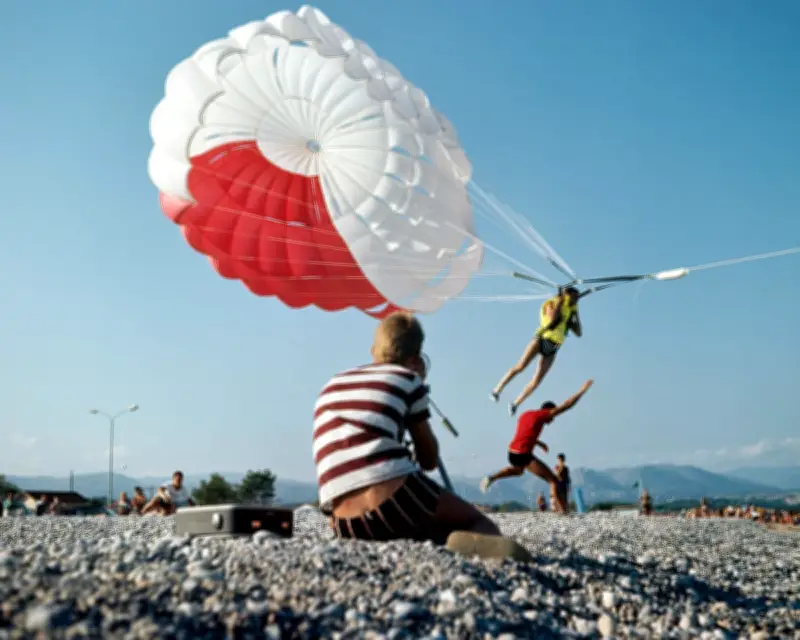
A major new UK exhibition is dedicated to the rarely seen colour photographs by the pioneering 20th-century French photographer and painter Jacques Henri Lartigue. Jacques Henri Lartigue: Life in Colour is at MK Gallery, Milton Keynes, until 4 October.
Who Was Jacques Henri Lartigue?
Lartigue (1894–1986) is best known for his black-and-white photographs capturing the elegance and joie de vivre of high society and modern life, particularly during the early 20th-century Parisian belle époque. Although he did not receive widespread critical acclaim until later in life, Lartigue was at the centre of France’s golden era of creativity, moving within a social circle that included cultural icons such as Jean Cocteau, Grace Kelly and Pablo Picasso.
From Black-and-White to Colour
Lartigue also became known for his interest in documenting the speed and movement of new innovations, such as motor racing and aviation, and photographs of life on the French Riviera. He is regarded as a pioneer of the ‘spontaneous’ snapshot – a departure from the formal portraits that were typical of the time – which would later become known as street photography and popularised by Instagram.

Lartigue began experimenting with early colour photography as a teenager, at a time when the process was still technically demanding and rarely used. His colour photographs from this period show intimate portraits of his family, friends and everyday life. However, the long exposure times and cumbersome equipment led him to focus on painting throughout the 1930s, until the use of modern colour photography became more widespread in the 1950s.
The Exhibition: Over 150 Works
This exhibition consists of over 150 of Lartigue’s works, focusing on his lesser-known colour photographs. It also includes his early experimental stereoscopic images, which produce three-dimensional effects, as well as vintage prints, unique works on paper and archival documents. Until recently, the majority of Lartigue’s colour photographs had never been seen, despite representing nearly 40% of the over 100,000 images in his archive, the Donation JH Lartigue.
Highlights from the Exhibition
Among the images on display are Chute to thrill … Jean Creff in parachute jumping (1964), Florette Lartigue, probably for a nail polish ad (1961), Silvana Empain (1961), Pablo Picasso at a bullfight, Vallauris (1965), Monaco Grand Prix (1956), Los Angeles (1962), Martine Carole, Magagnosc (1961), Florette Lartigue, Vence (1954), Jean Creff in parachute jumping (1964), Portrait of Florette Lartigue painted by Dany Lartigue in 1945, Opio (1965), Corn drying, Piozzo (1956), Jacques and Florette Lartigue, Old Tucson (1962), and Jacques Lartigue and Germaine Boivin, dressed as twin sisters for a ball at the Savoy Hotel, Chamonix (1919).
Lartigue’s Connection to Italy and Fashion
Lartigue was deeply connected to Italy due to the Italian origins of his wife, Florette. He visited Piozzo with Florette during their summers – a region known for its agricultural products. Here, corn is dried and ground to make polenta flour. The exhibition showcases the breadth of Lartigue’s career, from drawings he made as a child in the 1900s to his work in the fashion world of the 1960s, and his abstract floral photographs of the 1970s.
Early Colour Techniques
In 1912, Lartigue became interested in autochrome, an early technique used to apply colour to photographs, which had recently been invented by the Lumière brothers. In 1915, Lartigue attended painting classes at the Académie Julian in Paris before embarking on a career as a painter. In 1928, he stopped his autochrome practice. All images courtesy of Ministère de la Culture, France/AAJHL.