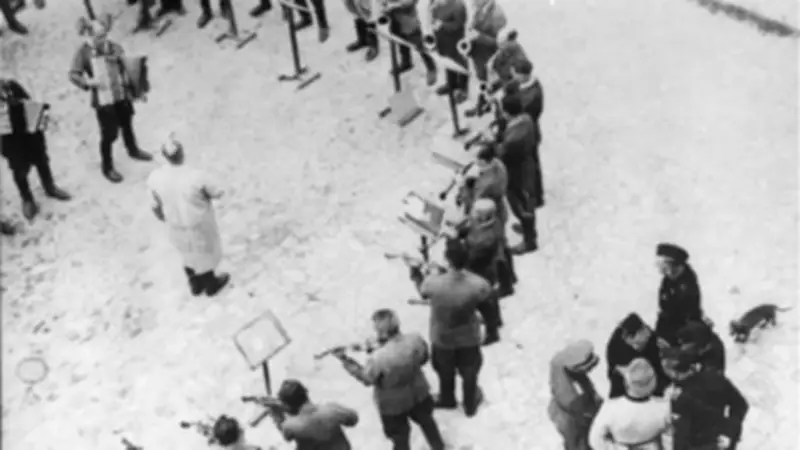
In the renowned Holocaust documentary Shoah (1985), former SS guard Franz Suchomel sings a song prisoners had to perform in the Treblinka death camp in Nazi-occupied Poland. After finishing the last line, he chillingly asks the director, Claude Lanzmann: “Satisfied? That’s unique. No Jew knows that today!”
More than 30 years before, in 1945, Yehuda Eismann, a Holocaust survivor, published a little collection of songs, conveyed to him by Jewish refugees passing through Bucharest in Romania. He called it Mima’amakim: folkslider fun lagers un getos in poyln 1939-1944 (Out of the Depths: Folks Songs from the Camps and Ghettos of Poland, 1939-1944).
“The poets and the others who sang the songs are for the most part no longer living,” he wrote in the introduction. But the songs survived. Passed from mouth to mouth, they lived among survivors. Eismann and his team collected and recorded them to create a “memorial stone for Polish Jewry”, a community largely destroyed by the Holocaust.

Review: Out of the depths: the first collection of Holocaust songs – by Joseph Toltz and Anna Boucher (Manchester University Press)
Eighty years later, two Sydney-based scholars, Joseph Toltz and Anna Boucher, republished the songs, with information about their authors. The collection shows that the Nazi plan to erase the memory of those slated for destruction – their suffering, but also their resilience – failed.
A lucky coincidence led to recovery
A lucky coincidence led to the recovery of these hidden voices of the Holocaust. In 2013, Olga R., a Sydney based Polish–Jewish survivor, passed away. Her family found a little booklet containing songs written in Yiddish in her cupboard. They shared it with Toltz, which led to more than a decade of arduous labour, tracing the origin of the songs and the fate of their authors. This incredible piece of history includes the musical score and translations of the songs.
Songs are part of Holocaust history
In concentration and death camps, such as Treblinka, Auschwitz and Janowska, the SS forced Jewish inmates to perform songs as a way of mocking and torturing them. The camp orchestras had to play as Jews marched to the backbreaking slave labour, or to their death. In other contexts, Jewish prisoners in the ghettos, camps or forests performed songs to keep their spirits high and forge a strong collective identity. Others responded to the events they witnessed and composed new songs. Some documented their experience; others paid respect to the memory of their loved ones, murdered by the Nazis and their accomplices.
Many of the songs died with their authors before the end of the war. But others spread around the world during the massive postwar migration of Holocaust survivors, staying hidden among personal belongings – until their discovery decades later.
Eismann’s journey
Eismann, who recorded these songs, was born in 1913 in Lviv (Lemberg), a town now located in Ukraine, though between the world wars it was part of independent Poland. In 1941, the town was occupied by the German army and the Nazis together with Ukrainian nationalists orchestrated a brutal pogrom, killing hundreds of Jewish civilians. Eismann passed through several ghettos and camps, until he assumed a false identity and escaped to Budapest in Hungary. Eventually, in late 1944, he moved to liberated Bucharest. His parents and brother perished.
In Bucharest, Eismann and a small team – including architect Flora Romm, his future wife, and Olga R., who later came to Australia – recorded close to 1,000 protocols with Jewish survivors who passed through the city. They tried to capture their memories of wartime events immediately after the liberation. Similar initiatives developed across liberated Europe. Survivor activists collected evidence to record the wartime persecution, commemorate those who perished and help bring to justice those who caused their predicament.

But the survivors carried more than just their trauma and memory of the persecution. As Eismann wrote, “as refugees arrive the songs arrive with them”. Testifying and recording the songs helped survivors cope with the trauma of survival. It also returned agency to those who suffered for so long. The book is another proof that the oft-repeated dictum about survivors’ silence early after the war, and their unwillingness to talk about their experiences is inaccurate.
Toltz and Boucher situate Eismann’s efforts in the long tradition of Jewish zemler (collectors): ethnographers who recorded traditional Jewish culture at the time of mass migration and dislocation. The destruction wrought by the Holocaust, however, turned them into “crisis ethnographers”, who captured the lost world and the civilisation the Nazis tried to erase.
The Holocaust as a global event
The story of the authors, composers and performers is also about global migration, Toltz and Boucher suggest. There is a common belief that Holocaust survivors moved straight from the liberated camps to what is now Israel. In fact, survivors passed through Bucharest on their way from eastern Europe to their new homes overseas. Many of those who passed through Bucharest migrated to other places, including countries in Europe and the Americas. With them, they carried the trauma of survivor and memory of the Holocaust, including the cultural production that originated during the genocide. When they stopped in Bucharest, Eismann and his team, through their strenuous efforts, captured their memories. The survivors then moved to their new homelands, bringing the story of the Holocaust and their communities to the rest of the world.
The discovery of the songbook in Sydney reminds us that Australia was part of the Holocaust’s geography. Around 27,000 survivors came to Australian shores in the decades after the war. Eismann and Romm settled in Tel Aviv.
‘Death has taken all I love’
Preparing the book, Eismann wanted to offer a holistic perspective on the Jews’ experiences. The survivors came from eastern Europe, where the Jews were the first to experience the deathly part of the Nazi persecution in the summer of 1941. More than 90% of Polish Jews perished.
The narrative arc of Mima’amakim has a redemptive direction, leading us through three sections: despair, hope, and battle and victory. The songs do not shy away from dealing with traumatic experiences of the suffering and death in the ghettos and camps. In The Third pogrom, the author, Ayzik Flaysher, 13 at the time, wrote: “Brothers shot, my sisters lost, impoverished in the death. Death has taken all I love and left me here to mourn.”
Later, the songs turn to themes more familiar from other popular Holocaust songs: Jewish partisans (or, resistance fighters), resistance itself and hope for survival. Many of the songs originated from Vilna (contemporary Vilnius in Lithuania), where Romm lived. The Jewish partisan groups were active in this area. Their members composed several resistance songs, including the Partisan March: “Comes the hour that we have yearned for, strong and dear. As our footsteps drum the beat: now we are here!”
Jewish resistance
The book raises the contentious question of Jewish resistance during the Holocaust. Some of the songs are directly related to the experiences of Jewish fighters. The truth is, only a small minority of Jews actively fought against the Nazis and their local collaborators with weapons. But the assumption that the Jews “went like sheep to the slaughter” is based on a wrong premise. The Jews lived in a hostile environment. They faced a mighty, well-organised army. They knew that once they started fighting, they condemned the weaker of them – women, children, the elderly – to death.
That is why a wider definition of resistance is more appropriate. Some historians promote the concepts of Amidah (standing up against) and sanctification of life. They argue any activity that went against the declared Nazi goals of destroying the Jews, their humanity and any traces of their existence counted as resistance. This included cultural or education activities in the ghettos and camps that helped to ensure a meaningful Jewish survival. It could be almost any activity that supported other prisoners, kept their spirit high and helped them cope with the persecution. Some of the songs recorded in the book certainly belong to this category.
Many have opposed this wide definition. Already, during the war, some Jewish people opposed cultural activities in the ghettos and camps. They criticised those who staged theatre performances, cabarets or concerts. “You do not sing and dance on the graves of millions,” they believed. Others saw it as escapism that distracted prisoners from “real” resistance activities, like fighting the Germans and their accomplices with guns.
A task for all of us
The question of resistance is open to interpretation. However, cultural production during the Holocaust, including these songs, ensured the survival of the memory of what happened – and evidence of Jewish responses to persecution. The authors and interpreters behind this book have preserved the humanity of the victims. Those who composed the songs are no longer with us. The songs remind us about the fate of millions who perished during the Nazi-led genocide. They also carry a deeper meaning now, when the last survivors are dying. The songs, their authors and those remembered in the lyrics are here to stay.
As Toltz and Boucher ask: “Please share the stories of these contributors, sing the music of this book and carry with you their resilience, tenacity and creativity.” This is a task for all of us.