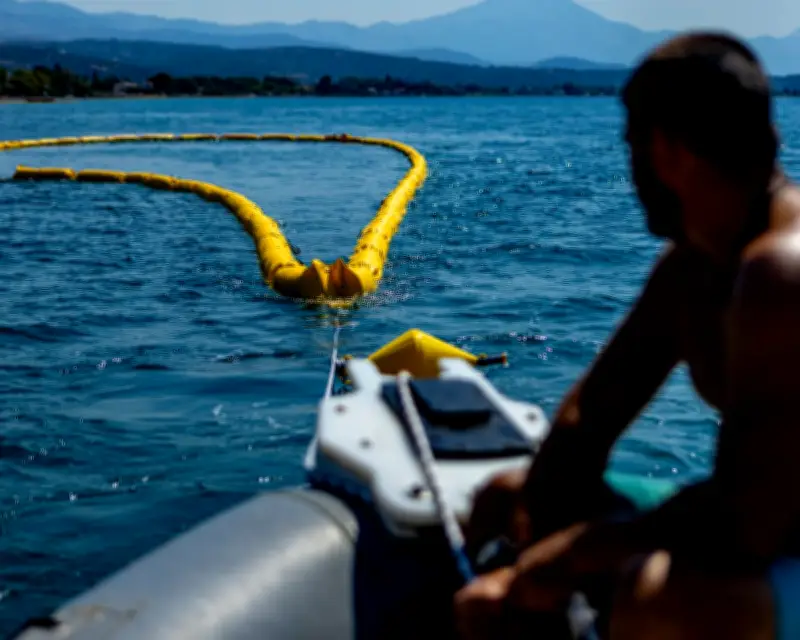
Greece has deployed a floating barrier in the Aegean Sea to prevent invasive pufferfish from entering marine protected areas, as rising sea temperatures push the species northward. The barrier, installed off the coast of Crete, is part of a pilot project to protect native marine life and local fishing industries.
Invasive Species Threatens Ecosystems
The silver-cheeked toadfish (Lagocephalus sceleratus), a highly invasive pufferfish, has been expanding its range due to warming waters. Originally native to the Red Sea, the species entered the Mediterranean via the Suez Canal and has since devastated local fisheries by preying on fish and damaging fishing gear. According to the Hellenic Centre for Marine Research, the pufferfish population has increased by 40% in Greek waters over the past five years.
“The barrier is designed to block the pufferfish from entering key breeding and nursery areas for native species,” said Dr. Maria Papadopoulou, a marine biologist at the University of Crete. “Without intervention, the ecological balance of these protected zones could collapse.”

Floating Barrier Technology
The barrier consists of a series of floating nets anchored to the seabed, extending from the surface to a depth of 10 meters. It spans 500 meters across a narrow channel between two islands. The nets have a mesh size specifically designed to catch adult pufferfish while allowing smaller native fish to pass through. The project cost €1.2 million and is funded by the European Union’s LIFE program.
“Initial results show a 70% reduction in pufferfish sightings inside the protected area within the first month,” said project coordinator Nikos Stavros. “We are monitoring the barrier’s effectiveness and plan to expand it to other vulnerable sites.”
Climate Change Drives Northward Migration
Sea surface temperatures in the Aegean have risen by 1.5°C over the past 30 years, creating favorable conditions for tropical species like the pufferfish. The species is now found as far north as the Sea of Marmara and the Dardanelles. Scientists warn that without adaptation measures, the pufferfish could establish permanent populations across the entire Mediterranean.
“This is a clear example of how climate change is reshaping marine ecosystems,” said Dr. Elena Koutsoubas, a climate scientist at the National Observatory of Athens. “The barrier is a stopgap measure, but long-term solutions require reducing greenhouse gas emissions.”
Impact on Local Fisheries
Local fishermen have reported significant losses due to the pufferfish. The species not only preys on commercially valuable fish like red mullet and sea bream but also damages nets with its sharp teeth. In the region of Crete, fishing revenues have dropped by 25% since 2020, according to the Greek Federation of Fishermen.
“We welcome any measure that helps us protect our livelihood,” said Yiannis Makris, a fisherman from Heraklion. “The barrier gives us hope that we can continue fishing sustainably.”
Next Steps
Greece plans to install two additional barriers in the coming year, targeting the islands of Rhodes and Kos. The government is also exploring biological control methods, such as introducing natural predators, though these are still in the research phase. The project has drawn interest from other Mediterranean countries, including Italy and Turkey, which face similar invasions.