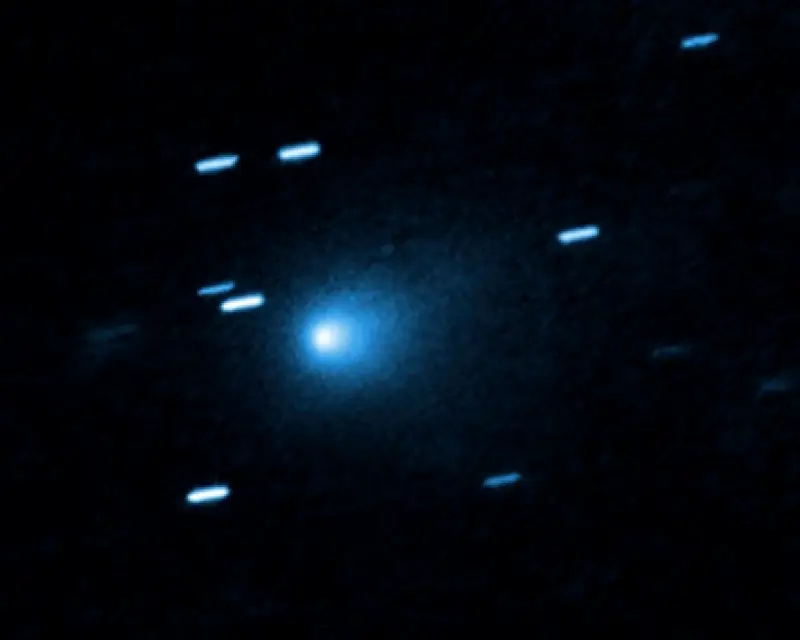
A recently discovered interstellar comet may be the oldest object ever observed within our solar system, according to new research. The comet, designated 2I/Borisov, was first spotted in 2019 and has since been studied extensively. Scientists now believe it originated from another star system and could be billions of years old, preserving material from the early formation of its parent planetary system.
Discovery and Analysis
2I/Borisov was detected by amateur astronomer Gennady Borisov in August 2019. It is only the second interstellar object known to have passed through our solar system, following 'Oumuamua in 2017. Unlike 'Oumuamua, which was rocky and elongated, Borisov is a comet with a distinct tail of gas and dust. Researchers from the University of Cambridge and other institutions analyzed its composition and trajectory, concluding that it likely formed around a different star billions of years ago.
Age and Composition
The study, published in the journal Nature Communications, used observations from the Hubble Space Telescope and other facilities. The team found that Borisov's dust grains are rich in carbon and oxygen, similar to comets in our own solar system but with a higher proportion of carbon monoxide. This suggests the comet formed in a region of its home system that was extremely cold, possibly as low as -250 degrees Celsius. According to lead author Dr. Maria Womack, "The comet's pristine composition indicates it has never been heated significantly since its formation, making it a fossil of its original planetary system."

Implications for Planetary Formation
The findings provide a rare glimpse into the building blocks of planets around other stars. By studying Borisov, scientists can infer conditions in distant protoplanetary disks. The comet is estimated to be at least 4.5 billion years old, comparable to the age of our own solar system. Its journey through interstellar space took millions of years, and it is now leaving our solar system forever. The research team hopes that future interstellar visitors will be detected earlier, allowing for more detailed observations.
Future Observations
Astronomers are now scanning the skies for more interstellar objects. Upcoming telescopes like the Vera C. Rubin Observatory are expected to find dozens of such objects per year. Each one could reveal new clues about the diversity of planetary systems across the galaxy. As Dr. Womack noted, "2I/Borisov has opened a new window into understanding how planets form elsewhere."