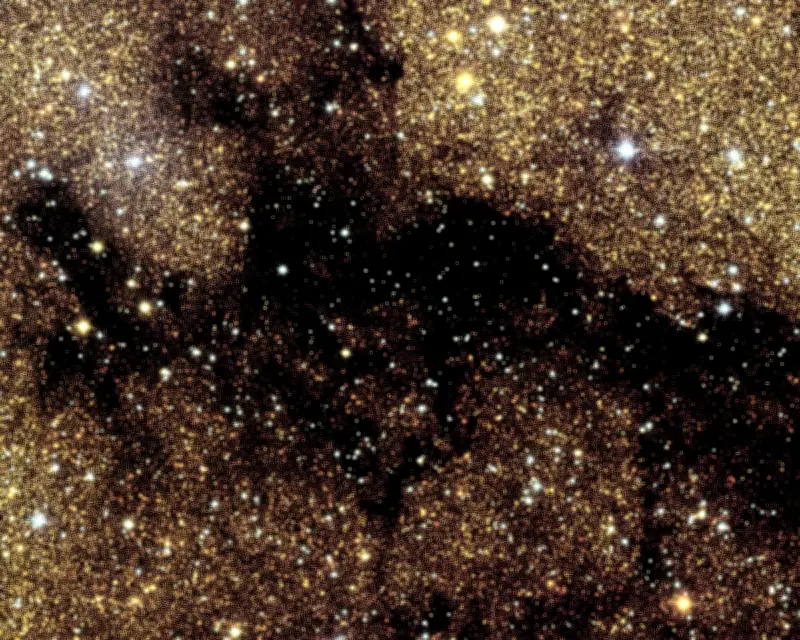
The European Space Agency's Euclid telescope has delivered unprecedented views of the Milky Way's galactic bulge, uncovering millions of stars that were previously obscured by interstellar dust. The images, released on June 24, 2026, provide the most detailed look yet at the dense central region of our galaxy, which is typically hidden from optical telescopes by thick clouds of gas and dust.
Unprecedented Detail in the Galactic Core
Euclid's sensitive infrared instruments can penetrate the dust that blocks visible light, allowing astronomers to see stars that have never been observed before. The new images cover a region of the sky about the size of the full moon, revealing a dense concentration of stars, including many that are faint and cool. According to the ESA, the data will help scientists map the structure of the galactic bulge and understand how it formed.
The galactic bulge is a dense, spheroidal region of stars at the center of the Milky Way, about 25,000 light-years from Earth. It contains some of the oldest stars in the galaxy, making it a key target for studying the early history of the Milky Way. Euclid's observations are part of a six-year mission to map the large-scale structure of the universe, but its sharp vision is also providing valuable insights closer to home.

How Euclid Sees Through the Dust
Euclid is equipped with a 1.2-meter telescope and two scientific instruments: a visible-light camera (VIS) and a near-infrared spectrometer and photometer (NISP). The NISP instrument is particularly adept at seeing through dust because infrared light is less scattered by dust particles than visible light. By observing in the near-infrared, Euclid can reveal stars that are completely hidden at optical wavelengths.
"Euclid's ability to see through the dust is like having X-ray vision for the galaxy," said Dr. Giuseppe Racca, Euclid project manager at ESA. "We are seeing stars that have been there all along but were invisible to us until now. This is transforming our understanding of the galactic bulge."
Implications for Galactic Archaeology
The new data will allow astronomers to study the composition, ages, and motions of stars in the bulge, providing clues about how the Milky Way formed and evolved. The bulge is thought to have formed through a combination of processes, including the merging of smaller galaxies and the inward migration of gas and stars. By analyzing the properties of the stars, scientists can test different models of galaxy formation.
"The galactic bulge is a fossil record of the Milky Way's early history," said Dr. Elena Rossi, an astronomer at the University of Padua and a member of the Euclid team. "With Euclid, we can now examine that record in exquisite detail. We are seeing structures and populations that were previously only hinted at."
One surprising finding is the presence of a large number of cool, low-mass stars that are fainter than previously thought. These stars are difficult to detect even with infrared telescopes, but Euclid's sensitivity has revealed them in large numbers. This suggests that the bulge may contain more mass in low-mass stars than previously estimated, which could affect our understanding of the galaxy's total mass.
Next Steps for Euclid
The Euclid mission, launched in July 2023, is designed to map the distribution of dark matter and dark energy across the cosmos. However, its surveys of the sky also produce invaluable data for studying our own galaxy. The telescope is expected to observe billions of stars in the Milky Way over its lifetime, providing a comprehensive census of stellar populations.
The images of the galactic bulge are just a taste of what Euclid will deliver. As the mission continues, astronomers hope to create a detailed 3D map of the bulge, revealing its structure and the motions of its stars. This will help answer fundamental questions about the formation of the Milky Way and the role of dark matter in shaping galaxies.
"Euclid is a mission of discovery," said Dr. Carole Mundell, ESA's director of science. "Every new image brings surprises, and the galactic bulge is no exception. We are only beginning to scratch the surface of what Euclid can tell us about our cosmic home."