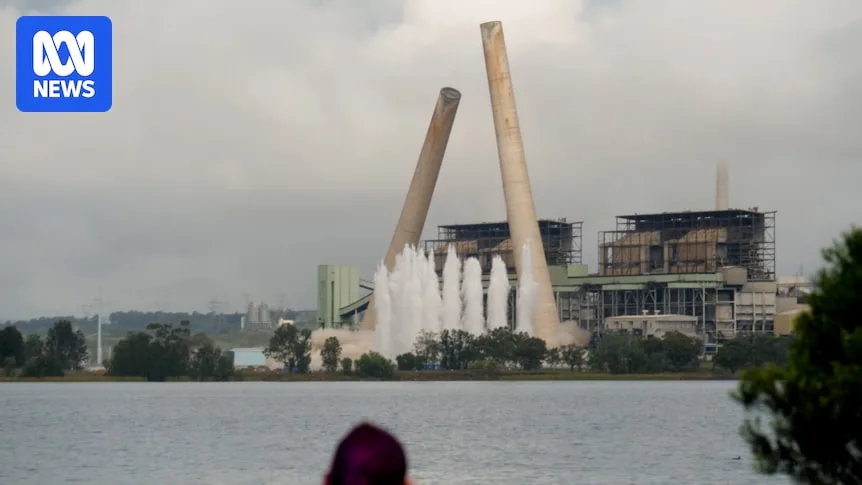
The demolition of the Liddell Power Station in the NSW Hunter Valley has begun with the controlled explosion of its two 170-metre chimneys. The iconic stacks, which had been a landmark for decades, were brought down using explosives packed into their bases.
AGL, the owner of the site, plans to transform the area into a renewable energy hub, including the recently completed 500-megawatt Liddell Battery. The power station was retired in 2023 after 52 years of operation, marking the end of an era for coal-fired power in the region.
AGL site transition general manager Brad Williams described the demolition as a bittersweet moment. 'These stacks have been an icon for the site, the region, and the community for a number of decades,' he said. 'Bringing these stacks down really does signify a move into opening the site for reuse as an industrial energy hub.'

The demolition process involved drilling about 700 holes in each chimney and packing them with explosives. Triangular sections were cut to act as hinges, allowing the structures to fall in a controlled manner. Over the past 18 months, the site has been cleaned out, with about a million litres of oil recycled.
During its lifetime, Liddell generated about 431,000 gigawatt hours of power, enough to power NSW for 6.5 years at consumption rates at the time of its closure. The neighbouring Bayswater Power Station, also owned by AGL, is due to close in 2033.
Newcastle Institute for Energy and Resources director Paul Ebert called the demolition a significant moment in the state's energy transition. 'This is really the first large-scale thermal power station that has got to the demolition phase,' he said. AGL is considering proposals for the Hunter Energy Hub, including solar panel manufacturing, recycling, and a data hub.