In a creative rebellion against artificial intelligence's slick and uncanny outputs, artists and designers are increasingly embracing a conspicuously handmade, imperfect aesthetic that some are calling 'anti-slop'. This movement celebrates the janky, the primitive, and the homespun, standing in stark contrast to the hyperrealism of AI-generated content.
Earlier this year, the Runway AI Summit in New York City showcased the potential of AI in filmmaking and advertising. Rob Wrubel, co-founder of San Francisco ad firm Silverside, touted the speed of AI production for Coca-Cola's 2025 Holiday Caravan ad, noting it took only two weeks from script to final cut. However, the ad—featuring computerized polar bears and fake-looking trucks—was widely panned by the public, generating headlines such as 'People really don't like Coke's AI holiday commercial' and 'Coca-Cola's New AI Holiday Ad is a Sloppy Eyesore'. Wrubel acknowledged the backlash, stating, 'The conversation around the ad became almost as important as the ad itself because it surfaced questions the entire creative industry is wrestling with right now.'
This rejection of AI is not new. Thousands of artists have signed open letters opposing infringement on their work, and major pop singers have announced concerts with hand-scrawled notes. Lawsuits against AI companies training on copyrighted material are also on the rise. Now, this spirit of rejection is coalescing into a distinct design aesthetic: anti-slop.

Photographer and designer Michael Schmelling exemplifies this trend. His recent suite of covers for reissued novels by Roberto Bolaño, published by Picador, feature crude, scribbly, doodle-like qualities reminiscent of basement punk show posters or tattoo flash sheets. Designed in collaboration with tattooist Mike Adams, the covers are intentionally sloppy but thoughtfully so. Schmelling noted, 'This AI stuff has just been rammed down our throats. AI is everywhere. And all of a sudden there's a backlash.' He also turned down a commission that asked to train AI on his illustrations, doing so 'vehemently'.
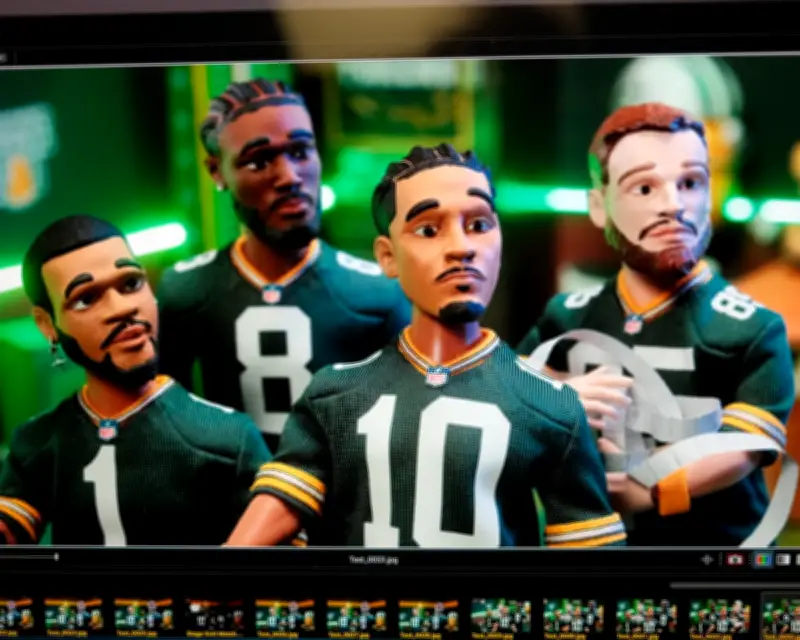
Another example is Stoopid Buddy Stoodios' stop-motion animation ad for the Green Bay Packers. The video features team stars like Jordan Love, Tucker Kraft, and Micah Parsons as 1980s-style action figures battling anthropomorphic cheese curds in an old-school arcade. Created by the Emmy-winning team behind 'Robot Chicken', the ad was painstakingly handcrafted. Studio co-founder John Harvatine IV said, 'We do everything here by hand. The way the team responded, and the fans responded, was really encouraging.' The Packers' social media team even posted a behind-the-scenes making-of video with the caption, 'Your AI slop bores us,' likely a jab at the Arizona Cardinals' AI-heavy schedule release video.
While Stoopid Buddy uses some AI digital tools in production, Harvatine emphasized, 'When you get down to the creative process and what would be a fun story to tell, why would you want to just prompt that, and let something else spit out that story? We take that feeling through the whole process of making the props and the sets. We want to put ourselves in it.'
This ascendancy of AI echoes the arrival of mass-market photography in the late 19th century, which freed painters to move beyond realism and explore impressionism, surrealism, and cubism. Similarly, AI's hyperrealism may offer artists opportunities to create work that feels more bespoke, DIY, and human. However, Schmelling is cautious, anticipating a 'backlash to the backlash' where enthusiasm for AI resurges. He compared it to the advent of Photoshop, which made retouching easy, leading some artists to advertise their work with a struck-through 'PS' graphic. 'Those conversations almost seem quaint now,' he said. 'Everything comes out of our iPhone retouched.'