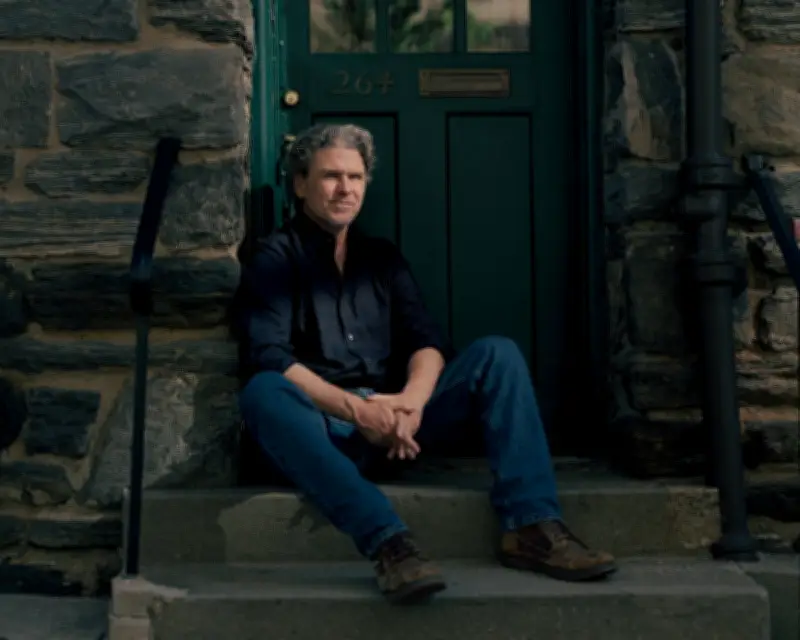
Dave Eggers, the acclaimed author of A Heartbreaking Work of Staggering Genius and numerous other works, sat down for an interview that began with an unconventional activity: life drawing. At his suggestion, the interview started with a session featuring a model named Prudence, nude except for black knee-high socks. Eggers, who dropped out of art school but has drawn for decades, demonstrated how to measure proportions using a pencil and thumb. Since the pandemic, he has organized regular life-drawing sessions at McSweeney's, the publishing house he founded in San Francisco in 1998. He believes figure drawing cultivates empathy, saying, 'In three hours of drawing a human, you learn so much about them and there is so much affection that comes from carefully trying to get them right.'
Eggers's Latest Venture: Art + Water
Eggers, now 56, has written over a dozen novels, half a dozen nonfiction books, and numerous children's and art books. He has also launched many nonprofits aimed at reducing barriers to literature and the arts. His most recent venture is Art + Water, an arts centre on the San Francisco waterfront modelled on a traditional artists' atelier. In exchange for free studio space, 10 established artists provide mentorship and instruction to 20 local emerging artists. The programme is free to attend, contrasting with the high cost of MFA degrees in the US, which can easily reach $100,000 a year. Eggers calls this price 'absurd' and says it produces an 'arts industrial complex that makes everyone miserable.' He adds, 'There's nothing that makes me more crazy than an economic barrier to a creative writing class or a drawing class.'
The International Library of Youth Writing
After drawing, Eggers led the way through a Narnia-style wardrobe separating McSweeney's offices from the International Library of Youth Writing. The library showcases books written by children who attended writing centres Eggers helped found nearly 25 years ago. The original centre, 826 Valencia, is across the road, inside a pirate-supply shop—a necessity due to local planning laws requiring commercial use. Eggers believes children need more whimsy in their lives. The library features oriental rugs, a portrait of Queen Elizabeth I with fuchsia nails and a cartoon pink dog head, and a hidden boudoir behind a grandfather clock. A pink chest of miniature drawers serves as postboxes for neighbourhood kids, who send each other letters and receive jokes from the library's curator. 'It's not like a digital mailbox, it's a box with a real person that's putting a letter in every day,' Eggers says. 'If you give them a real, tangible choice, they will always choose the person, the typewriter, the tactility, as opposed to another screen. But we assume that they want more screens, and we give them more screens, and we serve nobody. It's just a tragedy.'

The Threat of AI to Creativity
Eggers pulls out a pamphlet featuring a story by children set in 'the fluffy pizza beetle desert of doom.' He delights in the 'bonkers' nature of many books in the room. 'We don't question the weirdness, as long as it's original,' he says. 'That's the only requirement, it can't be about you know, SpongeBob or something. It has to be their original thoughts.' Over two decades of working with children, Eggers thought he had seen every educational challenge—until AI entered classrooms. 'The AI challenge really is beyond an existential one,' he says. 'Every time I think I'm going to talk to somebody who would never deign to use AI in any form I find there's this very porous line where, you know, a smart 10-year-old will say, “well, I don't use it to write, I just use it to generate ideas”, which is far, far worse.'
Eggers reminds students of their uniqueness: 'You're one of one. You're unprecedented in the entire line of human history. Only you have your brain. Only you can think of what you can think of. Only you can tell a story in a particular way. Why would you cede that to a machine?' His voice rises as he adds, 'Once you have a machine think for you and write for you, you're cooked as a species. That's it. That's the worse dystopian outcome there could ever be.' He condemns the idea of willingly outsourcing one's voice to 'an unthinking machine who has plagiarised all of the world's authors and has come up with this terrible soup of bad writing.'

Countermovement Against AI in Schools
Despite dispiriting news about AI-written books and reviews, Eggers believes a countermovement will emerge, similar to growing resistance to giving teenagers smartphones and social media. Most teachers, he suspects, understand the problem with tech in schools, but the issue lies with policymakers. He cites a speech by US education secretary Linda McMahon, who talked about introducing AI into schools for children as young as five, but repeatedly referred to AI as 'A-one.' 'This is who we have leading the department of education,' Eggers complains. 'We're in such a comical place right now …'
Eggers and his wife, writer Vendela Vida, are part of two class action lawsuits against Anthropic over the AI firm's unauthorised use of their books to train large language models. 'I guarantee you they didn't even think they were stealing anything because it's just “content” to them,' he says. He calls 'content' the 'world's worst word,' as it dehumanises writing and suggests 'it has no real value inherently, and it doesn't matter if humans made it or not.'
Eggers's Writing Process and Political Engagement
Eggers's nonfiction often stems from outrage. Books like The Monk of Mokha and Zeitoun illuminate aspects of American history. Zeitoun faced criticism for oversimplifying its hero, who was later imprisoned for stalking his ex-wife. Eggers studied journalism at the University of Illinois, where professors—'hardcore old Chicago newspaper guys'—warned that 'no one will get better than a B-minus because you don't deserve it.' He describes nonfiction as a 'slog' due to fact-checking, while fiction is 'infinitely more fun.'
His dystopian novels The Circle (2013) and The Every (2021) feature a monopolistic big tech firm. In The Every, the president communicates in emojis and AI sanitises novels. Eggers was invited by Sam Altman of OpenAI to discuss AI-written novels on campus. He found it an interesting, open conversation. 'It was a really nice afternoon, actually, because what we always forget is that the maniacal illusions of a few of the people at the very top are not always shared by the rank-and-file … at least some of the people working there do want to be told what's right and what's wrong,' he says. 'But I definitely did have to give them the bad news … there's no such thing as AI art. Only humans can create art.' At best, machine output is 'computer generated imagery.'
Personal Habits and New Novel
During the interview, Eggers's flip phone rings. He writes first drafts by hand and transfers them to a 1998 Mac computer never connected to the internet, now held together with duct tape. He has never seen Facebook and avoids social media, but admits to wasting time on ESPN and old concerts on YouTube, like a Kate Bush show from 1981 or a two-and-a-half-hour Sinéad O'Connor concert. He didn't have home internet until the pandemic, and now writes on a boat in San Francisco Bay 'to escape the internet,' with no phone reception and only passing fishers, porpoises, or harbour seals as interruptions.
Eggers's new novel, Contrapposto, spans six decades and follows the friendship between Cricket and Olympia, who meet as children when Olympia commissions Cricket to write pornographic graffiti on the playground. Eggers started the novel around 20 years ago, jotting notes on copy paper. He says it took turning 50 to understand he could write such a story because people are surprisingly consistent. 'Most of my friends I've had since first or second grade, and none of us changed much. We have the exact same relationship,' he says.
Eggers dismisses similarities between himself and Cricket. He was an 'active, antsy kid' who loved drawing but was friends with naughty boys. He briefly studied art at university and interned at a snooty gallery that received no visitors for a week, but unlike Cricket, Eggers is practical. He sells prints of his art—animal drawings with captions like 'Oh God the beauty will kill me' under a forlorn bear—to pay the library's rent. A theme in Contrapposto is the complex relationship between talent and success. One character notes that the most talented guitarist might be playing in a Journey cover band in Reno. 'Which I've seen, you know,' Eggers says. 'Best guitarist I ever saw was in Reno in some bar.' He finds it strange that little artistic value is placed on streetside portrait artists, saying, 'I'm astounded when I see some of them, what they can do.'
Before leaving, Eggers and the interviewer review their sketches. He offers generous praise, as he always does for aspiring artists. One drawing he plans to keep is a sketch of Prudence facing away, pulling at the end of a dark braid, conveying motion and looseness with control. Contrapposto by Dave Eggers is published by Canongate on 2 July.