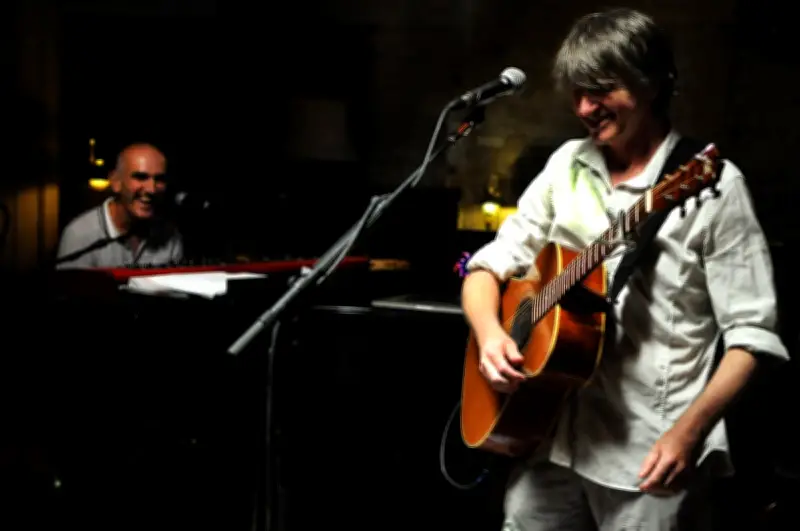
Paul Kelly and Neil Finn in rehearsal at Bakehouse Studios in Richmond, Melbourne, in 2013. Photograph: Leon Morris/Redferns/Getty Images
‘A kick in the bollocks for Australian music’: how band rooms and live venues became a dying breed. Changing tastes and rising rents are to blame, says owner of the latest Sydney rehearsal studio to shutter.
Alan Scott says in the 1990s he would lose his rock musician customers to drug overdoses “and other nefarious, self-inflicted wounds”. In 2026, he says, they are more likely to die of cancer and heart attacks – a combination of poor diet, no exercise and old age.

“If I could afford it I’d have a defibrillator machine, I’m not joking,” Scott says. “Instead of dying from heroin, the poor buggers are just eating too many fatty foods.”
Scott won’t have to make that morbid purchase; his business, Zen Studios, has gone into liquidation and closed with a garage sale in Tempe on the last weekend of May.
Zen started in November 1990 with a four-room facility in Marrickville, and became a go-to rehearsal space for bands in Sydney’s inner west, be they indie, punk and metal, alt country and beyond. Radio Birdman, Frenzal Rhomb and Front End Loader have all practised their sets in its bunker-like rooms.
Front End Loader’s drummer Pete Kostic with a student at Zen in 2015. Photograph: Zen Studios
Zen added three more rooms to its Marrickville space in the late 1990s, and opened Zen 2 in Tempe in 2010. What may have seemed the high-water mark for the business was the beginning of a long decline, which culminated in liquidation and closure – first Zen and now Zen 2.
It’s the latest loss in a series of renowned Sydney rehearsal rooms such as Sound Level – the first to go in the 2000s – and Troy Horse in 2016, victims of changing musical tastes, demographic shifts, a struggling live music scene and high Sydney rents. Other smaller rooms were flushed out during and after the pandemic.
“Back in the 90s everyone wanted to be a musician, especially if you lived around here,” says Scott. “You could afford to rent in Surry Hills if you were on the dole, and just about everyone in Newtown was in a band.” These days, he says, “if you live within 30 kilometres of here and you’re under 30 you’re [now] spending 50% of your income on rent”.
And as the rents went up, live venues started to close too. Newtown lost the Sandringham, the Annandale lost its live stage, and the legendary Hopetoun hotel in Surry Hills still lies derelict. More recently, the city has lost other venues too, such as Marrickville’s the Great Club and Ultimo’s jazz club Foundry616.
Former frontman of the Angels, Doc Neeson, at a rally to save the Sandringham hotel in 2012. Photograph: AAP
And on the same weekend as Zen closed its doors, another well-known Sydney venue announced its demise: Mary’s Underground, formerly the famous Basement at Circular Quay, which says it has hosted 1,000 shows performed by around 3,000 artists over the last seven years. Once again, the reasons given were financial.
‘It’s harder to find that extra $50 in the budget’
Across the country, the Covid pandemic was almost an extinction event for live venues, with an Apra Amcos report from 2023 saying it wiped out 1,300 small and mid-sized venues – around one-third of the sector. A strong music scene needs rehearsal rooms as part of its ecosystem, and as venues close so do the opportunities for gigs and the demand for rehearsal space.
But another factor is the changing tastes of younger people: rock bands aren’t as dominant as they used to be, and if musicians want to make music, they often do it digitally at home. “It’s social change, with young people falling out of love with rock music, but also the cost of living,” Scott says.
It’s not just happening in Sydney either. Hamish Cox has run Sunset Rehearsals in Adelaide for 13 years and has seen the shift. “When you combine cost of living expenses, the massive jump in utility bills, rent hikes and the lack of any significant fee increases for musos to perform, it just means it’s harder to find that extra $50 in the budget for a rehearsal space,” he says.

“We’ve maintained the low prices we started with because we understand how integral having a place to rehearse is and how it shouldn’t cost a lot to have a place to practise with your mates,” he says. “It’s harder for us … but without an affordable place to hone their craft we would lose artists and never hear songs we should hear, and that would be a kick in the bollocks for our music industry.”
Jet’s Nic Cester performs at Bakehouse in 2023. Photograph: Martin Philbey/WireImage
Even the bigger rehearsal spaces are operating on a financial borderline. Opened in 1990, Bakehouse Studios is one of the premier spaces in Melbourne and has been used by names such as Paul Kelly, Jet, Dan Sultan, Ed Sheeran and Ed Kuepper. But co-founder Helen Marcou says Bakehouse has survived only by transforming into a “multi-function arts space”. “If we hadn’t diversified and upped our game many years ago, I don’t think we could have survived, given the rent conditions here in Melbourne.”
Marcou says at least seven studios that competed with Bakehouse were wiped out after the pandemic, including Kerr Street, Aesthetic Studios and Factory Sound. “I don’t think we’ll ever get back to 2019 levels of occupancy, and now we’re seeing another slump again,” says Marcou.
‘An ongoing issue’
Matt Francis, the head of public affairs at Live Performance Australia, the peak body for Australia’s arts and entertainment industry, says that “affordable and accessible spaces for artists and creatives to practise, develop and present their work is an ongoing issue across the board and something which governments should prioritise”. “Australians still strongly value live music experiences, but it’s clear that some parts of the industry are under pressure – particularly smaller venues,” Francis says.
Back at Zen’s closing-down sale, a diverse crowd of punters – many of them long time customers – are picking over everything from plastic chairs to sought-after guitars and amplifiers. Scott says his goodbyes to the regulars; one gives him a $120 bottle of whisky in thanks. Paul, a sixtysomething punk rocker who had rehearsed at both Zen locations over many years, tries out a classic Marshall amplifier, knocked down to around half its value. “It’s always been such a great place, part of the culture,” he says. “It was for the community, not for the stars. Other studios, if someone big wanted a room they’d cancel all the other bookings so they could rehearse in private; here they’d give them whatever room was going and if there wasn’t a room tell them to go somewhere else.”
As for Scott, who just turned 60, his next career is as a handyman, also under the “Zen” brand. “People say I should learn audio engineering, but I’d rather learn welding,” he says. “I got into this business to make money, and because I saw a demand. Now there’s no more demand for rehearsal space, I need to move into something where the market is growing.”