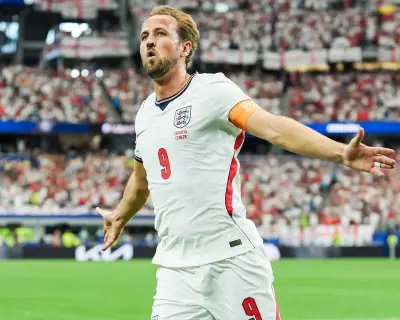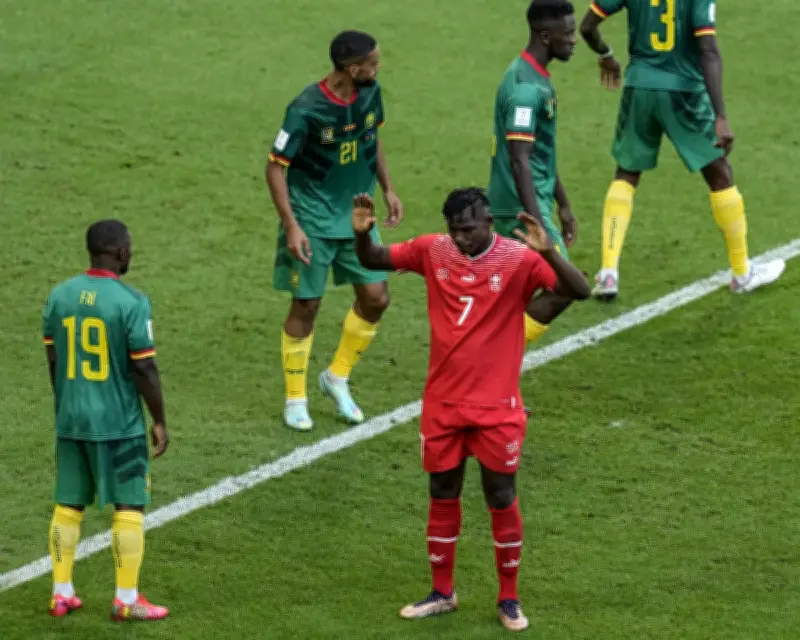
Breel Embolo, the Swiss international born in Cameroon, notably refrained from celebrating his goal against Cameroon at the 2022 World Cup. This act of respect towards his country of birth raises the question: which other footballers have refused to celebrate a goal against another country due to personal connections?
Early Examples of Restrained Celebrations
Sweden's Yasin Ayari, who has a Tunisian father, chose not to celebrate his first goal against Tunisia, though he couldn't resist celebrating when he scored later. Declan Rice did something similar after scoring against the Republic of Ireland in 2024. But the earliest example of this gesture is Lukas Podolski, who scored two goals against Poland, the country of his birth, at Euro 2008. Podolski later told FourFourTwo magazine in 2022: "This was a difficult and emotional game for me. Both the German and Polish press focused on me before it, building the pressure, and there were so many Polish fans in the ground. I didn't celebrate, but I'm a professional and had to do what was expected of me. I support Poland on every other occasion. I was emotional before and after the game, but for 90 minutes I came to do my job for Germany."
During a European Championship qualifying match in 2010, Mesut Özil showed restraint in his celebrations when he scored for Germany against Turkey in a 3-0 win. Özil was born in Gelsenkirchen to Turkish immigrants, making his subdued reaction understandable.

Dick Advocaat's Unique Coaching Career
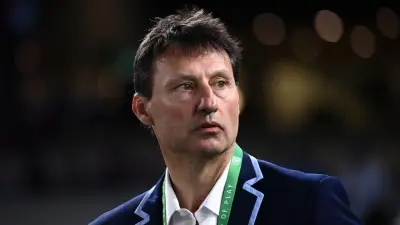
Luke Carruthers posed two questions about Cape Verde manager Dick Advocaat: has he coached more men's international teams than anyone else, and how rare is it to manage both a country's men's and women's senior teams? Advocaat has managed eight different men's international teams: Netherlands, South Korea, Belgium, Russia, Serbia, Iraq, United Arab Emirates, and Cape Verde. However, Rudi Gutendorf holds the record with 17 national manager jobs over 53 years, including Chile, Bolivia, Venezuela, Trinidad and Tobago, Grenada, Antigua, Botswana, Australia, New Caledonia, Nepal, Tonga, Tanzania, Ghana, Fiji, Zimbabwe, Mauritius, and Rwanda. Gutendorf also coached the Iranian and Chinese Olympic teams. When asked why he managed so many countries, he replied: "One cannot conserve excitement." However, Christoph Arlick notes that many of Gutendorf's teams did not play official games during his tenure. He actually managed 77 games across nine countries: Bermuda, Chile, Botswana, Australia, Nepal, Ghana, Mauritius, Zimbabwe, and Rwanda, beating Advocaat's record by at least one country.
Other managers with extensive international experience include Bora Milutinovic (eight: Mexico, Costa Rica, USA, Nigeria, China, Honduras, Jamaica, Iraq), Claude Le Roy (nine: Cameroon, Senegal, Malaysia, DR Congo, Ghana, Oman, Syria, Congo, Togo), Danny McLennan (10: Philippines, Mauritius, Rhodesia, Iran, Bahrain, Iraq, Jordan, Malawi, Fiji, Libya), and Tom Saintfiet (12: Namibia, Zimbabwe, Ethiopia, Yemen, Malawi, Togo, Bangladesh, Trinidad and Tobago, Malta, the Gambia, the Philippines, Mali). Saintfiet still needs to manage in South America and Oceania to complete the set.
Regarding managing both a country's men's and women's senior teams, John Herdman is a notable example. The Englishman managed Canada's women's team from 2011 to 2018 and the men's team from 2018 to 2023. After the women's team lost all three group games at the 2011 World Cup, many players considered retirement. Retired defender Emily Zurrer recalled: "We were completely broken. Some of us were thinking about hanging up our boots and here's this guy talking about being on a podium and seeing our flag rise … and very quickly he instilled that belief in us." Under Herdman, Canada won bronze at the 2012 and 2016 Olympics. He then took over a divided men's team in 2018 and led them to their first World Cup in nearly four decades in 2022.

Longest Wait Between World Cup Appearances
Alexander Scott noted that New Zealand's Chris Wood and Tommy Smith played at their second World Cup 16 years after their first. This equals the record set by Faryd Mondragón, who played for Colombia at the 1998 and 2014 World Cups. Before Mondragón, the longest wait was 12 years, shared by players such as Alfred Bickel (Switzerland, 1938 and 1950), Erik Nilsson (Sweden, 1938 and 1950), José Martínez Sánchez 'Pirri' (Spain, 1966 and 1978), Wilfried Van Moer (Belgium, 1970 and 1982), Michael Laudrup (Denmark, 1986 and 1998), Hernán Medford (Costa Rica, 1990 and 2002), Niall Quinn (Republic of Ireland, 1990 and 2002), Santiago Cañizares (Spain, 1994 and 2006), Lee Dong-gook (South Korea, 1998 and 2010), Daniel Van Buyten (Belgium, 2002 and 2014), and Aleksandr Kerzhakov (Russia, 2002 and 2014). Randall Azofeifa (Costa Rica, 2006 and 2018), Edin Dzeko and Sead Kolasinac (Bosnia and Herzegovina, 2014 and 2026), Nabil Bentaleb, Aïssa Mandi, and Riyad Mahrez (Algeria, 2014 and 2026), and Lucas Digne (France, 2014 and 2026) also waited 12 years.
Dave Beasant Penalty Myth
In 2018, George Jones asked about the common belief that England should have brought on penalty-save specialist Dave Beasant for the shootout against West Germany at Italia 90. The theory suggests that Bobby Robson could have substituted Beasant for Peter Shilton before penalties. However, this is a myth. According to The Guardian's Rob Smyth, England had not used all their substitutes; they had only brought on Trevor Steven for Terry Butcher (two subs were allowed). The other subs were Chris Woods, Tony Dorigo, Steve McMahon, and Steve Bull. Moreover, in those days, teams had to name five substitutes for each match, so Beasant was not even on the bench.