Valie Export, the Austrian artist who used performance, photography, and sculpture to challenge the representation of women, has died at the age of 85. She was part of a global generation of feminist artists who used their bodies to confront social structures and male-dominated values.
Early Life and Name Change
Born Waltraud Lehner in Linz, Austria, during World War II, she was one of three sisters. Her mother became a war widow when Waltraud was two. Educated at a convent, she was expelled multiple times before attending the School of Applied Arts in Linz. At 14, she took her first photograph—a self-portrait—with a friend's camera, foreshadowing her later interest in role-play and performance.
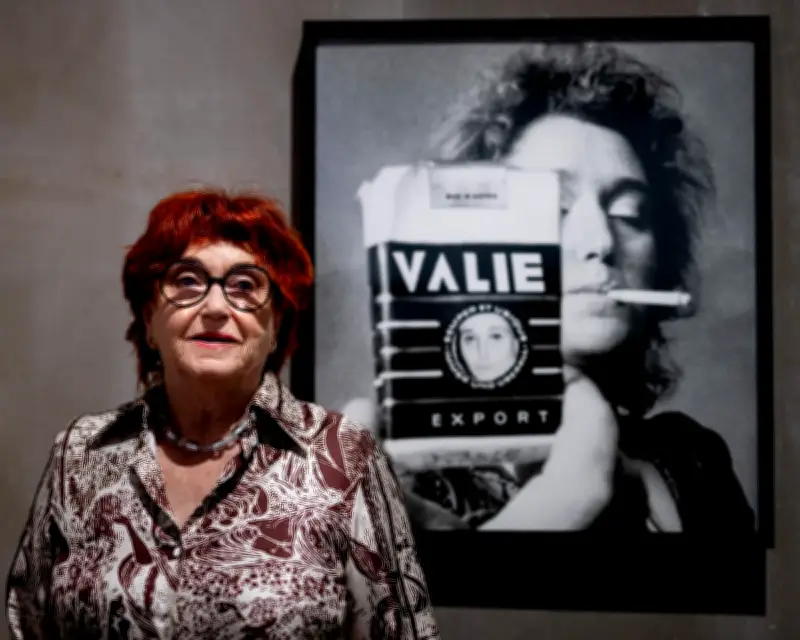
In 1967, she changed her name to Valie Export, always styled in block capitals, blending her nickname with the Smart Export cigarette brand. In her self-portrait Valie Export – Smart Export (1970), she holds a modified soft pack labeled “Made in Austria: Valie Export.” This act severed ties with her father's and ex-husband's names, announcing herself as an independent entity.

Feminist Art and Expanded Cinema
Export's work often involved “expanded cinema.” In 1968, she staged Touch and Grope Cinema on the streets of Munich and Vienna, wearing a “cinema” strapped to her chest that allowed the public to touch her exposed breasts. This reversed the typical male gaze in movie theaters, exposing the audience to the artist's scrutiny.
In 1969, she performed Action Pants: Genital Panic at an avant-garde film festival in Munich, wearing jeans with the pubic area removed. The lights were on, forcing a full view. Later that year, she posed for photographer Peter Hassmann, sitting with legs splayed and holding a machine gun, disrupting erotic conventions.
Career and Recognition
Export co-founded the Austrian Filmmakers Cooperative in 1968 and was professor for multimedia and performance at the Academy of Media Arts Cologne until 2005. She wrote Women's Art: A Manifesto in 1970 and curated Magna in 1975, showcasing female artists. In 1980, she and Maria Lassnig were the first women to represent Austria at the Venice Biennale.
Her work was not fully appreciated until the early 21st century. The Austrian curator Gabriele Schor noted that in 1968, Export was the first female artist to make a provocative, feminist statement in the male-dominated Viennese art scene. In 2015, the Valie Export Center opened in Linz, housing her extensive archive.
Legacy
Export received numerous awards, including the Yoko Ono Lennon Courage Award for the Arts in 2014. In 2023, she was the subject of a retrospective at the Albertina Museum in Vienna. Her second husband, Robert Stockinger, died in 2016, and her daughter, Perdita, died earlier this year. She is survived by a sister, Elisabeth, and a grandson, Patrick.