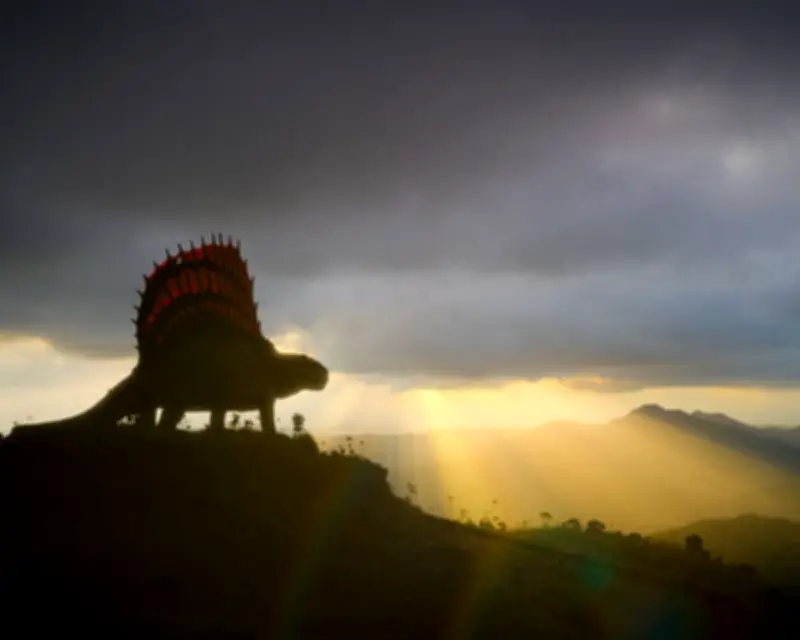
Nearly three decades after producer Tim Haines revolutionized natural history with Walking with Dinosaurs, he is back with a new blockbuster series titled Surviving Earth. Premiering on NBC on Thursday, this docuseries delves into eight mass extinction events spanning 450 million years, focusing on the creatures that lived before and alongside the dinosaurs and how life managed to rebound after each catastrophe.
A Journey Through Earth's Deadliest Events
Haines, known for using CGI and animatronics to bring prehistoric beasts to life, now applies that same visual magic to explore even deeper into the past. Surviving Earth examines volcanic eruptions, flooding, and drought that repeatedly wiped out nearly all lifeforms, but its core message is one of resilience. 'The biggest message of the show is that the Earth is an incredibly changeable place and life has evolved on it, which means that life has evolved to cope with change,' Haines said. 'No matter what the Earth has tried to do, life has always managed to crawl through it and come out the other side stronger.'
Scientific Collaboration and Visual Innovation
Haines worked with over 300 scientists, including paleontologists and paleoclimatologists from around the world, over three and a half years to accurately depict the creatures in Surviving Earth. While CGI technology has advanced since Walking with Dinosaurs premiered in 1999, the production process remains similar. A paleo artist designed the animals, film crews shot background locations—some reused from Walking with Dinosaurs, like a Chilean forest with monkey puzzle trees—and tech teams built landscapes and detailed animal models before animating and compositing everything together.

Haines acknowledged that depictions of prehistoric life are always 'best guesses' based on fossil evidence. 'We never know when we're right, but we know when we're wrong,' he said. For instance, the gorgonopsians in the first episode, reptilian apex predators and early distant relatives of mammals, sparked a debate about whether they should have hair. Haines wanted whiskers but was overruled by a scientist who noted they were 'really' early relatives, so they appear similar to modern Komodo dragons.
Storytelling and Emotional Connection
Haines aims to emotionally connect audiences to animals that cannot verbally communicate, while avoiding anthropomorphization. 'We want you to emotionally connect to their stories, but we don't want to start calling them Eric and Sonia,' he said. A challenge is that the creatures in Surviving Earth are less familiar than dinosaurs, but Haines believes good storytelling transcends that. 'The storytelling we're using is universal,' he said. 'It is parents and babies, it is fathers and mothers, predators and prey... they are creatures living their lives, and what natural history shows you is that you can get some very rich stories out of that.'
A Message of Optimism Amid Climate Crisis
The first episode addresses the current climate crisis, acknowledging that it's easy to imagine we are in the midst of an imminent extinction event. Borrowing from another blockbuster franchise, the series' overall message is that life finds a way. However, that optimism is tempered by the fact that 99.9% of all species that have ever lived are now extinct, and humans could face the same fate. Narrator Josh Goodman points out that today's carbon dioxide levels are not high compared to Earth's history, meaning humans are not the only species to have caused climate change. 'Other types of life have changed the Earth as well,' Haines said. 'As a form of life, we're not the first ones to change the climate, but we are the first ones who know we're doing it.'
The concern lies in the speed of human-driven climate change, but Haines emphasizes that humans have the unique opportunity to be the first species to stop the damage. 'The program isn't here to lecture anyone or tell anyone what to do, but it's blindingly obvious that if the Earth changes, you have to acknowledge that and change with it as much as you can,' he said. 'And if you're responsible for changing it, you'd be wise to try and reduce the amount you change it by.'
Surviving Earth begins on NBC on 11 June, with UK and Australia dates to be announced.