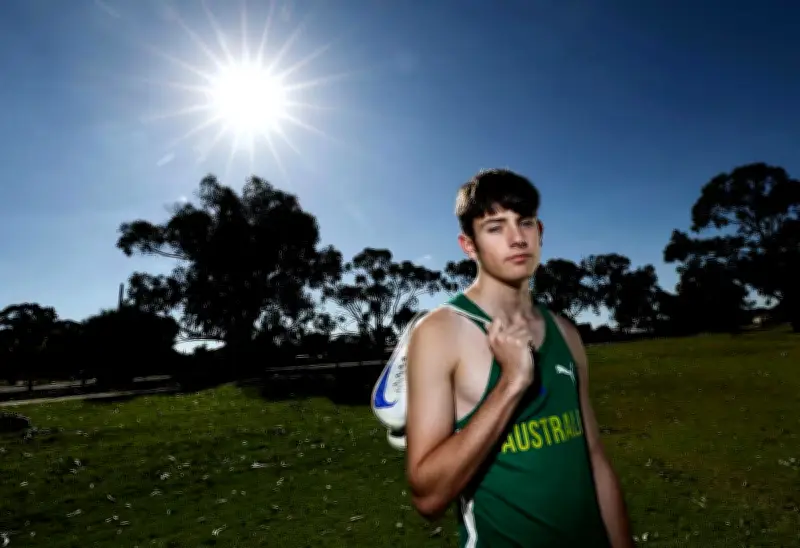
At 15, most teenagers are preoccupied with dating, gaming, and deciding what to study, but Mitchell Warrilow was facing a life-changing decision: whether to step into the world of para-athletics after years of success in able-bodied events. It is a decision that the Mandurah teen still grapples with, but what is not in doubt is the speed contained within a youngster yet to reach his peak.
Gold and Silver at Oceania Championships
At the recent 2026 Oceania Athletics Championships held in Darwin, Mitchell took out two golds and a silver in the men's ambulant 400m, 800m, and 200m respectively. He also holds the eighth fastest time in the world in the para-400m and set national records in the 100m and 400m at the 2025 WA All Schools Championships. At the same event, Mitchell was part of the team that won silver for Western Australia in the under-16 4x400m mixed relay.
The list of athletes who have competed in both the Olympics and Paralympics is short, but Mitchell hopes to join their number.

A Mother's Determination
It was the sheer determination of Mitchell's mother, Danielle, who after discovering her son had cerebral palsy as an infant, did everything she could to ensure the disability would not hold him back. “Mitchell always seemed to struggle to do things, like he wasn’t sitting up easily, he would fall over a lot, he was dribbling, and I’m like, what is going on here?” Danielle said. “I didn’t have any other kids, I only had other mums in playgroup, and they’d say ‘Oh no, there’s nothing wrong with him, you know, he’s a boy, boys are lazy’.”
After visiting a paediatric neurologist, the diagnosis was mild cerebral palsy. Turns out Mitchell was born with left hemiplegic cerebral palsy after being squashed by his twin Madison in the womb. Cerebral palsy can cause a limp or ataxia (mild shaking) and can slow down messages to the limbs; in Mitchell's case, it affects his left ankle and wrist.
“When people think cerebral palsy, they think fully disabled, like in a wheelchair, but they don’t understand that the spectrum is so large because you can be someone like me, who is mildly affected,” Mitchell said. “You’ve got a T38 who could be like me who when they’re running you’d think they’re not disabled, you know people think ‘they’re cheating’ but then there could be a T38 with a very visible problem with their gait and you’re like but that’s not fair. But it is because it’s all down to fine motor control, and not necessarily how it impacts you day to day.”
First-time mum Danielle was determined to do everything she could to ensure Mitchell could achieve his full potential. She put a roof over their pool, added a heater, trained as a swim teacher, and started intense physiotherapy with her son.
Discovering Speed
Cerebral palsy was not something that would hold Mitchell back. After running in the school sports carnival at Frederick Irwin, he found out he was fast. But he realised he was really fast after winning at the interschool carnival and asked his mum if he could start little athletics. “I liked the feeling of winning,” Mitchell said. “Obviously the thing you do after Little Athletics, is you go on to states, yeah, and then you go on to nationals, going to nationals at that point was like the biggest thing ever.”
Mitchell went on to have great success, gathering a slew of track and field medals along the way. But at training for the WA State relays last year, the coach said Mitchell would run a lot faster if he straightened his leg. Danielle explained that Mitchell had cerebral palsy and may not get the leg straight, and it was then they learned about classifications for para sports.
Para-Classification Journey
It is not easy to receive a para-classification, and at times it can be confronting. Mitchell was classified as T38 (these athletes have the mildest forms of movement and coordination issues) in October to compete in Australia. He broke all the records for his age group and his classification, so the next hurdle was international classification. To be accepted by World Para Athletics, the process is not pleasant and involves stripping down and submitting your body and medical records to a panel of doctors, something normal athletes do not have to do. There are also costs involved, including travelling to Canberra for assessment.

It is an unspoken truth, but athletes want to win. A T38 classification meant Mitchell could compete and potentially be the best. But accepting the classification is something Mitchell has struggled with, describing it as a “double-edged sword”. “Especially because I’m not affected on a day-to-day basis, if I’m not in elite sport, then I am completely fine, just like everyone else, there’s nothing I can’t do that an able-bodied person can’t,” Mitchell said. “But when you get to a high level of sport, it’s like, you know, maybe I’m never going to be as fast as world record holders or whatever, so maybe it’s time to accept, even though I don’t want to accept that there is this mild impairment.”
Funding and Treatment Disparities
Funding will always be an issue for para-athletes, who receive just a fraction of high-performance resources. Still, Mitchell would love a Nike sponsorship one day, but laughed, admitting, “Nike doesn’t really do the Aussies”. There is also a difference in how para-athletes are treated. At elite athletics meets, there is usually a tent where competitors can book a pre-race sports massage. At the recent Oceania Athletics Championships, when he tried to book a pre-race massage, Mitchell was told this service was not available to para-athletes.
Advice for Others
Despite the challenges, Mitchell still recommends that other people with disabilities give athletics a go. “I think you know you’ve got to have the determination, shoot high and see where you land,” he added. “But don’t go and do something if you’re not willing to give it 100 per cent because if you’re not going to, there’s no point in doing it, you know, don’t half ass it.”