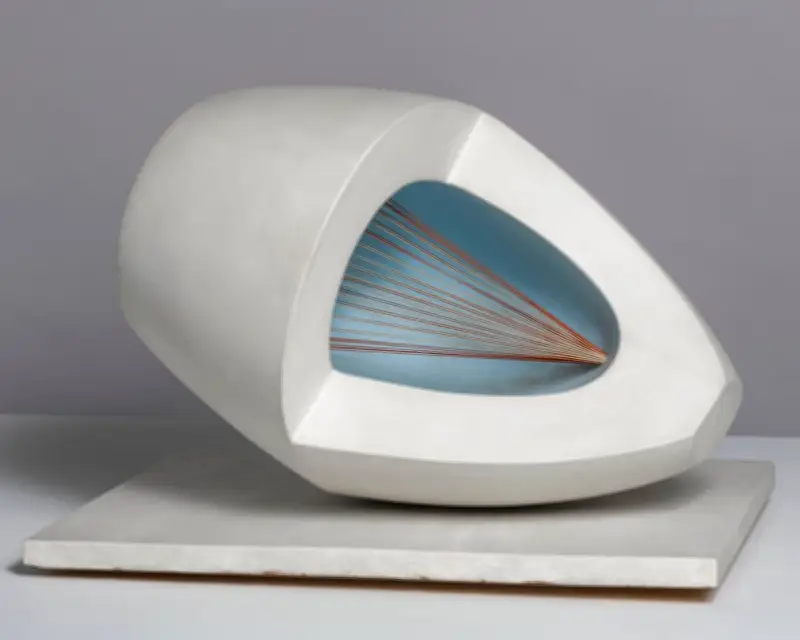
The rounded, white plaster objects are cut open to reveal deep blue interiors that seem immemorial, although Hepworth has simply painted them. Across the blue illusionistic depths, red-painted strings are tautly fixed. The red strings might suggest seaweed if, like me, you can't get nature out of your head looking at these abstract yet evocative works.
They say in St Ives that if you put your ear to a Barbara Hepworth sculpture, you can hear the waves breaking on Porthmeor beach. Well, maybe they do say that and maybe they don't. But the sea definitely roars in the ravishing sculptures at the heart of this small survey of just one aspect of her work: her use of colour.
Hepworth's favourite colours turn out to be – wait for it – blue and white, the colours of the sea: the white foamy breakers and the rippling waters that swaddle the Cornish fishing town where her home and studio are proudly preserved.

And they haunt Hepworth's rounded, pierced, convex and concave tabletop sculptures. In the first and most beautiful room, a series of objects the size and shape of geodes are displayed on pedestals. The rounded, white plaster objects are cut open to reveal deep blue interiors that seem immemorial, although Hepworth has simply painted them. Across the blue illusionistic depths, red-painted strings are tautly fixed. The red strings might suggest seaweed if, like me, you can't get nature out of your head looking at these abstract yet evocative works.
Is it OK to see Hepworth as an artist of salty seascapes? The Courtauld frames her in a more formalistic, high modernist way as a pure abstract creator. Around her vivid sculptures, in which so many wild windswept walks by the sea seem compressed, the gallery walls are hung with her precise designs. They feature carefully calculated curves and radiating, intersecting lines that map out a lucid, geometrical beauty.
It's interesting to see these drawings, at least at first. But the obligation to keep looking from Hepworth's captivating, self-contained sculptures to her studies starts to feel like a chore. The argument of the exhibition is a bit empty, anyway: this famous British artist used colour. Is that a surprise? It seems reductive that a couple of pieces – a curvaceous, holey stone with a splash of yellow paint and a tall, graceful monolith that resembles jade – seem to be here simply to show Hepworth didn't think in monochrome. They surely deserve better than to be chucked in as evidence that she enjoyed her colours.
But Hepworth is such a great sculptor, perfect and immaculate. Her 1946 elmwood carving Pelagos curls over like an especially elegant wave, the kind that surfers wait for off St Ives. Hepworth must have watched waves for hours, for years, to be able to visualise this graceful, smooth curve of gathered force, which she has painted white on its underside. Red strings, again, are suspended between the double curve, creating an almost cinematic sense of movement. They add to the sense that Hepworth doesn't only work with colour but sound, too.
The strings make her sculptures resemble the Aeolian harp, an instrument that can be played by the wind. Samuel Taylor Coleridge had one and wrote: 'How by the desultory breeze caressed … the long sequacious notes / Over delicious surges sink and rise.' In this windowless room in central London, Hepworth's stringed sculptures may not sing in the wind but they resonate in your mind.
Hepworth's passion for the forms created by the wind and waves fills this exhibition with blues and blue-greens. Her oil and pencil sketch Turning Form (Atlantic) is a rolling white misty spray in a spattered blue ocean, while Sea Form (Porthmeor) suggests those same wild waters in a wide horizon of green bronze. Most mysterious and lingering of all is Sculpture With Colour (Eos). This upright oval was carved from Hopton Wood stone in 1946. Hepworth dug a hole into it and painted it blue. The resulting oceanic oval recess in the miniature monolith resembles a huge staring eye: is it the eye of Eos, the Greek goddess of dawn?
I never thought of Hepworth as a mystic. But the calm and stillness her art creates feels spiritual. When you gaze at the upper and lower curves of her work Wave, time stops, as for a surfer on the water.

Hepworth's art does not depict nature. Instead, it makes you feel the solitude, peace and the immensely long, dwarfing time cycles of nature: the time it takes for the sea to make a cave in a cliff, or for rain to sculpt a peninsula. The sculptor's chisel has often been imagined as a penetrating, aggressive tool, shaping stone into convex, upright figures. Hepworth releases concavities, liberates holes. Maybe exhibitions of her art are often careful and fussy, as this one is, because they are a little intimidated by the sheer power of British art's nature goddess. At the Courtauld, London, from 12 June to 6 September.