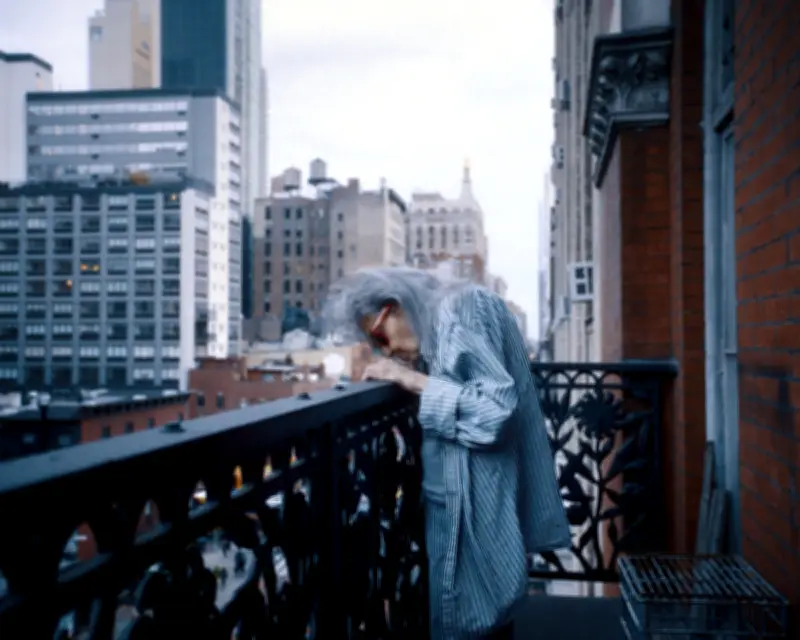
The reclusive artist Bettina, who spent decades filling every surface of her apartment at New York's Chelsea Hotel with artworks, is now receiving long-overdue recognition. A selection of her sculptures, photographs, and films is on display for the first time at the Glasgow International festival of contemporary art in an exhibition titled Bettina: Finite Structures.
Inside Room 503
When artist Yto Barrada first stepped into room 503 at the Chelsea Hotel, she was overwhelmed. Every inch of the walls was covered with Xeroxed word art, graphic reproductions of geometric sculptures, hundreds of photographs of passersby, and collections of leaves laid out in grids. Piles of cardboard boxes and crates created teetering canyons through which Barrada had to turn sideways to navigate. Every visible surface was covered with sculptural forms in brass, marble, and wood. In the midst of it all, on a small daybed surrounded by 40 years of fervent work, was Bettina.
Barrada, who edited the book Bettina with designer Gregor Huber, wrote: "One sees Bettina and understands that some disaster has taken place, long ago." Bettina had permitted only a handful of people to enter her room since she moved into the Chelsea in 1972. Despite the bohemian buzz around the hotel, with neighbors including Patti Smith, Bob Dylan, and Andy Warhol's entourage, Bettina locked herself away, devoting her life to conceptual works that flowed unstoppably from deep within.

A Life of Devotion to Art
Born Bettina Grossman into an Orthodox Jewish family in Brooklyn in 1927, she studied commercial art and worked as a textile designer. In the late 1950s, she traveled to Paris and spent eight years traversing Europe, collecting skills in glass, sculpture, silversmithing, and photography. She explored marble quarries in Carrara, designed silverware in Stockholm, and learned stained glass production in Chartres. During this period, she became known as Bettina.
Returning to New York in 1966, she moved into a live-work studio in Brooklyn Heights. She began to see parallels between her work and the systemic painting and geometric abstraction popular in New York's art world. However, a devastating fire destroyed her studio, all her work, possessions, and her cat. Left with nothing, she abandoned commercial design and committed to life as an artist.
Rebirth and the Chelsea Hotel
After the fire, Bettina sought harder, more resilient materials. She created a series of marble egg sculptures symbolizing rebirth. Her work became increasingly theoretical and diagrammatic, inspired by the esoteric Russian philosopher Peter Ouspensky, who spoke of a fourth dimension. She moved into the Chelsea Hotel and pinned a sign to her door: "The Institute for Noumenological Research."
As artworks accumulated, Bettina became estranged from family and friends. When leaving for groceries, she took her latest works in a shopping trolley for fear of burglary. She slept in her hallway on a lawn chair as her output colonized every room.
Exhibition and Recognition
The Glasgow International exhibition features industrially cut marble sculptures, a newly digitized 8mm animation titled Penetration of Four Equal Constants by Eight Elements of Progressive Displacement (1975-76), made with physicist Robert W Weinberg. Photographic works from the 1970s include Phenomenological New York, depicting distorted reflections in skyscrapers, and a series of self-portraits titled Rencontres Psychic.
Before her death in 2021 at age 94, Bettina saw her work displayed at MoMA PS1. Now, Barrada and a team are still unboxing and cataloguing Bettina's unprecedented archive. Room 503 has yet to give up all its secrets.