In a world where buildings, technologies, and everyday items require constant maintenance, recycling and reuse have become essential for innovation. Artists, often at the forefront of experimentation, repurpose objects to create powerful connections between their work and daily life. This practice, known as adaptive reuse, challenges viewers to confront unspoken attitudes and inspires ethical or political action.
From Duchamp to Albert: A Legacy of Reuse
French modernist Marcel Duchamp pioneered reuse as an artistic practice with his “readymades,” like Fountain (1917), a porcelain urinal signed “R. Mutt.” Pablo Picasso similarly transformed torn newspaper, toys, and furniture into collages and assemblages. More recently, Girrimay/Kuku Yilanji/Yidinji artist Tony Albert repurposes “Aboriginalia”—ashtrays, tea towels, and other items adorned with harmful stereotypes—to expose racial prejudice in Australian culture. His exhibition Not a Souvenir, now at the Museum of Contemporary Art in Sydney, forces viewers to acknowledge their role in perpetuating invisibility.
Defining Adaptive Reuse
Unlike Duchamp’s readymades, Albert’s works are examples of adaptive reuse, a term borrowed from heritage conservation and architecture. It refers to adapting existing buildings for new purposes, such as converting a disused factory into a living space. This practice gained traction in the 1970s due to climate change awareness and resource scarcity. Romanian architect Sherban Cantacuzino warned in 1975 that “wholesale and indiscriminate destruction” posed “fundamental ecological and sociological problems.” Today, artists like Albert, Ashley Eriksmoen, and Sarah Goffman apply similar principles.

Artists Transforming Waste
Canberra-based Ashley Eriksmoen creates monstrous sculptural assemblages from discarded furniture, highlighting the creative potential of forgotten objects. Sydney-based Sarah Goffman transforms single-use plastics into ornate replicas of historical ceramics, addressing pollution and sustainability. In a recent paper, I examine how Chinese contemporary artist Cai Guo-Qiang uses adaptive reuse in a series of works starting in 1993, when he discovered a wrecked ship on a remote beach in Iwaki, Fukushima Prefecture.
Cai Guo-Qiang’s Wreckage Works
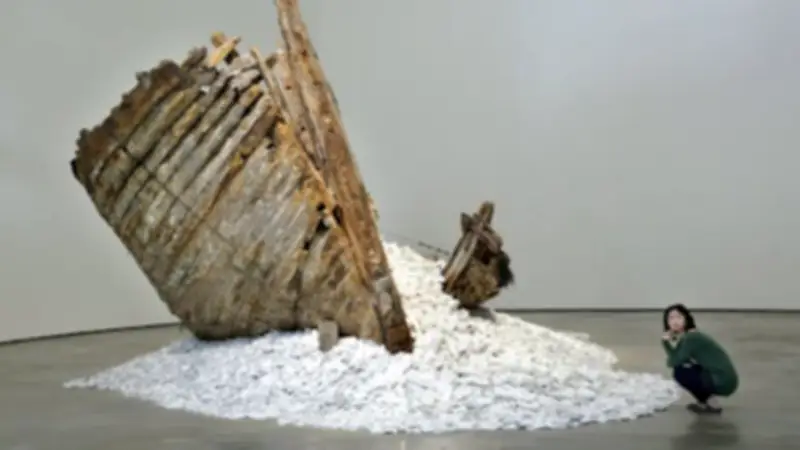
With local volunteers, Cai salvaged timbers from the ship to create five works over a decade. In Kaikou – The Keel (1994) and Reflection – A Gift from Iwaki (2004), he installed the skeletal hull in museums, embedding it in nine tons of sea salt for Kaikou and white porcelain figurines of Guanyin for Reflection. For The Orient (1995) and other works, he built makeshift pagoda-like structures from salvaged wood, later stacking them for display at the Museum of Contemporary Art, Tokyo, and suspending them like a missile at the 47th Venice Biennale. The wreck gained new life as a vehicle for exploring place, identity, geopolitics, trade, and ecology.
Born Again Through Ethics
In adaptive reuse artworks, discarded objects are reborn through ethical motivation, not just aesthetics. Albert reclaims stereotyped kitsch to expose racial prejudice, Eriksmoen transforms hard rubbish into surprising beauty, Goffman highlights plastic pollution, and Cai raises cultural and ecological questions. These artists show that recycling can provoke new awareness and inspire change.