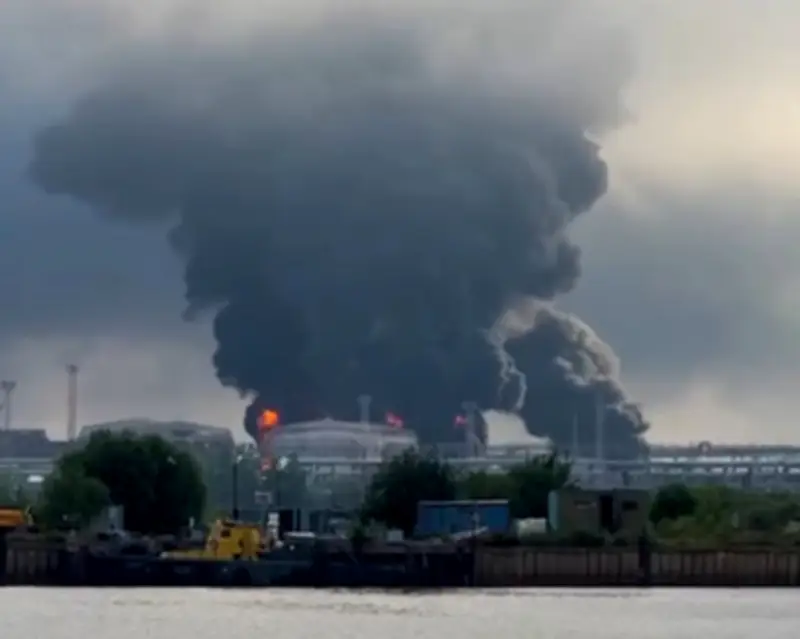
Ukrainian drones hit an oil terminal in St Petersburg and a nearby port early on Saturday, causing a large fire and disrupting operations, Russian officials said. The attack targeted the Ust-Luga oil terminal, about 110 kilometers west of St Petersburg, and the port of Bronka, according to the Russian Defense Ministry. The strikes mark a significant escalation in Ukraine's ability to hit targets deep inside Russian territory.
Details of the Attack
The Russian Defense Ministry reported that air defense systems intercepted several drones over the Leningrad region, but some reached their targets. The Ust-Luga terminal, a key export hub for oil and gas products, was set ablaze, with flames visible for kilometers. The port of Bronka, a major container terminal, also sustained damage, though no casualties were reported. Local authorities declared a state of emergency in the affected areas.
Impact on Energy Infrastructure
The attack on Ust-Luga is particularly significant as it handles about 40% of Russia's oil exports to Europe, according to energy analysts. The terminal's operator, Novatek, confirmed that operations were suspended indefinitely. This disruption could further tighten global energy markets, which have already been strained by sanctions and geopolitical tensions. Russian officials condemned the strike as a "terrorist act" and vowed retaliation.

Ukraine's Strategic Shift
Ukrainian officials have increasingly targeted Russian energy infrastructure in recent months, aiming to reduce Moscow's revenue from oil and gas sales. President Volodymyr Zelenskyy stated that such attacks are part of a broader strategy to weaken Russia's war effort. "Every ton of oil that does not reach the Russian budget is a step towards our victory," he said in a televised address. The strikes also demonstrate Ukraine's growing drone capabilities, with long-range models capable of reaching targets over 1,000 kilometers away.
International Reactions
The United States and European Union have not officially commented on the attack, but analysts suggest it could complicate diplomatic efforts to de-escalate the conflict. Russia has called for an emergency UN Security Council meeting to discuss the incident. Meanwhile, oil prices rose by 2% in early trading on concerns about supply disruptions. The attack also raises questions about the security of critical infrastructure in Russia's economic heartland.
Local Response and Aftermath
Emergency services in the Leningrad region worked to contain the fire at the oil terminal, with over 200 firefighters deployed. The blaze was brought under control after several hours, but the terminal remains closed for assessment. Residents of nearby towns reported hearing explosions and seeing a large plume of smoke. Local officials urged calm and assured that there was no threat to public health from the fire.
Broader Implications
The strike on St Petersburg, Russia's second-largest city, represents a psychological blow to the Kremlin. It shows that no part of Russia is safe from Ukrainian attacks, challenging the narrative of a secure homeland. Military experts say Ukraine is likely to continue such operations to disrupt Russian logistics and morale. The attack also highlights the vulnerability of Russia's energy infrastructure, which is crucial for funding the war in Ukraine.