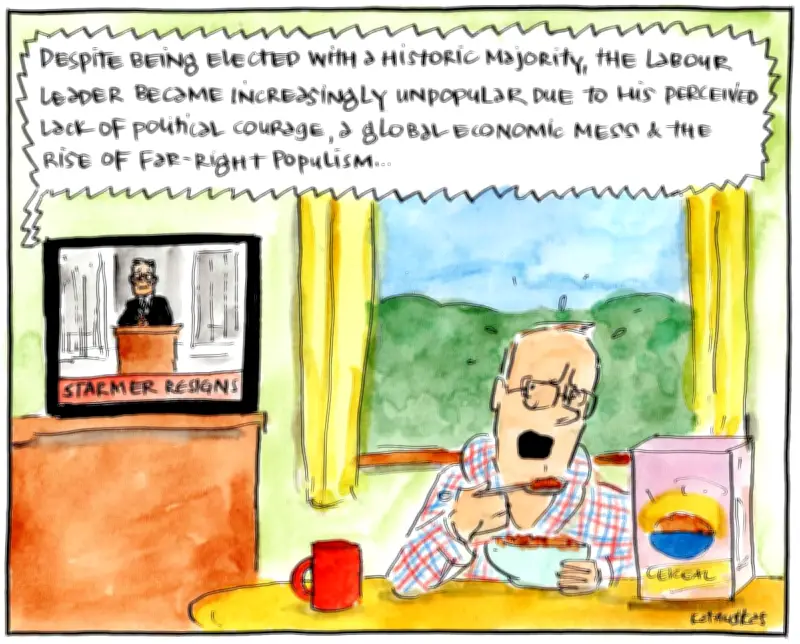
A new political cartoon draws an unexpected parallel between two leaders on opposite sides of the world: UK Labour Party leader Keir Starmer and Australian Prime Minister Anthony Albanese. The artwork, published in a prominent commentary section, suggests that both men share a common predicament: navigating the treacherous waters of centrist politics while trying to satisfy their party’s progressive base.
The Cartoon’s Core Message
The visual depiction shows Starmer and Albanese in strikingly similar poses, each grappling with the challenge of maintaining party unity. The cartoonist implies that both leaders are caught between the demands of their left-wing supporters and the need to appeal to moderate swing voters. This balancing act is a theme that resonates in both the UK and Australian political landscapes.
According to the cartoon’s accompanying commentary, the comparison is not merely superficial. Both Starmer and Albanese have been criticised by some within their own parties for being too cautious or too willing to compromise on key policies. At the same time, they face relentless attacks from conservative opponents who paint them as too left-wing.

Parallels in Political Strategy
Starmer, who became Labour leader in 2020, has worked to reposition the party after its heavy defeat in the 2019 general election. He has sought to distance himself from the more radical elements of his predecessor Jeremy Corbyn’s tenure, focusing on fiscal responsibility and national security. Similarly, Albanese, who took office in 2022, has emphasised economic management and social cohesion, often taking a pragmatic approach to issues like climate change and energy policy.
Both leaders have also faced internal rebellions. In the UK, Starmer has dealt with dissent over his handling of the Israel-Hamas conflict and his stance on workers’ rights. In Australia, Albanese has navigated tensions within the Labor Party over housing policy and Indigenous recognition. The cartoon suggests that these struggles are not unique but rather emblematic of a broader trend in Western democracies where centrist leaders are increasingly squeezed.
Public Perception and Media Portrayal
The cartoon’s publication has sparked discussion on social media, with some commentators arguing that the comparison is apt. One user noted, “Both are trying to hold together coalitions that are inherently fragile. It’s a thankless job.” Others, however, have pushed back, claiming that the differences between the two leaders are more significant than the similarities.
Despite the debate, the cartoon serves as a reminder that political leadership often involves uncomfortable compromises. As one political analyst put it, “Starmer and Albanese are both products of their parties’ internal dynamics, and their fates will depend on how well they can manage those dynamics while winning over the broader electorate.”
Broader Implications for the Left
The cartoon also raises questions about the future of centre-left politics. In both the UK and Australia, Labour parties have historically relied on a broad coalition of working-class voters, progressives, and moderates. Maintaining that coalition has become more difficult in an era of polarisation and populism. The cartoon implies that Starmer and Albanese are emblematic of this challenge, and their success—or failure—could have lasting implications for their respective countries.
As the next general elections approach in both nations, the pressure on these leaders will only intensify. Whether they can defy the odds and forge a new path for the centre-left remains to be seen. But for now, the cartoon offers a wry commentary on the shared burdens of political leadership.