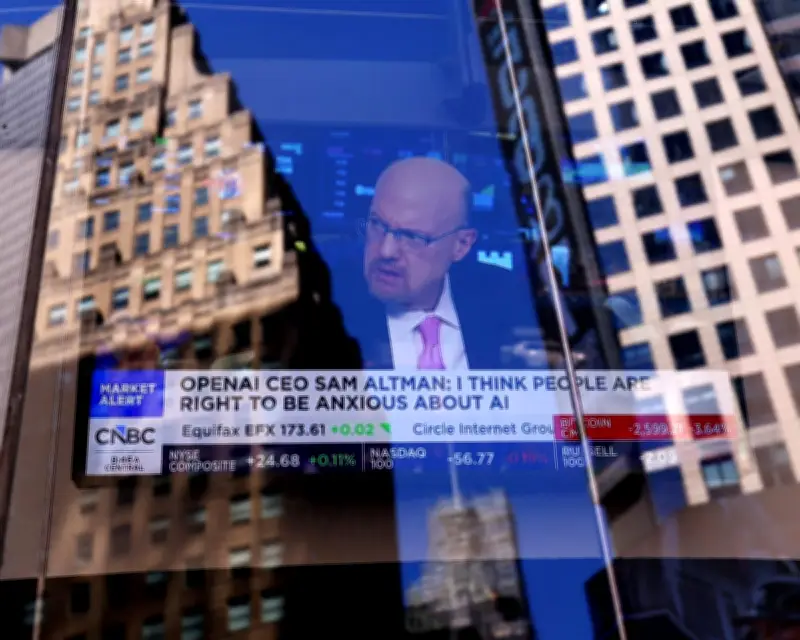
A year is a long time in the world of artificial intelligence. Just 12 months ago, OpenAI CEO Sam Altman was predicting that his company would build a super intelligence and fundamentally reshape society. Now, the head of the ChatGPT developer is walking back those ambitious ideas after failing to generate profits from advertisements and erotic chatbots.
Meanwhile, competitors are surging ahead with expansion plans and public listings on the stock market, in what is widely anticipated to be a season of record-breaking initial public offerings (IPOs). Elon Musk's SpaceX, which owns the AI firm xAI, is set to go public this month, while Anthropic confidentially filed for an IPO on Monday, with the New York Times describing it as a potential "once-in-a-generation" moment for Wall Street. The AI chip designer and Google's parent company, Alphabet, is raising $80 billion to fund a larger AI infrastructure buildout, which analysts call the largest equity fundraising ever.
The Numbers Behind the AI Economy
These flotations—and OpenAI's, if it proceeds—will reveal much about the ambitions and current state of the AI economy. The figures involved are staggering; there is already discussion about whether these IPOs might strain limited pools of capital. Questions linger over the progress of AI infrastructure development and the extent to which AI tools can replace human labor. Some of the biggest uncertainties surround OpenAI, once considered the "poster child" of the AI boom.

Back in early 2025, one might have been forgiven for thinking that money—or at least the question of profit—wasn't everything to Altman. The OpenAI CEO was blogging about creating "science fiction" tools that could "massively accelerate scientific discovery" and "massively increase abundance." US Vice President JD Vance was reportedly among those reading with concern the doomsday scenario AI 2027, which envisions a company loosely modeled on OpenAI building a super intelligence that destroys humanity.
Vast sums chased these visions of ultimate power; OpenAI announced a $500 billion investment into US AI infrastructure, named Stargate, "to secure American leadership in AI." For good measure, it also announced a less expensive Stargate in the UK, which it shelved in April this year. However, in 2026, it turns out that money is crucial—and OpenAI needs more. It may not be the best time to float, but there might not be a better one.
Monetization Challenges and Financial Realities
The basic facts of the business have not changed over the past year, even if belief in the "machine god" has tempered. This winter, OpenAI successively announced—then failed to execute—several strategies to monetize ChatGPT, including advertisements, which Altman had earlier called a "uniquely unsettling" proposition and a "last resort." Meanwhile, after teasing the idea of erotic chatbots in late 2025, OpenAI backed out in March, stating that its other work was a "higher priority."
According to The Information, OpenAI generated $5.7 billion in revenue in the first quarter of this year, but with adjusted negative margins of -122%, meaning it lost $1.22 for every dollar spent. These numbers are impossible to confirm, as OpenAI does not release financial details, but they underscore a fundamental truth of the AI economy: the computing power that makes ChatGPT possible is expensive and is not getting cheaper with scale.
Can OpenAI—valued at $852 billion in its last funding round—mount a successful IPO? What happens if it all goes sideways? "Until we see the numbers, it's very difficult for us to assess the valuation," says Russ Mould, investment director at AJ Bell. "We need to know what the projected market cap might be, what the revenues are... what cashflow looks like."
Shifting Tone and Strategy
In some ways, OpenAI is acting like a mature, IPO-ready business, says Adrian Cox, a Thematic Strategist at the Deutsche Bank Research Institute. At an event earlier this month in Australia, Altman struck a sharply different note about AI-related job loss than he did a year ago, saying he didn't expect a "jobs apocalypse." Last year, he had stated that people would "find new things to do, new ways to be useful to each other" following AI-related social change.

"The demands of a public company are very different from a private company, and the transparency required in going public has caused not only a change in strategy but also a change in tone around the company," says Cox. "The company is clearly engaging in an important shift as it positions itself as the kind of mature company you would expect to go public."
There are caveats, however, including reported clashes between OpenAI's CFO, Sarah Friar, and Altman over the timeline to go public. Friar has reportedly expressed doubts that OpenAI is ready to go public this year and reservations about whether it can cover its computing costs.
The Race to Market
The question is, can it afford not to go public? "This feels like the year for mega AI IPOs," says Cox. "The demand seems to be there from retail investors. The demand is also there from users for AI." There could be consequences if it does not act. The market is at record highs, having weathered Iran-related wobbles earlier this year. There is only so much capital available to share with others planning to go public, such as Anthropic—which last week overtook OpenAI with a valuation of $965 billion—and SpaceX.
"Some might say there is only a finite amount of financing to go around; there may be a downside to waiting under those circumstances," says Cox. Mould adds: "You've got a market with enormous potential with a lot of very big people jockeying for position. We don't know who's going to win. They can't all be valued as winners in the long run."
What happens if OpenAI's stock is a flop? For some, including Gary Marcus, noted AI critic and professor at New York University, it could signal the start of something bigger: cracks in the "fantastical thinking" that undergirds its business model—and that of its rivals—and potential knock-on effects for the broader economy if it were to slide. A wide range of people might be exposed to this. Significantly, US indexes including the S&P 500 and the Nasdaq are considering changing their rules—or have already changed them—around including newly floated companies on their indexes. This could lead to ordinary investors being more exposed to OpenAI's fortunes.
Then again, Facebook's IPO was also a flop, and it is now worth more than $1.5 trillion. The market has changed, says Cox—OpenAI is no longer the symbol of the AI boom the way it was even a year ago. Its fortunes are not necessarily a sign of how AI is going generally. "There has been a diversifying of the AI narrative over the past couple of years," Cox adds. "So any one IPO is probably less likely to be taken as a bellwether for the entire industry than it would have been before."
OpenAI declined to comment.