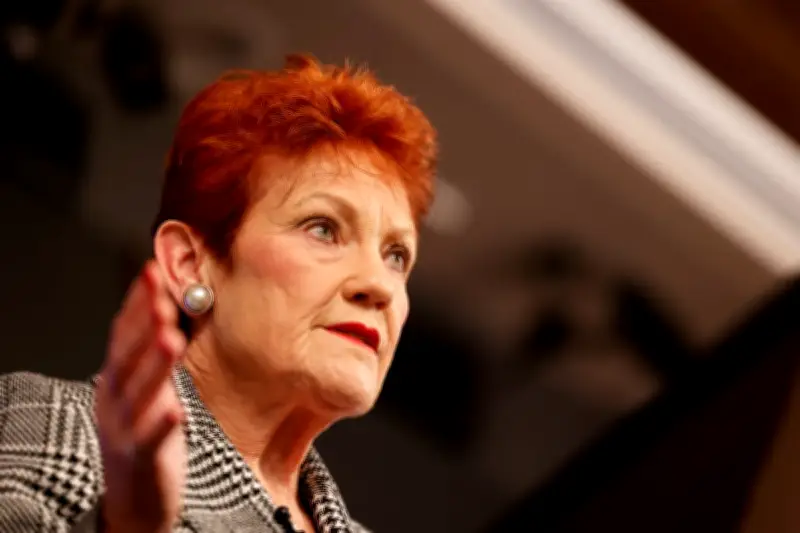
One Nation leader Pauline Hanson's recent proposals on paid parental leave and childcare have drawn sharp criticism from economists, who warn they could set women back decades, damage productivity, and exacerbate gender inequality.
Hanson's Controversial Address
In a speech at the National Press Club on Wednesday, Hanson suggested that women should not receive pay from employers while on maternity leave, arguing that businesses should not bear the cost when women are not working. She also called for family income splitting and major reforms to the childcare system, including directing government funds directly to parents rather than childcare providers.
“If women take time off and they are not paid their wages because they’re not working, fair enough. Why should business pay? But they’re not at work. That’s the difference. That’s why the pay gap is there,” Hanson said.

Economic Backlash
Leonora Risse, an associate professor in economics at Queensland University of Technology, said questioning such policies would reverse decades of progress for women. “It isn’t just the financial implications for women, it is also setting women back in terms of decision-making, having financial independence, having a say, having status and respect in society,” she said.
Risse emphasized that competitive paid parental leave helps women remain in the workforce, improving productivity. “If women can sustain their involvement and their attachment to the workforce and to their employer during their child-bearing years, that’s positive for productivity because it maintains a good job match,” she said.
Income Splitting Proposal
Hanson also pushed for income splitting for families with dependent children, which would allow couples to combine their incomes and split the total, subjecting it to two tax-free thresholds. The policy, already in place in countries like France, is intended to encourage one parent to stay home. One Nation's website states it will “encourage parents to look after their own children, and reduce the cost to the government of childcare, especially pre-school.”
Independent economist Silvia Griselda warned that such policies could lead to skills shortages and increased immigration. “Women, on average, tend to be more educated than men, so if you’re asking half of the workforce to not work … it means that we are kind of limiting the growth and the productivity of the Australian economy,” she said.
Childcare Overhaul
Hanson called for an overhaul of the childcare system, which costs about $16 billion annually. She described the system as “completely out of control” and advocated for direct payments to parents rather than providers. “I was a mother of four children. I didn’t have a university degree to look after my children. Why do we now expect these childcare centres to have students or people with some sort of degree to look after a child?” she said.
Caroline Croser-Barlow, CEO of The Front Project, countered that high-quality childcare is essential for working parents. “We have an economy that expects two parents to work and then say we’re not willing to invest in high-quality safe environments for your child,” she said. She warned that paying parents directly carried a “very high fraud risk” and could compromise quality and safety.
Broader Implications
Griselda concluded that the combined policies would harm households and the economy. “Her point is we don’t like to pay tax, that we should reduce the tax, that’s why we shouldn’t pay for parental leave or childcare. Let’s let the mother stay home. This in the long run, or even in the short run, will definitely limit the economy.”