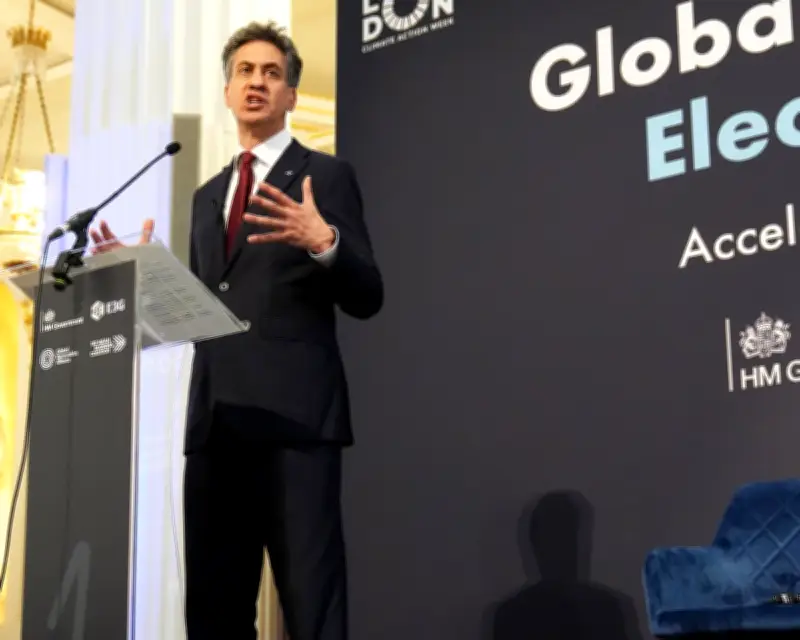
Progressive economists have strongly rejected criticism of Ed Miliband from Unite leader Sharon Graham, defending the Labour frontbencher's green industrial plans as vital for both climate action and job creation.
Graham's attack on Miliband
Earlier this week, Graham accused Miliband, the shadow climate change and net zero secretary, of pursuing an "ideological" approach to green policy that would cost jobs in traditional industries. She argued that the transition to net zero must prioritise protecting existing jobs over aggressive decarbonisation targets.
In a speech to Unite's executive council, Graham said Miliband's plans risked repeating the mistakes of past industrial closures, leaving workers behind. She called for a more pragmatic approach that would not alienate workers in oil, gas, and manufacturing sectors.

Economists push back
However, a group of 12 leading progressive economists, including Ann Pettifor and Danny Blanchflower, have issued a joint statement rejecting Graham's characterisation. They argue that Miliband's green transition plan is not only environmentally necessary but also economically sound, creating hundreds of thousands of well-paid jobs in renewable energy, retrofitting, and public transport.
"The idea that Miliband's green plans are ideological is itself ideological," the statement reads. "The real ideology is the assumption that we must cling to fossil fuels and outdated industries to protect jobs, when in fact the transition can be a huge opportunity for workers."
The economists point to independent analysis showing that Labour's green prosperity plan could create over 1 million jobs by 2030, with a focus on unionised, secure employment. They also highlight that failure to act on climate change would cause far greater economic damage.
Miliband's response
Miliband has so far declined to engage directly with Graham's criticism, but allies insist his approach is built on social partnership and a just transition. A Labour source said: "Ed is absolutely committed to ensuring that workers are at the heart of the green transition, with guarantees on jobs, training, and wages."
The row comes as Labour attempts to balance its climate ambitions with the need to retain support from union affiliates like Unite, which remains a key donor and campaign partner. Graham's stance reflects a growing tension within the union movement over the pace of decarbonisation.
Impact on Labour unity
The public split has alarmed some Labour MPs, who fear it could undermine the party's electoral appeal on economic competence. However, the economists' intervention is seen as a boost for Miliband, reinforcing the message that his policies are backed by credible experts.
"We cannot afford to delay climate action," said Ann Pettifor, director of the Policy Research in Macroeconomics (PRIME) centre. "The transition is coming, whether we like it or not. The question is whether we manage it in a way that benefits working people or leaves them behind."
Pettifor added that Miliband's plan includes specific measures to support workers in transitioning industries, such as retraining programmes, wage guarantees, and early retirement options for those nearing the end of their careers.
Unite's position
Unite has not commented on the economists' statement, but Graham is expected to continue pressing her case at the TUC congress later this year. The union represents workers in oil and gas, automotive, and manufacturing, many of whom fear for their jobs in the green transition.
Graham has previously called for a "managed transition" that would see fossil fuel production phased out only when alternative jobs are available. She has also criticised Labour for not doing enough to support workers in carbon-intensive industries.
The debate highlights the challenge facing Labour as it seeks to present a credible climate policy while maintaining the support of its union base. With an election expected within the next 18 months, the party cannot afford a prolonged internal battle.