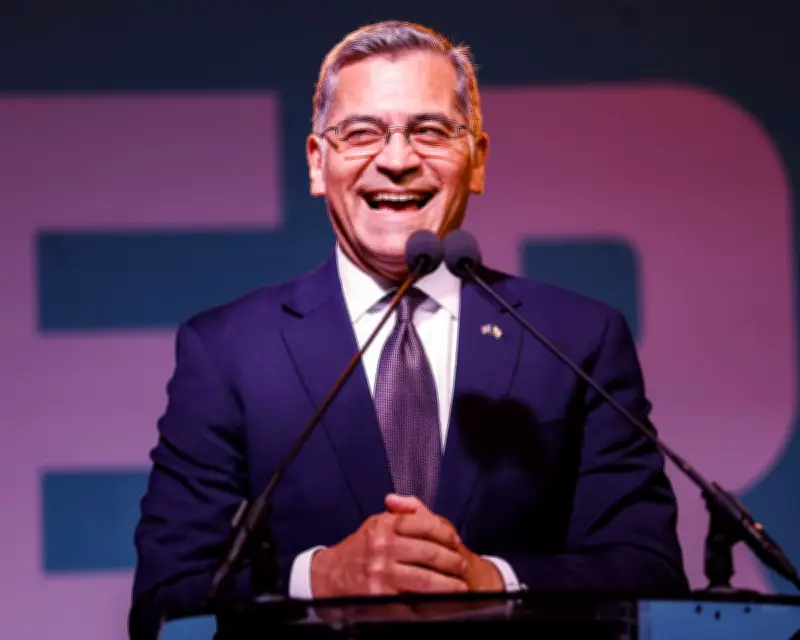
Xavier Becerra, the former Biden cabinet official whose California gubernatorial campaign survived a deeply underwhelming start, has advanced to the general election in a stunning reversal of political fortune.
If he prevails in November, Becerra would make history as the state's first Latino governor since 1875, when California was briefly led by Romualdo Pacheco, who was born in the territory when it was still part of Mexico.
Becerra, born in Sacramento to a Mexican immigrant family, rose from the California state legislature to Congress, where he served from 1993 to 2017, to attorney general of California, taking the place of Kamala Harris when she was elected to the US Senate. He departed that role in 2021, when he was tapped by then president Joe Biden to be the health and human services secretary.

Despite his government bona fides, Becerra floundered at the start of the race to succeed the term-limited Gavin Newsom as California governor. His polling hovered around 3% in late March, and he lagged far behind three Democrats and two Republicans in the non-partisan primary.
Since Donald Trump's return to the White House, Democrats had moved to quickly turn the page on the Biden years. Many voters gravitated toward leaders willing to brawl on the president's level, like Newsom. The party has sought anti-establishment outsiders and younger-generation challengers. Becerra, a mild-mannered 68-year-old political veteran, seemed hardly a match.
There was a particular anti-Trump buzz in California after the passage of Proposition 50, a Newsom-led redistricting plan meant to blunt Republican gerrymandering in Texas, said Christian Grose, a University of Southern California political science professor.
The crowded Democratic field had also stoked concern that the party vote would be so splintered that the two Republican candidates could finish first and second in the primary, locking Democrats out of the general election top-two runoff. In March, Rusty Hicks, the chair of the California Democratic party, urged candidates without a viable path to drop out.
Becerra's bid was dealt a blow when he failed to qualify for a planned March debate at USC. Six candidates were invited, based on a mathematical viability formula, but the forum was nixed after blowback that it would feature no candidates of color.
His odds changed when the race was jolted in April by a slew of sexual misconduct and assault allegations against Eric Swalwell, who denied the allegations but withdrew his bid and resigned from Congress. Becerra surged to the top of polls in the vacuum left by Swalwell.
On the campaign trail, Becerra's speeches have often been interspersed with anecdotes about being the son of Mexican immigrants. He has linked his personal history to the current moment, as the Trump administration wages a mass deportation campaign targeting undocumented Latinos.
About 37% of Latino voters said they would vote for Becerra, according to a poll conducted just before this week's primary by professors at three California universities.
Becerra supporters from other California communities also mentioned his working-class appeal. Dwayne Murphy, a 35-year-old Irvine resident, told the Guardian he cast a ballot for Becerra after initially considering Tom Steyer.
As California's slow vote-counting process remains underway, with an estimated 3 million ballots still to be counted, it remains unclear whether Becerra will face Republican Steve Hilton or Democrat Tom Steyer in the general election.