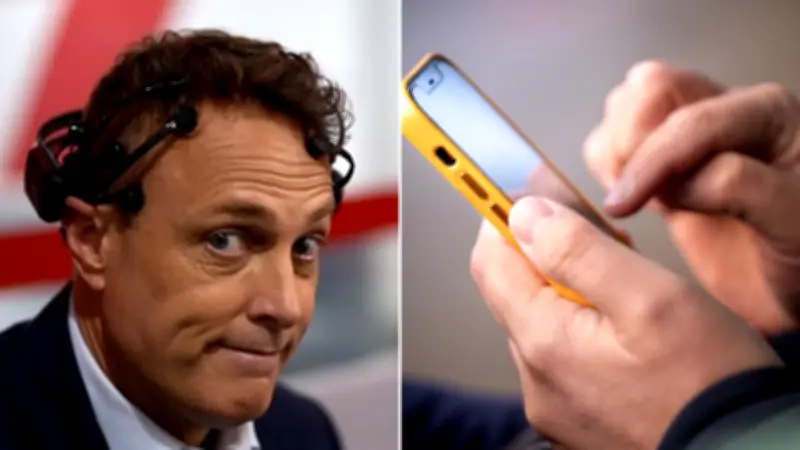
On Monday, Sunrise presenter Matt “Shirvo” Shirvington handed over his smartphone and swapped it for an old-school flip phone.
Five days later, a neuroscientist said the experiment delivered measurable changes to his brain activity and sleep patterns, with EEG scans showing he was able to reach a calm, relaxed state far more easily than before.
WATCH THE VIDEO ABOVE: Brain scans reveal surprising smartphone detox results

Know the news with the 7NEWS app: Download today
The week-long challenge was designed to examine what effect giving up a smartphone would have on Shirvington’s mind and overall wellbeing, with neuroscientist Dr Mark Williams monitoring the results through surveys and brain scans.
According to Williams, a major improvement was in Shirvington’s sleep.
“One of the biggest changes was that his sleep seemed to be better,” Williams said. “Because he wasn’t checking his phone just before he went to sleep, he was actually getting into a better sleep rhythm, and he was dreaming.”
Before the challenge, Williams said Shirvington struggled to produce alpha brain waves, which are associated with calmness and relaxation.
“We had to take him through a whole meditation and breathing exercise to actually get that alpha up. He wasn’t calm at all,” Williams explained.
Brain scans revealed dramatic changes after Matt ‘Shirvo’ Shirvington gave up his smartphone for a week. Credit: Sunrise/AAP
Be the first to know: Add 7NEWS as your preferred news source on Google
After a week without a smartphone, however, the difference was significant.
“Yesterday, that happened really, really quickly. He went straight into a lot of alpha activity, which is really, really cool,” he said.
Despite the positive findings, Shirvington admitted the challenge was not without its difficulties.
“I’ve definitely been flat this week,” he said. “The world around us is set up for the convenience of having a phone because so much of that technical evolution is being forced onto that singular device.”
Shirvington also admitted he exercised less during the week because he no longer had easy access to music.
“I think it’s definitely a motivator for me, is to know that I can put my headphones on and just focus on it,” he said.
Williams said the experiment was not about abandoning smartphones entirely but using them more deliberately.
“We do need the phones these days, and they are an amazing technology,” he said. “But having boundaries around them when we use them, when we’re sitting at dinner or at breakfast with our family, don’t have the phones around so we can actually interact with each other.”
Following the challenge, Shirvington said he plans to introduce regular phone-free family dinners as a way of maintaining some of the benefits he experienced during the week.
Stream free on