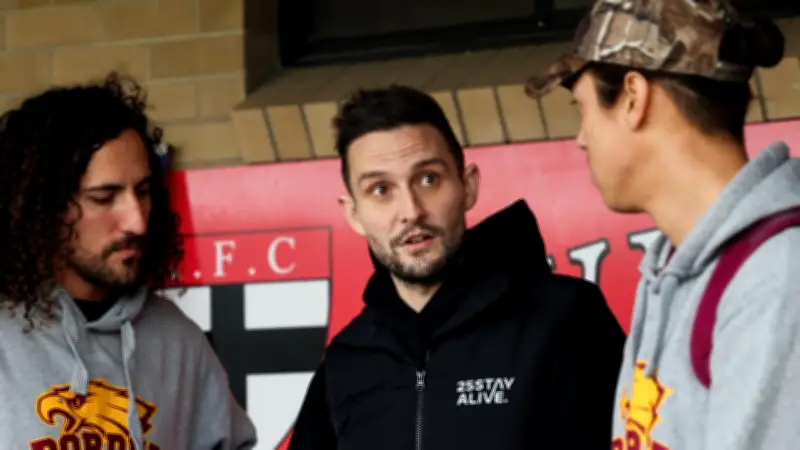
An award-winning Australian mental health campaigner sees a turning tide of men able to open up about their struggles. Charity founder Hugo Toovey says fears about the ‘manosphere’ create a complicated blame game.
“It’s interesting when you get different buzzwords or topical conversations. I think that it’s a really good thing and it puts it on the agenda of conversation,” Mr Toovey told NewsWire. “Yes, the manosphere has got something absolutely right; it’s that men are struggling. Seven blokes every day in Australia take their life. This is a real problem.”
“I think men don’t need more anger as an outlet. Men are losing what their version of purpose is; whether it’s being that really great, present father or finding purpose for work and why you wake up each day,” he said.

Despite beginning his health crusade talking about physical health after multiple cancer diagnoses in his 20s, in 2025 Mr Toovey was awarded a national Australian Mental Health Prize, after his campaign work naturally pulled in mental health aspects alongside physical health.
This year’s awards, organised by the University of NSW, the Black Dog Institute and Neuroscience Research Australia, are now open for nominations. Neuroscience Research Australia chief executive Matthew Kiernan said the 2025 award winners covered “grassroots campaigns to bring dignity to those suffering mental ill-health, to decades of national advocacy – as well as the vital area of Indigenous mental health.”
“The Australian Mental Health Prize plays such an important role in highlighting both the toll of mental health on society and the efforts of amazing individuals to alleviate it,” Professor Kiernan said.
Mr Toovey credits the award in helping him speak to more Australians across the country, and he has plenty of emotional examples to share. Speaking with NewsWire, Mr Toovey tells of a seminar he ran with night shift construction workers a few years ago. In the room was a hulking tradie; neck tattoos, shaved head, who was intensely staring at this mental health speaker who popped in during night shift. “I kept bringing my eyes back and we’re making eye contact and I thought ‘Jesus this guy’s just death-staring me.”
Mr Toovey pushed on. At the end a few workers came up and thanked him, shook hands, said they enjoyed it but went and cracked on with their shift. Then the tattooed figure walked up. “This guy came up to me, he had sort of glassy eyes and said ‘mate can I give you a hug?’ I said ‘of course’.” “I just saw his face and his eyes and you could tell he was fighting back tears almost. He said thanks for just sharing that in such a real way.” The worker told Mr Toovey about ongoing custody issues, not seeing his young daughter, and the mental health strain. “He tried to communicate this in his way. And I could tell that he hadn’t really properly shared it with anyone before. And he was just, he was trying to share.”
Just this week, Mr Toovey went and spoke at his former high school in Adelaide. One of the young men took heed of the message and texted his mate during the seminar to check in. “I saw him and he kept looking at his phone. I said, ‘do you want to share what the response was?’” “The response was three missed calls from that mate because he was actually checking in to say is everything OK? That is beautiful. That’s what we need more of.”
This year’s UNSW Australian Mental Health Prize awards are now a joint venture with the all-ages mental health researcher Black Dog Institute, and Neuroscience Research Australia. Chair of the Advisory Group for the Australian Mental Health Prize, University of Sydney Adjunct Professor Sophie Scott said having the three organisations brought together expertise in research, clinical care and advocacy. “Many dedicated Australians work tirelessly to improve mental health, and the Australian Mental Health Prize is an important way of acknowledging their contributions,” Professor Scott said. “This new partnership brings together leading expertise in research, clinical care and advocacy, strengthening the prize’s ability to recognise Australians creating meaningful change in mental health.”

A group of 10 school mates from Canberra are one such advocacy collective using their brush with acute mental health to try and make change. Barely a few years out of high school, in December 2022 their friend Connor Hogan took his own life four years after being diagnosed with schizophrenia. The tight group of friends from Karabar High School have since raised $126,000 for schizophrenia research at Neuroscience Research Australia. With an annual weekend of physical challenges and awareness-raising, Connor’s friends hope to get more people of similar ages checking in on each other.
Luke Bradley says when his friend was diagnosed with schizophrenia, their group saw him change but they didn’t know how to help. “There’s nothing that we could say or do that would fix the situation,” Mr Bradley told NewsWire. “But just being there as a support network is probably more important in that situation; it’s medication that treats schizophrenia, but he just needed mates. It’s definitely a big eye-opening experience.” The friend group saw Connor losing his spark, bailing on plans last minute, falling out of love with sport and music, but they weren’t sure if that was the start of adulthood or something more sinister.
Now every weekend in May they put on a series of physical challenges to raise money for the research, sell some merch and a pub in Canberra donates a portion of the takings from the after drinks. Growing over the years, at the last edition about 250 people did the 5km walk or 10km run. The group of 10 mates use the weekend to have a “genuine” check in with each other, and the sentiment has sparked far more regular calls and messages throughout the year. Connor’s parents Carolyn and Rob are supportive. “I actually had a pretty good chat to Carolyn about it this year. She said it’s very bittersweet,” Mr Bradley said. “I think it was the first or the second year, she said she thought people were just going to forget about Connor straight away.”
The Neuroscience Research Australia researchers have been sending videos for the attendees to watch at the pub. “One of the things they’ve found this year was, they’ve now found a link towards a thing called oligodendrocytes … So they’re getting more of the piece of the story,” Mr Bradley said. “Heading in the right direction.”