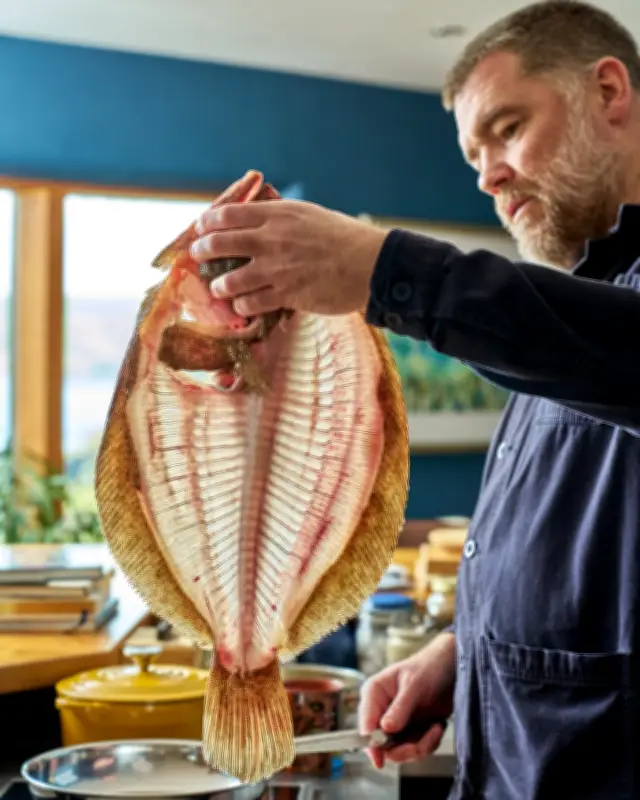
More than two decades after winning his first Michelin star, Cornwall-based chef Nathan Outlaw is returning to his roots with simple, unfussy seafood cooking. In an interview, he explains why he prefers straightforward techniques and shares his recipe for steamed brill with pea, shallot and cider stew.
From Michelin Star to Bistro Cooking
Outlaw opened the Black Pig in Rock, Cornwall, 23 years ago at age 25, against everyone's advice. He already had a great job at the Vineyard in Stockcross, Berkshire, his wife Rachel was eight-and-a-half months pregnant, and he had won prestigious young chef awards. But he wanted his own place with a simple menu, 'bistro cooking.' 'That's why I became a chef,' he says. 'I loved cooking, my dad's a good canteen chef... I loved the physical aspect, standing up doing something. I loved the way there's a lot of team work. I didn't know anything about Michelin stars or being famous.' Despite his modest ambitions, he earned his first Michelin star the year after opening.
Following that, Outlaw became a name in fine dining and television, with two eponymous restaurants at the St Enodoc hotel in Rock, appearances on Great British Menu and Saturday Kitchen, and a foothold in Mayfair with Outlaw's at the Capital in the 2000s. He is known as a calm cook, never one for theatrics. 'My mum always said to me: you can't be the one that throws your weight around, you're too big,' he recalls.

Pioneering Curing Techniques
When Outlaw started, people only cured salmon—a fish he no longer uses due to difficulties finding decent farms (problems include overcrowding, bad feed, and lice). He began curing nearly all local catch with incredible precision, ensuring cuts were immaculately even for uniform curing. He would remove fish from brine of salt, sugar, and white wine every half hour to check progress. 'Now, people are using the technique for lots of different things. Probably because I've showed them how to do it,' he says modestly.
His new book, Nathan Outlaw on Fish, and his restaurant and B&B in Port Isaac mark a return to bistro sensibility. 'I was always worried about getting to this stage of my career and hating it. I don't enjoy the challenge of the industry,' he admits, referencing rising costs and pricing pressures. 'But in terms of the cooking, I probably enjoy it more than I ever have done. I get to teach a lot of guys, I get to work with great ingredients, and I've got enough good people around me that I don't need to do anything boring.'
Tips for Buying and Handling Fish
Outlaw advises never deciding what to cook before visiting the fishmonger. Adapt plans to what looks good, and always ask where the fish came from. If they don't know, they might not be reliable. He clarifies the smell test: 'An ozoney smell is like an oyster, or a really nice harbour, or the smell of the sea on a hot stone. You can smell that on good fish. Bad fish are a different kind of fishy, and what you're smelling is not the fish, it's the water it was caught in.'
Brill, a flatfish similar to turbot, is more delicate. 'Texturally, they're very different. With brill you can do raw and cured dishes, turbot you can't—it's very tough. Brill is a much more delicate fish,' Outlaw explains. Filleting requires a sharp, flexible knife because 'the bones are not straight, so you need to be able to flex around them. With a flatfish, just follow the line all the way from the head to the tail. Through the knife, in your hand, you should be able to feel the bone; if you can't, you're probably cutting into the flesh. Or you've gone through the bone.'
He recommends roasting fish bones before making stock, like chicken bones, for better flavour. 'A lot of traditional recipes are just boil the bones up—that's why it doesn't taste that great. If you roast the bones first... it's much tastier. You get a bit of caramelisation; you get a lot of flavour. Season it, add a little bit of olive oil, put it in the oven at about 180C/350F/(160C fan)/gas 4 for maybe 25 to 30 minutes. The most important thing is only to get a bit of colour in it—if it's singed, it'll bring a bit of bitterness.'

Simple Cooking Philosophy
Outlaw isn't 'one of these butter-and-baster chefs. I don't use a lot of dairy, apart from today—we're going to have a huge amount of clotted cream. But I'm always trying to get a natural flavour. The lemon and butter thing, it is tasty, but it's also a way of covering up fish that isn't fresh.' He uses a triple-layered stainless steel pan from Robert Welch, noting 'you've got to get it hot before you put the bacon in, otherwise it will stick.'
His goal is to make seafood accessible. 'Because I'm quite finicky myself, and I was so fussy when I was younger, I bear in mind what people don't like about fish, and try to make the seafood very accessible. Still to this day, if I was presented with a huge fruits de mer with loads of stuff on it... well, I'd eat it—but I'd find it quite daunting. And if you're starting from zero with fish and shellfish, you've got to accept there's going to be a little bit of trial and error. That's why you should start simple and work your way up. Once you get to the fancy stuff, you'll realise the simple stuff is better.'
Steamed Brill with Pea, Shallot and Cider Stew Recipe
Prep 20 min | Cook 50 min | Serves 4
Ingredients:
2 tsp fennel seeds
2 tsp sea salt
8 slices smoked streaky bacon or pancetta
2kg brill, filleted and portioned into 4 x 120g portions
2 tbsp olive oil
A drizzle of extra-virgin rapeseed oil, to finish
For the pea, shallot and cider stew:
50g unsalted butter
2 tbsp rapeseed oil
12 shallots, peeled and left whole
200ml dry cider
1 sprig of rosemary, finely chopped
300ml fish stock
200g fresh peas, podded
100g clotted cream (ideally Cornish)
1 tbsp chopped mint leaves
1 tbsp chopped flat-leaf parsley leaves
Sea salt and freshly ground black pepper, to taste
Method:
To make the stew, heat the butter and oil in a medium saucepan over a medium heat. When the butter is bubbling, add the shallots and gently let them colour all over, stirring occasionally, for 15–20 minutes. Don't cook them too quickly—if they start to colour fast, reduce the heat.
Once the shallots are well coloured, add the cider and rosemary and increase the heat to allow the cider to reduce quickly. When the cider has reduced by three-quarters, pour in the fish stock and simmer until reduced by half. Add the peas and simmer for a further 20 minutes.
Meanwhile, set up a large bamboo steamer or switch on the steamer oven. Crush the fennel seeds and sea salt together in a mortar and set aside. Cook the bacon until crisp under a hot grill or in a frying pan, then set aside.
Season the brill with two teaspoons of the fennel seed salt and drizzle with the olive oil. Put the fish on a sheet of baking parchment and steam for four to five minutes.
While the fish is cooking, add the clotted cream to the stew. Bring to a simmer and whisk it in, then add the chopped herbs. Taste and add salt and pepper as you like.
To finish, ladle the stew into bowls. Peel the skin away from the brill and sprinkle the flesh with one teaspoon of the fennel seed salt. Place the fish on top of each portion of stew and add two slices of crispy bacon to each bowl. Drizzle a little extra-virgin rapeseed oil over the fish and serve, either with new or mashed potatoes.
This recipe is an edited extract from Nathan Outlaw On Fish: A Seafood Handbook, published by Kyle Books at £30.