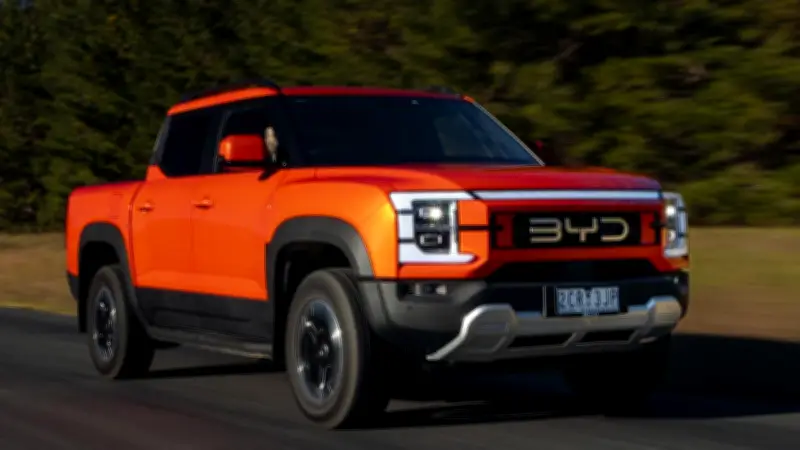
There is bad news for some of Australia's favourite utes. The Ford Ranger and Toyota HiLux may be mainstays at the top of the sales charts, but BYD is sneaking up behind them to become a serious player in the heartland of the Aussie automotive market. And it is thanks to an incredibly unorthodox ute, the Shark 6, which ditches the turbocharged diesel engines typically found in these workhorses in favour of a plug-in hybrid (PHEV) powertrain.
The combination of a small turbocharged petrol engine and electric motors means the Shark 6 has excellent performance (321kW of power and 650Nm of torque) but can also silently drive along on electric power alone and sips fuel at just 2.0L/100km. However, there was a flaw in the Chinese brand's cutting-edge technology, or rather there 'was' a flaw. The small, 1.5-litre turbocharged petrol engine was not strong enough to tow the industry-standard 3500kg. That meant people looking to tow a caravan, a boat or any other heavy equipment needed to look elsewhere. It was a very obvious problem for BYD, so they have fixed it.
New Performance and Cab Chassis Models
The new BYD Shark 6 Performance sits above the existing Shark 6 Premium and replaces the 1.5-litre engine with a new, bigger 2.0-litre unit. In addition, the electric motor on the front axle is more powerful, resulting in a PHEV powertrain that makes 350kW and 700Nm, which is enough to tow 3500kg. But that is not all BYD has done. There was another key ute market that the brand was missing out on: the working-class 'Cab Chassis' variants. These utes pitch the integrated 'bed' in the back in favour of either an aluminium 'tray' or any number of custom-made rear-end practical solutions. So BYD has added the Shark 6 Dynamic, a Cab Chassis model, which is still powered by the 1.5-litre version of the powertrain. This means BYD has tripled the trouble for its rivals.

Which is particularly bad news for Ford, which has struggled with its own PHEV ute, the Ranger Hybrid, and has slashed the price by more than $10,000 to compete with the Shark more closely, without offering a Cab Chassis variant either. The Shark 6 Performance is priced from $62,990 (plus on-road costs), which is $5000 more than the Shark 6 Premium, while the Dynamic Cab Chassis starts at $55,900 (plus on-road costs). For comparison, the Ranger Hybrid XL starts at $59,000 drive-away and the better-equipped Sport from $66,000 drive-away. That makes the Ford more competitive, but there is still a lot to do for the Blue Oval to close the sales gap to its Chinese rival in the PHEV ute contest.
Driving Impressions and Off-Road Improvements
So how do these new Sharks perform when put to the test? We were able to drive them across a number of conditions, including towing both a caravan and a small excavator, as well as on sealed roads and slippery surfaces. On the road the new Performance is pleasant to drive. BYD has also abandoned convention when it comes to suspension, ditching the more conventional leaf spring rear end (which is great for carrying lots of weight but not so good for ride comfort) for more SUV-like suspension that makes the drive more relaxing and enjoyable. However, this, combined with the electric motors on the front and rear axles instead of locking differentials, meant the Shark 6 also copped flak for its off-road performance. So BYD has added a new off-road setting for the car's complex computers.
Dubbed 'Crawl' mode, this new system activates between 0-12km/h and helps get over rocks, steep climbs, deep ruts and soft sand. Previously the Shark's traction control system could get confused in such situations and end up literally spinning its wheels. BYD Australia was deeply involved in both local towing testing and off-road development for the Crawl mode, and it shows. Pitting the Shark 6 against steep and slippery slopes at the Australian Automotive Research Centre outside of Geelong, where countless cars have been tested over the years, the updated models performed admirably. The Performance had little trouble scrambling up muddy, gravel-coated and deeply rutted inclines in a clear improvement over the previous Shark. BYD Australia executives are still hesitant to say it will tackle the toughest challenges, such as the infamous Beer O'Clock Hill in Queensland, but they are adamant it is now more capable of getting you off the beaten track, and back again.

Towing Capability
As for the towing, the caravan we pulled was only around 3000kg, but the Performance managed it with relatively little strain. Yes, you can feel the engine and motors working harder, but if you need to tow something large, the Shark 6 is also more capable. This is definitely bad news for the likes of Ford, Toyota, Isuzu, Nissan, Mitsubishi and the other brands hoping to sell more utes to Australians, because BYD has just made the Shark 6 more appealing to a wide array of potential customers.