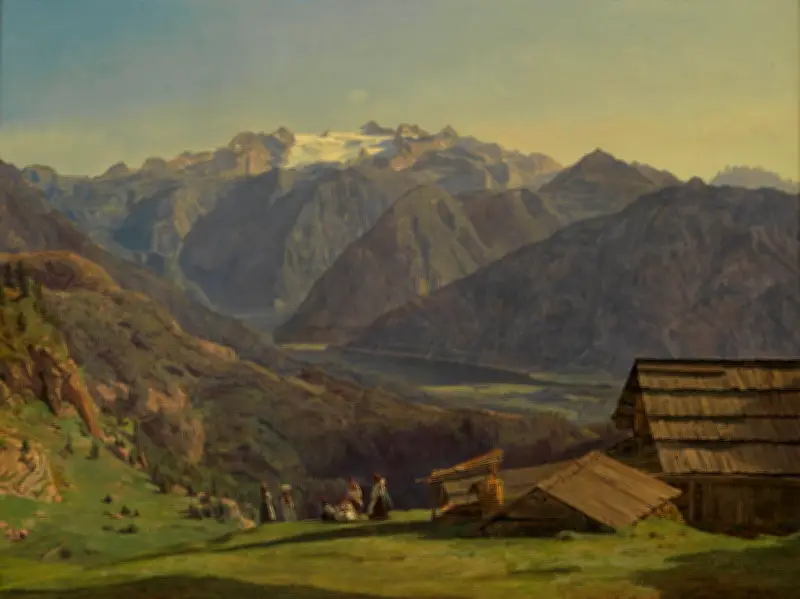
The exhibition of Ferdinand Georg Waldmüller's landscapes at the Belvedere in Vienna offers a captivating yet troubling glimpse into 19th-century Austrian society. While his paintings depict serene rural life and lush natural beauty, they also serve as a window into the bourgeois ideals and social tensions of the Biedermeier era.
The Artist's Vision
Waldmüller (1793-1865) was a master of light and detail, known for his idyllic depictions of the Austrian countryside. His works, such as The Prater Landscape and View of Mödling, showcase a world of order and harmony, where peasants labor contentedly and nature is bountiful. However, critics argue that these scenes were idealized to reinforce the values of the emerging middle class.
According to the exhibition curator, Dr. Sabine Grabner, 'Waldmüller's landscapes were not just representations of nature but reflections of a society that valued stability, hard work, and domestic bliss.' The show includes over 80 works, spanning his entire career.

Hidden Social Commentary
Beneath the surface, Waldmüller's paintings often hinted at the disparities of his time. For instance, The Harvest shows peasants toiling under a hot sun, while a well-dressed overseer watches from the shade. This subtle contrast underscores the class divisions that persisted despite the era's prosperity.
'Waldmüller was a keen observer of human behavior,' says art historian Dr. Michael Krapf. 'His landscapes are not just pretty pictures; they are documents of social hierarchy.' The exhibition highlights how his work appealed to a bourgeois audience that sought to legitimize its own status through art.
Technical Mastery
Waldmüller's technique was revolutionary for his time. He employed a meticulous approach to capturing light and shadow, often painting en plein air to achieve realism. His use of vibrant colors and precise brushwork made his landscapes stand out among his contemporaries.
One notable piece, Beech Forest in the Vienna Woods, demonstrates his ability to render dappled sunlight filtering through leaves. The painting's almost photographic quality drew praise from critics, with one 19th-century reviewer calling it 'a triumph of naturalism.'
Reception and Legacy
During his lifetime, Waldmüller enjoyed considerable success, particularly among the Viennese bourgeoisie. However, his work fell out of favor after his death, as modernist movements rejected his realism. It wasn't until the late 20th century that scholars rediscovered his significance.
Today, the exhibition at the Belvedere aims to reassess Waldmüller's place in art history. 'He was more than a mere landscape painter,' says Grabner. 'He captured the spirit of an age.' The show has drawn over 50,000 visitors since its opening, according to museum officials.
Critical Perspective
While the exhibition is visually stunning, some critics argue that it glosses over the darker aspects of Waldmüller's world. 'The curators present his work as charming and nostalgic, but they downplay the social inequalities he depicted,' writes art critic Julia Müller in Der Standard.
Nevertheless, the exhibition offers a rare opportunity to see a comprehensive collection of Waldmüller's landscapes. It runs until October 4, 2026, and includes guided tours and lectures that delve deeper into the historical context.