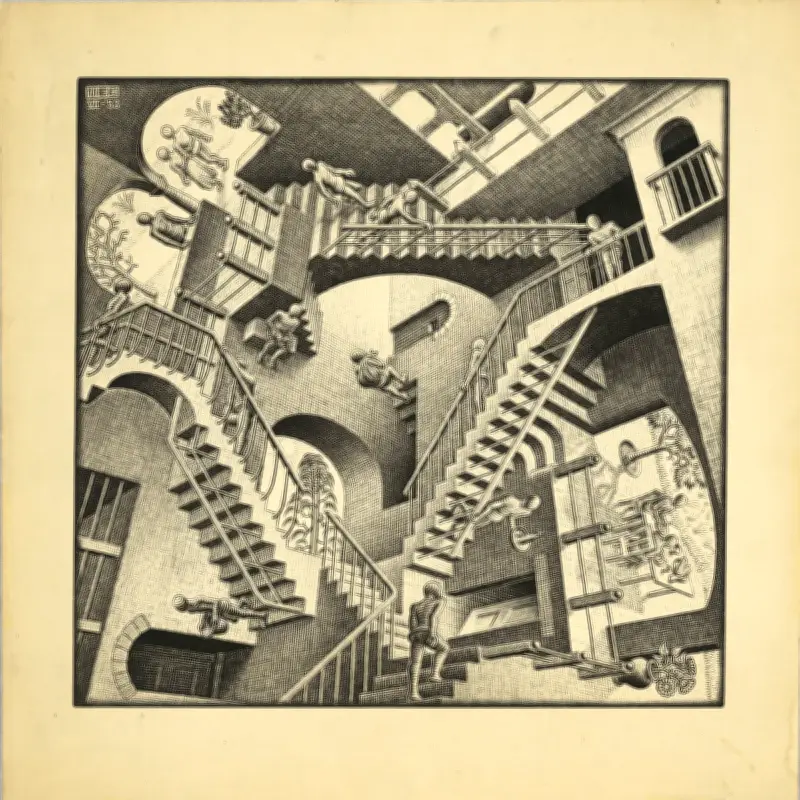
We think we know the world of Maurits Cornelis Escher with its mind-bending staircases and buildings that impossibly twist upon themselves. Yet a shocking glimpse of reality intrudes in Somerset House’s gripping journey through his metaverse. In 1945, Escher designed a diploma for students at a temporary academy in Eindhoven, recently liberated from Nazi rule. Behind a wise old owl in the foreground, twisting columns of black smoke rise from a riverside town, their evil sinuousness reflected in the water. The message of this depiction of war is not only that Escher was a civilised individual surviving a brutal age but also that his visual delights were never just fanciful. Even his wildest speculations reveal the workings of the world itself, grounded as they are in what Galileo called “the language of mathematics” in which “the book of nature is written”.
Impossible Geometries and Paradoxical Places
You don’t have to be fluent in that language to lose yourself in Escher’s art. You just need to look, and this exhibition lets you look so much more closely and deeply than you can in books and reproductions and imitations of his work. At times you feel you are actually inside his paradoxical places. I chuckled for ages in front of his 1958 lithograph Belvedere in which a king and queen survey a mountainous landscape in different directions from two storeys of a Renaissance building, but wait, they don’t just face different ways, their separate floors are totally at odds, the king’s pointing sideways while the queen faces out of the picture in a 90-degree shift: the columns on the front of the king’s balustrade support the back of the queen’s floor and the whole building turns in two different dimensions inhabiting two truths at once. No wonder the builders are dressed as jesters while an architect sits studying geometry.
Pop Culture and Scientific Acclaim
By the time Escher designed this joke of a building he was feted by scientists and about to burst into pop culture. The young British physicist Roger Penrose saw him as a geometrical visionary and soon the psychedelic era would find its hallucinations reflected in Escher’s art; included here is the sleeve of Pink Floyd’s Ummagumma, with the band sitting in apparently infinite Escher-like perspectives, receding until they’re invisible.

A Rockstar-Style World Tour
Hitting London as part of a rockstar-style world tour, this show won’t let you forget he’s fun: it’s got videos, installations, giant metal spheres and chessboard floors in case you are turned off by all those black and white woodcuts and lithographs. One visitor complained to me about the “terrible” music: “But it’s Bach,” I said. Apparently his fugues are too populist for some. I don’t think its worth being snobby about this show’s showmanship because that will stop you enjoying what is essentially a stunning, rich, subtle journey through Escher’s career as a printmaker.
The Patient Observer
He quickly shows he is the most patient and unpretentious of observers. In an early design he depicts a frog on a lily pad at night, already seeing how nature creates mysterious geometries: circular leaves recede on the water’s surface while the moon is reflected as a white disc on the water. Such a precise eye puts him in a long line of Netherlandish artists: when he portrays himself reflected in a glass sphere, his room distorted like a compressed rubber ball, he must surely be thinking of the convex mirror in Jan van Eyck’s Arnolfini Portrait.
An Old-Fashioned Artist in a Revolutionary Time
Living in a time of artistic revolution, Escher was an old-fashioned artist with zero interest in the avant garde. We can’t help calling him “surreal”, but he wasn’t a surrealist. Born in 1898, he trained with the Jewish printmaker Samuel Jessurun de Mesquita before setting out on a grand tour of southern Europe. The Italy where he lingered kindled his love of buildings and space, providing templates he would later implode. In one lithograph he looks down on Atrani, a town perched among cliffs over the sea on the Amalfi coast, its interconnected buildings becoming more cubic and abstract as they crawl upward.

From Cubism to Tessellation
Cubic – so was he a cubist? Tempting as it might be to cram Escher into modern art history by comparing him with Cézanne or Braque, his cubes are not their cubes. He studies space in the traditions of the Italian Renaissance, drawing in linear perspective, until he sees the Alhambra in Granada and it changes him utterly. A tessellated beauty is born. This medieval Muslim palace transformed how he saw the world, for its bright tiles interlock to create patterns your mind instantly understands to be infinite: they would literally go on for ever if the building had no walls.
Strange Loops and Magic Palaces
So Escher went into ecstasies of tessellation, not with abstract shapes but cartoon characters, geese, sea creatures. He loves to morph them into each other, to lower three-dimensional characters into a flat plane then bring them out of it, and back again, leading your eyes and mind on dazzling, hilarious journey the writer Douglas Hofstadter has aptly named “strange loops”.
Waterfall and Philosophical Paradox
These loops lead into the magic palaces he created at the peak of his genius. His 1961 print Waterfall depicts another columned Renaissance building, this time with water flowing along a lofty galleried canal until it crashes down in a great waterfall that works a windmill but then somehow it carries on flowing on the same flat level until it falls again. Pictorial illusion becomes philosophical paradox.
Escher, this utterly traditional artist, makes you see that we walk a world we don’t understand. We are his funny little people, going up and down the stairs, thinking we ascend or descend when we’re on the flat, propping up our everyday lives with cosy assumptions to hide from the infinite, the impossible real.
MC Escher. The Exhibition is at Somerset House, London, 5 June-6 September.