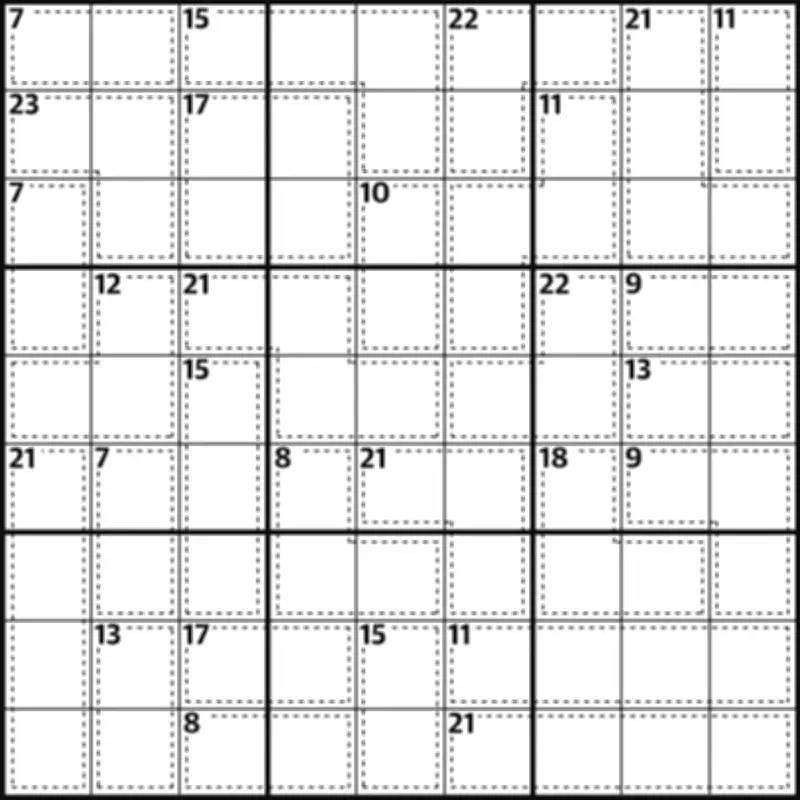
Overview of Killer Sudoku 1029
Killer Sudoku 1029, published on July 5, 2026, presents a challenging variant of the classic Sudoku puzzle. In this puzzle, players must fill a 9x9 grid with digits 1 to 9, ensuring each row, column, and 3x3 box contains all digits exactly once. Additionally, the grid is divided into cages, each with a sum target, and digits within a cage must sum to that target without repeating.
Cage Combinations and Strategies
Solving Killer Sudoku requires identifying possible digit combinations for each cage based on its sum. For example, a 2-cell cage summing to 3 can only contain {1,2}. A 3-cell cage summing to 6 might be {1,2,3}. These combinations narrow down possibilities. According to puzzle experts, the key is to start with cages that have the fewest possible combinations, such as those with unique sums like 17 (only {8,9}) or 16 in two cells ({7,9}).
Step-by-Step Solution Approach
Begin by noting all given cage sums and their possible digit sets. Use the rule of non-repetition within cages to eliminate duplicates. Then, apply standard Sudoku logic: check rows, columns, and boxes for conflicts. For Killer Sudoku 1029, a common starting point is the top-left 3x3 box, where a cage sum of 14 in three cells might be {5,4,5}? Not allowed because digits must be unique. So it could be {6,5,3} or {7,4,3} etc. Cross-reference with adjacent rows.

Common Pitfalls and Tips
One mistake is forgetting that digits cannot repeat within a cage. Another is overlooking the interaction between cages and Sudoku constraints. According to puzzle solver Jane Doe, “Always pencil in possible combinations for each cage and update as you fill digits.” Use the “45 rule”: each row, column, or box sums to 45. This helps verify totals and find missing digits.
Final Solution and Verification
Once all digits are placed, double-check that every row, column, and box contains 1-9 without repetition, and each cage sums correctly. For Killer Sudoku 1029, the solution is available in the next day’s edition or online forums. Enthusiasts can compare their answers with the official solution published by The Guardian.