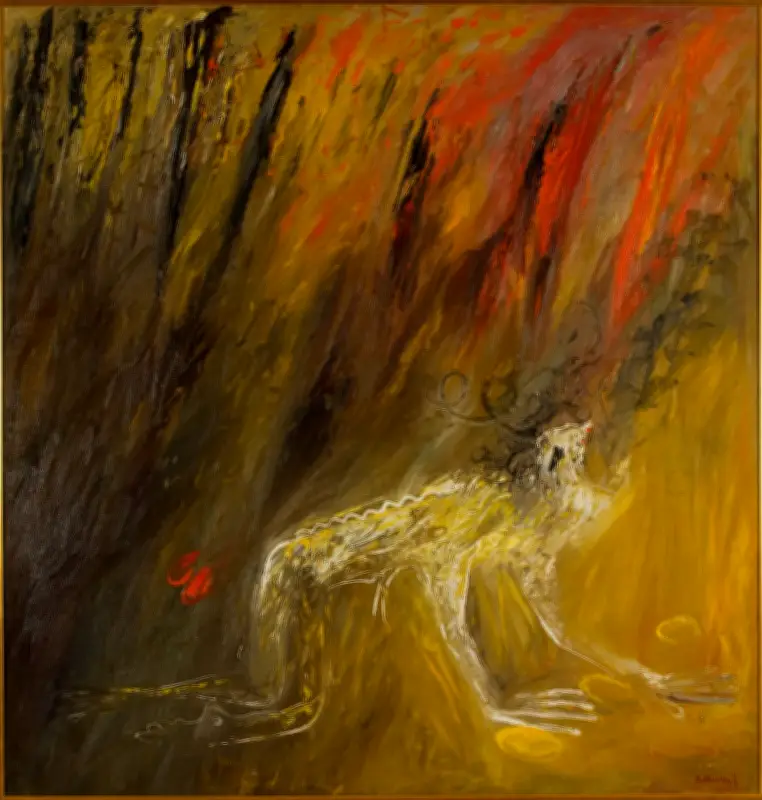
Bundanon, the sprawling estate on the New South Wales south coast once owned by Arthur Boyd, is now hosting a major exhibition that reunites two of the artist's most compelling series: the Nebuchadnezzar paintings and his Vietnam War works. The exhibition, titled 'Arthur Boyd: Nebuchadnezzar and Vietnam', brings together over 60 works from public and private collections, many never before seen together.
The Nebuchadnezzar Series: A Descent into Madness
Boyd's Nebuchadnezzar series, created between 1968 and 1971, depicts the biblical Babylonian king who, according to the Book of Daniel, was driven from human society and lived like a beast. Boyd transforms this ancient narrative into a potent metaphor for modern tyranny and ecological destruction. The paintings show a naked, hairy figure crawling through barren landscapes, often with a crown askew, symbolizing fallen power.
According to Bundanon's director, Dr. Sophie O'Brien, "Boyd saw Nebuchadnezzar as a symbol of hubris and the consequences of unchecked power. The series resonates strongly today with debates about authoritarianism and environmental degradation." The exhibition includes the iconic 'Nebuchadnezzar in the Wilderness' (1968-71), a large oil on canvas that has not been publicly displayed in Australia for over a decade.

Vietnam War Paintings: A Response to Conflict
Alongside the Nebuchadnezzar series, the exhibition features Boyd's Vietnam War paintings, created between 1966 and 1972. These works are a visceral response to the conflict, depicting scenes of violence, suffering, and protest. Boyd was a vocal opponent of the war, and his paintings reflect his outrage. Works like 'The Death of a Soldier' (1967) and 'Protest' (1969) show distorted figures and chaotic compositions.
The pairing of the two series is intentional, says curator Dr. Michael Brown: "Both series grapple with the nature of power and violence. Nebuchadnezzar represents ancient tyranny, while the Vietnam works confront modern warfare. Together, they form a powerful commentary on the human condition."
Bundanon: A Fitting Home
Bundanon, which Boyd donated to the Australian people in 1993, is a fitting venue for this exhibition. The estate includes the historic homestead, artist's studio, and a new museum building designed by Kerstin Thompson Architects. The exhibition is spread across both the historic and contemporary spaces, allowing visitors to see the works in the context of Boyd's creative environment.
"Boyd often said that the landscape of Bundanon influenced his work," notes Dr. O'Brien. "Having these powerful series here, where he lived and worked, adds a profound layer of meaning."
Key Works and Highlights
Among the standout pieces is 'Nebuchadnezzar in the Garden of Earthly Delights' (1970), a large triptych that references Hieronymus Bosch. The painting shows the king surrounded by fantastical creatures and decaying vegetation, a cautionary tale about environmental folly. Another highlight is 'Vietnam: The Burning Monk' (1967), inspired by the self-immolation of Buddhist monk Thich Quang Duc in 1963.
The exhibition also includes a selection of Boyd's preparatory drawings and sketches, offering insight into his creative process. According to the gallery, over 50% of the works have never been exhibited together, making this a rare opportunity for art lovers.
Relevance Today
The themes of the exhibition resonate with contemporary issues, from the war in Ukraine to climate change. Boyd's Nebuchadnezzar, with its imagery of a ruler brought low by his own arrogance, serves as a warning for today's leaders. The Vietnam paintings, meanwhile, remind us of the human cost of conflict.
As Dr. Brown states, "Boyd was an artist who engaged deeply with the world around him. These works are not just historical artifacts; they speak to us now, urging us to reflect on power, violence, and our relationship with nature."
Exhibition Details
'Arthur Boyd: Nebuchadnezzar and Vietnam' runs from July 12 to October 31, 2026, at Bundanon, 170 Riversdale Road, Illaroo, NSW. Tickets are $25 for adults, $20 for concessions, and free for children under 12. The exhibition is accompanied by a fully illustrated catalogue with essays by leading scholars.