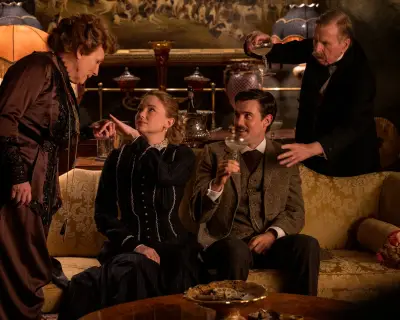
In the new 'wrongcom' series Alice and Steve, starring Nicola Walker and Jemaine Clement, the story begins as a tale of a lifelong friendship between two 50-something exes. They dated briefly decades ago and have since been inseparable platonic friends. In one early scene, Alice (Walker) tells Steve (Clement) that she loves him so much that if he were drowning, she would hollow out her own mother's body and use it as a canoe. The pair attend funerals, get drunk, talk frankly about disappointments, devise ill-advised solutions, and occasionally take cocaine—all the hallmarks of a loving friendship.
A Deep Dive into Relationships
Creator Sophie Goodhart uses the series to scrutinize every type of relationship. 'It's every stage of love Sophie is looking at,' says Walker. The show explores the doldrums of a long marriage between Alice and Daniel (Joel Fry) and the exquisite first love of Dom, Alice and Daniel's teenage son, which goes awry after they take an edible. However, the central fireworks revolve around a love story that destroys Alice and Steve's friendship.
After an overwrought funeral, Steve gets involved with Alice's daughter Izzy (Yali Topol Margalith). He is in his 50s, she is 26. 'To me, that's not the biggest thing,' Clement says. 'To me, it's the relationship between Steve and his friend and that it's his friend's daughter.' Goodhart doesn't think it's about age difference, though she adds, 'I should also admit that my husband is 14 years younger than me. What I like about the premise is the complete explosion. It completely breaks everything. It scorches the entire area.'

Friendship Under Fire
After watching Alice and Steve, I had conversations with lifelong male friends, all ending with the same conclusion: if they ever got involved with my daughter, my fury would reduce them to ash. 'You do always feel that your character's right when you're playing them,' says Walker, whose TV roles often put her in the right—as a DCI in Unforgotten, a lawyer in The Split, or a vicar in Collateral. 'But I really felt it with Alice, that I would do the same in her situation. I would do more. I would draw blood.'
Walker's utter credibility and white-hot rage make for gripping viewing, but it works because of Clement's comic chemistry and surrealism. 'I started off thinking of him as a cad,' he says, 'but I quickly dropped that, probably within the first day. Because it's more of a dilemma if he's actually thinking about what his friend is feeling.' If he had been even 5% a player, it would have felt tawdry. 'He's not grooming Izzy,' says Goodhart. 'If anything, Izzy is the one who has slightly more power.'
Full Metal Jacket
Without spoilers, Alice goes full metal jacket. She attends social events on a cocktail of rosé and dismay, intent on humiliating Steve and creating an unbearable atmosphere for everyone else. 'Every time I read a British script,' says Clement, 'sometimes I don't understand what the joke is. And then I remember: 'Oh, they're British, it's embarrassing.' British actors play with such pained embarrassment that it becomes funny.' There is a whole sidebar of cringe as Steve tries to ingratiate himself with Izzy's friends, who are torn between live-and-let-live and astonishment at the appalling things Gen Xers casually say. 'Different generations are almost like we're from different countries,' says Clement. 'We have such different sets of rules.'
Alice sets out to destroy Steve from the ground up, starting with his career. He is a hairdresser to the stars, and one tip to a gossip columnist revealing a celebrity's secret gets him dropped like a stone. 'I love the idea of them being stripped down, like [the film] The War of the Roses,' says Goodhart. 'That idea of, will you still fight when you've got nothing left?' Walker's performance is a raw mashup of pure fury and mystified indignation. 'Why doesn't everyone realise that I'm right? I'm the only one marching in time to the band,' Walker says.

Dark and Light
Clement thinks Goodhart and director Tom Kingsley (known for the comedy hit Ghosts) were like dark and light: 'She's nice but she has a really spiky and dark sense of humour, and Tom's influence keeps it fun.' There are tense moments when you can't imagine how the relationships will knit back together—or if that's even for the best. If it ever skirts close to the hokey values of Love Actually, it veers off into more complicated territory, becoming about mortality, marriage, and selfishness rather than romance.
'I don't understand romantic love,' says Goodhart, '100% every single day, 'I love you, and I will always behave in that loving way.' Marriages go through phases where you think: 'I'm not totally in love with you. We're just side by side and we're living very well, and we're on top of it.' I wanted to look at love in all its different shapes and sizes.'
Backstory and Drugs
Throughout, Alice and Steve's backstory emerges: they dated when they were young, which should make the situation even more uncomfortable, but there is so much else going on that you slide over it. 'They really played in their early 20s,' Goodhart says, 'just a gorgeous, manic chaos.' Drugs come up frequently, in a way not often seen in this genre of TV—heightened domestic comedy. 'I don't take drugs,' says Clement, 'but I've definitely been offered a lot of drugs. It is realistic that people take drugs. I can tell you that.' What is refreshing is not just that class A drugs are depicted as a realistic, if outlier, part of a normal-ish life, but that Alice can have an ambiguous relationship with delinquency. 'She's hidden the 20-year-old drugs, so there's a bit of shame,' says Walker. 'But despite it, she had no shame in digging it out. With her husband saying, 'Are you sure you want to do that? You got very paranoid last time.' It's absolutely brilliant.' Yet this doesn't dent her maternal identity at all.
After Motherland and Amandaland, the modern notion of mothering as total self-abnegation has already been challenged. Nevertheless, this feels challenging and original, particularly when, at the height of their enmity, Alice and Steve must wrangle a houseful of teens who have all had a psychedelic, edible-related mishap. These two friends, at each other's throats—she having a slow-motion breakdown, he weakly trying to please himself and everyone else—suddenly show their true competence, making a large number of people feel OK about incredibly weird sensations with calm, cheerful authority. 'They're like the A-team in that moment,' says Kingsley.
Fundamentally About Friendship
It might sound schmaltzy to say this is fundamentally about friendship; it is both more general—scoping out that a platonic relationship can be far hotter and more passionate than a marital one—and more specific. 'I often see that with my female friends,' says Goodhart, 'that they will have a very close friend and their husbands won't.' That might not look like a cute gender divide; it might look like the husband feeling lonely and devalued, which is certainly the story of Alice's marriage, with an endearing but infuriating meekness emanating from Daniel. 'Do you have a best friend?' Goodhart suddenly asks Kingsley, and he says: 'I think my best friend is the woman I was in a relationship with before I came out.' Goodhart and I nod to signify that that is acceptable, and he looks really relieved.
The cast is stacked full of what we used to call 'new men' (in the 90s)—put-upon Daniel, lovestruck Dom, hapless Steve. 'I feel there's been a lot of stuff about toxic masculinity, and I wasn't interested at all in talking about that,' says Goodhart. Alice and Steve had a life of its own while shooting, Clement says, the grey area of its sexual ethics bleeding into a quicksilver atmosphere: 'Even from what we filmed, you could make one Alice and Steve that's purely drama, or one that's just jokes.' If you fundamentally can't get past your outrage at the best friend/daughter romance, Alice resolves (definitely not in the way you think) by realising 'she should have trusted her daughter, because she made her daughter. So her daughter was bound to find the right way.' Perhaps that's the real inquiry: more than the impossibility of marriage, love, and friendship, the work of believing your mid-20s children could ever be capable adults—not least because that's the last description you'd ever use of Alice and Steve themselves.
Alice and Steve is on Disney+ from 8 June.