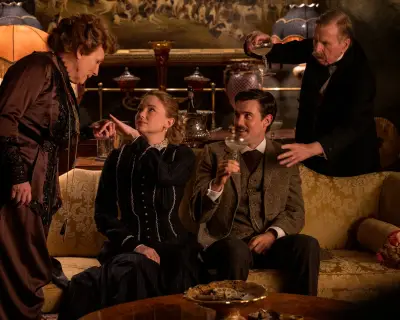
The Tuscan hills provide a stunning backdrop for Andrew Sean Greer's latest novel, Villa Coco. The Pulitzer-winning author of Less delivers a breezy confection of fish-out-of-water wit, insecurity, and self-discovery set in an Italian paradise.
Inspired by his own two-year stint directing a writers' residency at the Santa Maddalena Foundation outside Florence, Greer launches a hapless, clueless innocent into the Tuscan hills and the embrace of its eccentric aristocracy. The eponymous Coco, Baronessa Lisabetta, is a captivating figure who draws the narrator into her world.
A Young Man's Italian Adventure
Variously known as "our young man," Gio, and Giovedi, Villa Coco's narrator arrives to fill the post of "adjutant" for the Baronessa. His duties include pruning roses, emptying drains, hunting the Baronessa's mortal enemy—the pine marten—and cataloguing the dilapidated Villa Coco's contents. Among the camel saddles and hat racks, he is assured, lurk priceless works of art, including a Picasso and a Botticelli. He joins a staff consisting of a Sri Lankan cook, her husband, and a Lebanese factotum, all sharing in the Sisyphean task of keeping Villa Coco going and the Baronessa out of harm's way.

The Baronessa's Entourage
The Baronessa is not averse to trouble. At 92, she remains convinced that her best years are still ahead of her, while feigning deafness and blindness when it suits her. Along with his other duties, our young man must negotiate Coco's entourage. There is the charming bohemian neighbor Estelle and Coco's formidable whisky-drinking friend Pippa, a Venetian princess. There are relatives, dogs (disdainful pugs Gorky and Pushkin, and adoring truffle hound Cesare—Greer is very good at animals), lovers of lovers, and shady acquaintances, most of whom seem positively determined to bring the household into disrepute.
Gio, who has taken a vow of celibacy to maintain focus, finds himself alarmed by the sinuously predatory southern gentleman Furman Childress ("Ah was her friend's paramour") and charmed by faded Genoese aesthete Oscar, who gently dispenses romantic advice ("we must find you an Italian man").
The Trickiest Character
But the trickiest to handle is the most sweetly buttoned-up: the Baronessa's cousin Giacomo, stern but youthful, handsome but married, commissioned to accompany Gio on a mysterious errand but, it seems, also recruited to seduce our young man from the straight and narrow. Behind all these apparently chaotic and random introductions and excursions into Italy's hinterlands, it gradually becomes clear that the Baronessa has a precisely mapped course in mind, one that may land our young man in more trouble than he is ready for.
Greer's Charm Novel
In his preface, Greer states his aim unequivocally: he wishes to write what he calls a "charm novel," a book as soothing as a warm bath, funny but nourishing, with "a sliver of hope." The times are certainly propitious to such an ambition. He offers a hostage to fortune by naming as his paragons of the genre Nancy Mitford and the "entertainments" of Graham Greene, though this book, while it certainly charms, is nothing like them. Greer's young man is enchanted by Italians in the full admission of his ignorance of them, whereas Mitford knew her subject—the English upper classes—inside and out.
His tale also veers too close to whimsy, with a multiplicity of nicknames—even the car is a "Mitsu-bitchy." Greer does not have Mitford's merrily lethal edge, nor the wicked sophistication of Greene, nor the skill of both in lifting material free of its origins in lived experience. Instead—and it is a credit to the sincerity of his emotional response—what Greer offers is a fine eye for Italy's outrageous beauty. He gives us "the gold-green waters" of the Po delta and valleys full of white butterflies, while a description of the Grand Canal in fog is quite lovely: "a misty passage from which phantoms appeared—of pilings, rusted gates, lamp-posts, once the carved head of some drowned god."
Sentiment and Enchantment
He is in addition unashamedly sentimental, and though his other characters pale in her shadow, the Baronessa, with her stories and her machinations, her loyalty, wit, and courage, and the love and admiration of our young man, casts the requisite spell—delivering, in the end, an enchantment threaded through with hope.

Villa Coco by Andrew Sean Greer is published by Sceptre (£16.99). To support the Guardian, order your copy at guardianbookshop.com. Delivery charges may apply.