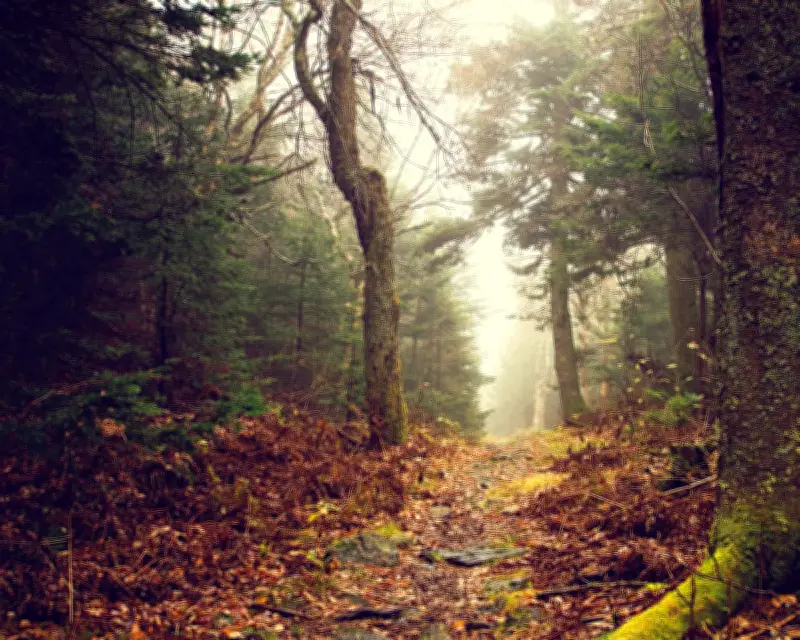
Daniel Mason's latest novel, Country People, returns to the verdant New England landscape that captivated readers of 2023's acclaimed North Woods. This time, however, he crosses from Massachusetts into Vermont, effecting a deeper shift. While North Woods traced a house and its inhabitants over three centuries, Country People turns attention to literature itself, mining myths, Milton, Shakespeare, Tolstoy, and more. At its core, it is a story about stories—the tales we tell each other, our children, and ourselves.
A Simpler Surface, Deeper Depths
On the surface, Country People is a linear account of a year in a contemporary family's life. This might seem a step back from the scope of North Woods, but surfaces are only a fraction of what we're dealing with. As one of its three baroque epigraphs notes: 'for every terrestrial stream, there run a thousand below the earth. For each pond, a hundred inner seas.' The action is driven by characters' compulsive need to dig deeper—into physical and metaphorical landscapes for meaning, inspiration, or just for the hell of it. Sometimes the digging is literal; often metaphorical; and occasionally, the boundary between the two blurs.
The Krzelewski Family in Vermont
Miles Krzelewski, a 45-year-old uxorious husband and adoring father, owns a truffle-hunting Italian dog. When his wife Kate, a brilliant Milton scholar, is offered a visiting professorship in Vermont, the family—including children Wesley and Olive, and dog Giuseppe—uproots from California. They drive to 'a new house, in a faraway forest.' For these west coast city-dwellers, Vermont's brooks, conifers, and deep green appear mythic and magical. Kate settles into her college, the children start school, and the new house holds no untoward surprises. The forest is filled with wildlife and birdsong, and at its edges are baseball fields with real grass and lemonade stands at affordable prices. The family is happy, and Miles is happy too.

Miles's Quest for Completion
But Miles is not fully grounded. The plan was for him to finish his PhD on Russian folktales—12 years overdue due to his tendency to switch focus. Vermont offers a wealth of distractions. The countryside calls to him, and he strides through woods and fords streams like a modern-day Walt Whitman. At first, he feels a tickle of concern about his lack of companions, but the people of Vermont prove as rich and varied as the wildlife.
Eccentric Companions
Over months, Miles falls in with a band of picturesque eccentrics. Among them are a local exterminator ('the Rat Man of Vermont') who waxes lyrical about 'Super-Rat-Lines'; a biochemist turned orchardist who introduces Miles to scything; a scooter-riding snowflake photographer; and a trekking guide named Hugh who may have once furnished Beyoncé with a blister cushion. Hugh believes the Earth is hollow and that hidden in their corner of Vermont is a portal to a fabulous underworld, first discovered by a 19th-century pastor, Jeremiah Wilkes, while walking his dog. Initially, Miles scoffs—'the exciting thing was that neither Kate nor Miles, in all their lives, had known this was something a person, a nonmedieval person, could believe'—but the Wilkes legend extends beyond Hugh, with a whole society devoted to its investigation. This is a rabbit hole of epic proportions, and Miles is drawn in.
Balancing Fantasy and Reality
The risk with such fantastical material is that it collapses under whimsy, but Mason sidesteps this pitfall. The surface structures may be sugar-spun, but the novel's foundations are solid, and its roots—the tangled web of stories that gave rise to new stories—are deliciously deep. The esoteric is counterbalanced by the mundane; family life is judged as worthy of investigation as underground caverns. The prose is witty and gorgeous, calling to mind Nabokov's comic masterpiece Pnin, surely another literary antecedent. This is a joyful book—and the deeper you dig, the more joyful it becomes.