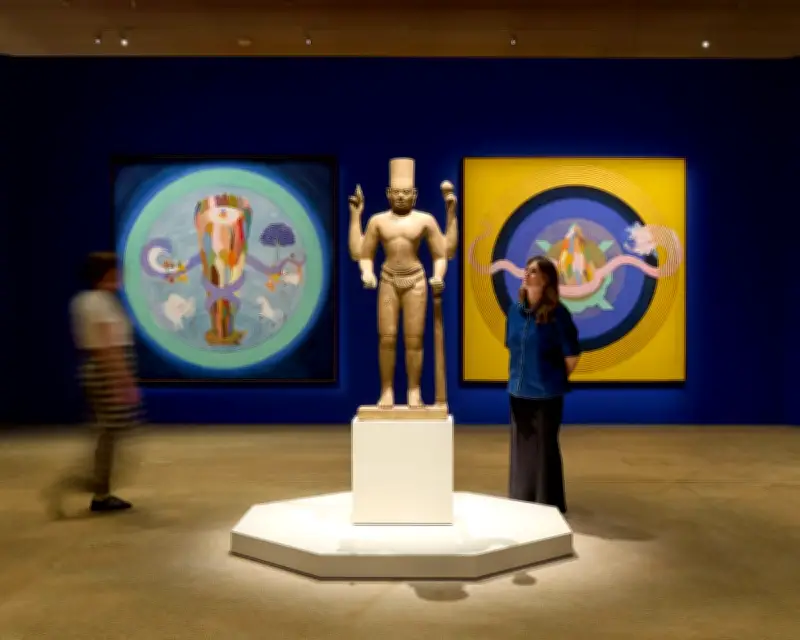
The many forms of Vishnu, the Hindu god depicted across 15 centuries of art, are showcased in a landmark exhibition at Sydney's Art Gallery of New South Wales. Titled Avatar: Forms of Vishnu, the display runs from 20 June to 5 October and features hundreds of ancient and modern interpretations of Vishnu's image, from the man-lion Narasimha to blue-skinned Krishna.
Exhibition Highlights
The exhibition includes a 12th-century bronze of Vishnu in the lotus, a symbol of purity and spiritual growth. The central figure holds a lotus, conch shell, citron, and an unidentified object, surrounded by petals representing his avatars such as Varāha the boar and Narasimha the man-lion.
A 19th-century ink drawing from a Ramayana manuscript depicts Rāma winning Sinta's hand in marriage, encounters with demons, and allegiances with monkey armies. This manuscript was created for the regency of Klungkung, Bali's political and spiritual centre from the late 17th to the early 20th century.

A sandstone lintel from Cambodia (c. 100–800) shows Vishnu reclining on the serpent Ananta Shesha, with Brahma seated atop a lotus blossom emerging from Vishnu's navel. Celestial beings in flight flank the central scene.
Another sandstone sculpture from Cambodia (c. 100–800) depicts Krishna lifting Mount Govardhana to shelter villagers from a storm, capturing a moment of heroism in a dynamic pose.
A bronze of Narasimha (c. 1529–1736) holds symbols of cosmic authority—the conch and discus—while his lower hands gesture reassurance and protection. A tiny Lakshmi figure appears on his chest.
A 15th-century bronze of Sita, heroine of the Ramayana, shows her with a crown-like hairstyle and her right hand forming the kataka mudra, associated with holding a flower.
A late 18th-century watercolour from India or Pakistan depicts Krishna defeating the demon Bāna, with blue-skinned Krishna holding a dynamic pose amid a chaotic battlefield.
Another watercolour from c. 1690–1700 shows Narasimha killing the demon Hiranyakashipu, using every loophole—at twilight, on a threshold, neither on ground nor in sky, and without weapons.
A late 19th-century watercolour from the Kalighat style depicts Vishnu as Matsya the fish, painted quickly on inexpensive paper with simplified iconography.
A mid-18th-century watercolour illustrates Rāma chasing the golden deer Maricha, a crucial moment in the Ramayana where Rāma's pursuit enables Rāvana to abduct Sita.
A late 18th-century watercolour shows Sita offering fruits to Rāma in the Dandaka forest, representing their idyllic forest life during exile.
An oleograph from c. 1894–1930 by Raja Ravi Varma's press depicts Vishnu with goddesses Lakshmi and Bhu Devi flying on Garuda, hand-embellished with cloth, embroidery, and sequins.
Gitanjali Das's 2025 painting Navagunjara on tussar silk shows a manifestation of Vishnu composed of nine animals, including a rooster's head, peacock's neck, bull's humped back, and lion's torso.
Desmond Lazaro's 2026 painting Samudra Manthana reinterprets the churning of the ocean of milk, where Vishnu manifests as Kurma the tortoise to support Mount Mandara.
The exhibition is curated by AGNSW curators Melanie Eastburn and Dr Chaitanya Sambrani, with Emma Joyce.