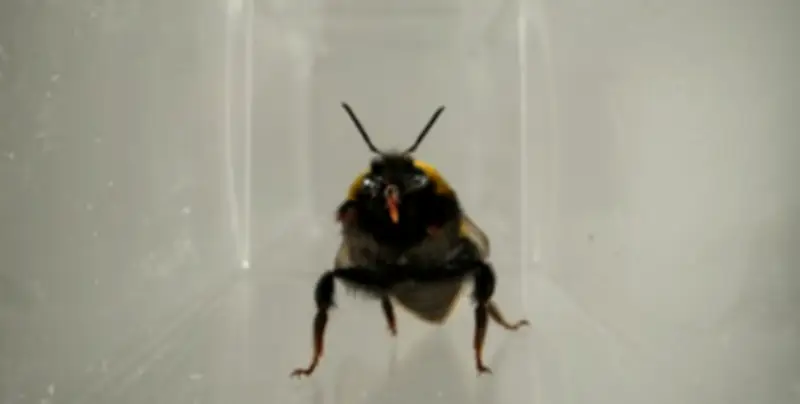
New research published in the Proceedings of the National Academy of Sciences suggests that bumblebees' facial expressions may reveal their inner states, offering potential insights into insect consciousness. The study, led by Cwyn Solvi and colleagues, found that bumblebees display distinct mouth movements when tasting different substances, similar to how humans and other mammals express liking or disliking.
Darwin's Idea Extended to Insects
Charles Darwin first proposed that facial expressions in animals could indicate emotions. While dog owners readily recognize joy, fear, or pain in their pets, insects have been largely overlooked due to their hard exoskeletons and impassive faces. However, bumblebees have highly mobile mouth parts, including a long glossa (tongue) used to sip nectar.
In experiments at Southern Medical University in Guangzhou, China, researchers offered bumblebees tiny droplets of sugar water or dilute salty water. When given sugar water, bees extended and retracted their glossa repeatedly after drinking, akin to lip-smacking. In contrast, salty water caused them to sample it, then back away shaking their heads and wiping their glossa, as if in disgust.

Not Just Automatic Reactions
To test whether these responses were merely chemical reactions, the team altered the bees' physiological state by heating them to 40°C for a short time, inducing dehydration. Dehydrated bees then drank dilute salty water eagerly and showed glossa extensions similar to those for sugar. This indicated that the glossa movements reflected the bee's subjective physiological need, not a fixed response to the chemical.
Further experiments manipulated bee neurochemistry. Bees treated with octopamine or dopamine were more reactive to sugar but did not show post-drinking glossa protrusions. However, those treated with an endocannabinoid showed enhanced protrusions without increased sugar reactivity. This demonstrated that the glossa protrusion is independent from sugar reaction and can be specifically modulated.
Implications for Insect Consciousness
According to the researchers, these findings suggest that bee responses are subjective and related to their internal state, paralleling those of humans and other mammals. While the study does not conclusively prove that bees feel emotions like liking or disliking, it adds to growing evidence that insects have an inner life beyond mere reflex.
"Now that we can read bees' faces to get a read on their subjective state, we can do a lot more work to probe what the inner life of an insect is like," the authors stated. The research builds on earlier work by psychologist Kent Berridge, who showed that rats' facial expressions indicate liking and disliking, and that these expressions are conserved across mammals.