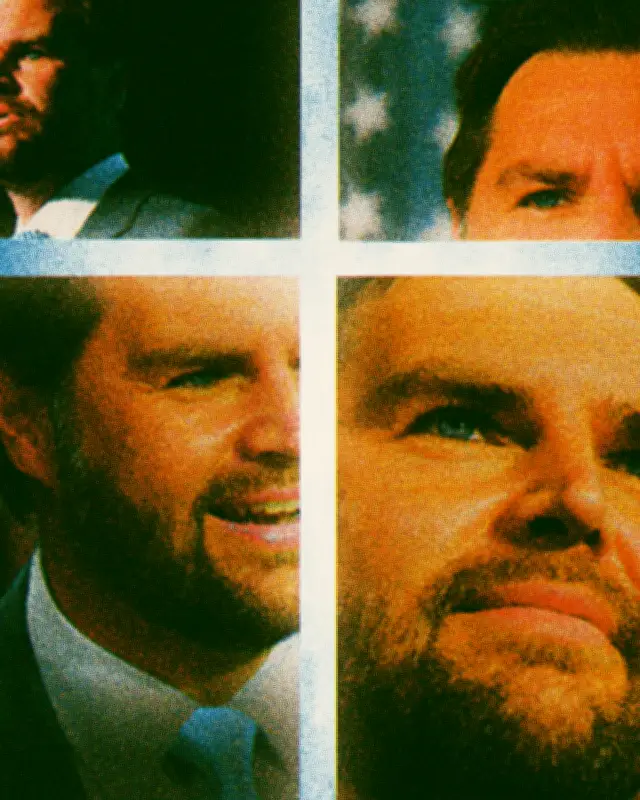
In his new memoir, Vice-President JD Vance recounts his conversion to Roman Catholicism and the political implications of his faith, as a more conservative strain of Catholicism rises in the United States.
Vance's Spiritual Journey
When JD Vance became a Roman Catholic, he wondered what his late grandmother Mamaw would think. She had no particular animus toward Catholics, but in his Ohio upbringing, he sometimes heard that Catholics were servants of the antichrist. The Church of Rome, with its rituals, foreign leadership, and veneration of Mary and the saints, seemed exotic and alien to his Appalachian family. Yet on the day of his reception into the church in 2019, he felt consoled by a sudden sense that his grandmother was urging him on from the grave, echoing her favorite phrase: “Time to shit or get off the pot.”
Vance's conversion, conducted by Dominican friars who first sparked his interest, occurred about five years before he became vice-president alongside Donald Trump, a man he once deemed unworthy of Christian support. His memoir, Communion: Finding My Way Back to Faith, traces his evolution from the casual Christianity of his grandmother, through his father's Pentecostalism, college atheism, to an orthodox Catholicism. The book argues for a Catholic-influenced third way to address America's political, economic, and cultural decline.

Catholicism's Influence on the American Right
Vance joins a number of observant Catholics among the American right's leadership. Although Catholics make up only about 20% of US adults, they have long held outsized influence in conservative circles. Six of the nine current Supreme Court justices, including nearly all conservatives, are Catholic. Vance has become a prominent figure in a revitalized conservative Catholicism allied with the MAGA movement, leading to clashes with the Vatican over immigration and anti-war stances.
The State of American Catholicism
American Catholicism is in flux. Despite scandals and secularization, some parishes report a boom in young converts disillusioned by modern life. This modest resurgence may foster a leaner, more fervent faith. Vance, as the highest-ranking Catholic in the US government and a potential 2028 presidential candidate, embodies this shift.
His memoir expands on a 2020 essay, How I Joined the Resistance, detailing his chaotic childhood and the appeal of Catholicism's structure. Mamaw, a woman of deep but unstructured faith, believed abortion was an individual moral matter. After reconnecting with his Pentecostal father, Vance embraced a disciplined Christianity but grew disillusioned by its anti-intellectualism. By college, he became an “angry atheist,” influenced by Christopher Hitchens.
At Yale Law School, he met venture capitalist Peter Thiel, a Christian who challenged his assumption that intelligence and faith were incompatible. By the time he married Usha Vance, he was “Christian curious” and drawn to Catholicism's intellectual rigor. Dominican friars guided his conversion, and he chose St. Augustine as his patron saint, citing Augustine's The City of God as an influence.
Vance's Political and Religious Views
As vice-president, Vance has defended hardline stances on immigration and law enforcement, and spread false rumors about Haitian migrants. His book walks back some controversial remarks, calling his “childless cat ladies” comment “boneheaded.” He frames himself as a civilizational warrior, writing, “My big fear isn't death, but that we inherited a great civilization and are slowly letting it fall into disrepair.”
The Dominican orthodoxy reflects a broader shift among US Catholic clergy: only 11% of priests ordained since 2020 identify as liberal, compared to 40% in the 1980s. White Catholics now tilt Republican, while Hispanic Catholics have also shifted right. Younger Catholics often view themselves as leading a counterrevolution against a “baby boomer Catholicism” that traded core theology for vague deism.
Leah Libresco Sargeant, a former atheist who converted in 2012, believes orthodox Catholicism will endure. “When people are seeking a church, but the one they encounter is very flexible, or doesn't ask things of them, or doesn't mark them out as distinct from the culture as a whole, I feel like they're less likely to come or to stay,” she said.

Massimo Faggioli, a theology professor, noted that American converts like Vance tend to hold a conservative, totalizing view that challenges the church's diversity. “It's one thing to become a Catholic via baptism; it's a little different to become part of the church in a way that accepts the messiness of Catholicism,” he said.
At St. Joseph's Church in Manhattan, pews are packed with young adults. Kate DePetro, 27, co-organizes weekly pizza-and-mass events. “Our generation is realizing that they want that sense of purpose, want that sense of community, want to have faith, want to have hope in something,” she said.
Political scientist Ryan Burge noted that Vance is statistically an outlier: most Catholics are “cradle” or “cultural” Catholics who rarely attend church. Converts tend to be more conservative. Burge is skeptical of claims that Vatican II reforms drove decline, noting that almost all Christian denominations are shrinking. The only growing segments are nondenominational and Pentecostal churches emphasizing emotional worship.
Burge described the Catholic revival as “bougie,” attracting college-educated people seeking intellectualized faith. “The average American doesn't want that,” he said. “They want to sing praise songs and clap and not think about all the problems they're facing for 45 minutes.”
Vance's book attempts to thread a needle: arguing for faith in politics while denying theocracy. Catholic doctrines don't align neatly with either party. On abortion, he writes, “Prudence is the better part of virtue. If your political argument on the abortion question – or any other – fails to persuade your fellow Americans, you have to make a better argument.”
The final section argues for “integralism,” a theory that Catholic morality should influence government. Vance presents this as pragmatic, not radical. Whether Americans embrace this vision, especially after the Trump administration's populism, remains uncertain. But if Vance reaches the Oval Office, he may represent American Catholicism's future.