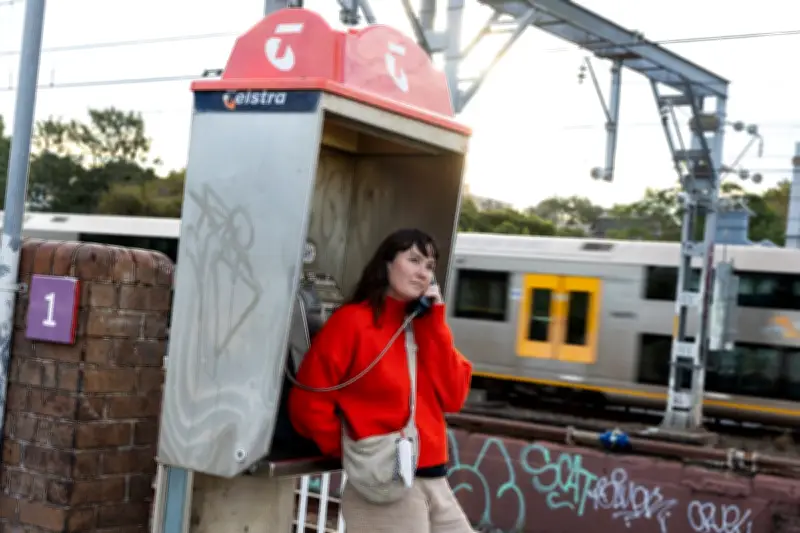
A man I have never met stands at a payphone in Sydney's CBD. 'A serene small park directly to the right of the payphone,' he says poetically into the receiver. 'There's a man with an interesting cap sitting down there, and an ibis. I guess they'll be immortalised in this phone voicemail forever.'
The man, known only as GippslandGuardian, has visited 106 payphones since late April. I know this because we are both playing a game called PayphoneGo, where he left this voicemail, creating a strange sense of connection in a small corner of the internet.
There are 14,000 remaining payphones across Australia, in far-flung locations like the Oodnadatta Track and Lord Howe Island. But in bustling cities, they blend in with bus stops, traffic lights, and electrical wires. They only reveal themselves when needed—or when trying to find them to accrue points for a game inspired by Pokemon Go.

The Game of PayphoneGo
That is why I am attempting the noble task of visiting 50 payphones across Sydney in a day. By pausing at these liminal spaces, I discover a secret side to the city: posters for lost birds, scrawled graffiti, empty coffee cups, and vomit.
PayphoneGo was created in April by Kris Norris, a 19-year-old Brisbane student. The premise is simple: each player gets a nine-digit ID, entered after calling the website's number from a payphone. Norris connected every payphone number in Australia on her backend, so when players call with their ID, they automatically accrue points.
If you are the first to call from a payphone, you get 20 points and can leave a voicemail uploaded to the website. The second visitor gets 10 points, then five, then one. Norris created the game to encourage people to 'go out into the community, out into the world and explore.' She says, 'It's based on the idea of going back to the old internet: no ads, no tracking, so few cookies. I hate how commercialised and corporate the internet has become. I want to make things just for the sake of having people play. Payphones are a vital public service, but most people ignore them.'
The Importance of Payphones
Since mid-2021, calls on Telstra payphones have been free, a move the telecommunications giant said would help protect vulnerable Australians. The decision attracted global headlines as smartphones rose. Australia's universal service guarantee (USG) mandates Telstra provide reasonable access to public payphones regardless of profitability.
About 4,000 of the 14,000 payphones also offer free wifi. The benefit for Telstra is advertising dollars. The telco does not publicly disclose ad revenue, but the USG allows phones in high-traffic areas, avoiding planning controls. This has led to backlash from some councils. In 2019, a coalition took Telstra to court over a proposal for nearly 3-metre-tall phone booths.
Telstra's payphone product owner, Pete Manwaring, says more than 100 million calls have been made since fees were scrapped, and usage has tripled, with 4 million calls from Sydney's 1,918 payphones in the past year. Payphones remain an 'incredibly important' essential service. About 37% of calls go to emergency services, helplines, and government support numbers, including triple zero or crisis lines. Another 33% go to utilities.
History and Decline
Payphones were introduced in Australia in the late 1890s to overcome the tyranny of distance. At their peak in the 1990s, there were 80,000 payphones across the country. Associate Prof Mark Gregory from RMIT's school of engineering says a few years ago there were 20,000, 40% more than today. He says the lost 6,000 should be reinstalled and all payphones should offer free wifi.
'The cost for upkeep of payphones isn't huge, and there is a trade-off because of advertising and marketing opportunities,' he says. 'The universal service guarantee is one of the few things that sets Australia apart from other nations in telecommunications. We need to stand up and fight for it.' Gregory is concerned about 'black spots' without access to a payphone, meaning people cannot contact triple zero when needed. 'To me, a payphone means safety. They're so important for people of low socioeconomic means, disabilities, children, and the elderly.'

Cult Following Online
Despite their decline, payphones are attracting a cult following online. Alongside PayphoneGo, more than 1,000 users play Payphone Tag, a 'real-world territory capture game' by independent developer Alex Allchin that allows competitive map building. An Australian cybersecurity expert also created an interactive map of every payphone in Australia, complete with features and jurisdictional breakdowns.
The first payphone I call from when playing PayphoneGo is around the corner from my house, on a daily walk with my dog. I have never seen it before. The next is covered in curious rubbish: an old vape, a half-drunk Dare iced coffee, a crushed Coke can. At another, I find a dirty high chair, a broken-off manicured nail, and a cigarette butt. Each payphone is an Easter egg: what will it hold? What condition will it be in? What hidden stairwell will it be tucked behind? It is both exciting and disturbing, like when I discover a telephone cord dangling off its hook and a large splatter of vomit being eaten by pigeons.
At one point, I have to wait because someone is using the payphone to talk to an actual person. I have never lined up for a payphone before. I am disappointed when I reach a string of payphones in Marrickville that have already been visited, so I cannot leave a message. I find myself dramatically sighing when a payphone is out of order.
Norris understands my new obsession. 'My favourite thing to do is just sit on the website and refresh and listen to the new messages coming in,' she laughs. 'There are people talking about their favourite local areas, people talking about what they can see. Sometimes people are venting. People are singing.'
At 5pm, I call my partner and tell him I have clocked 40 payphones and do not know whether to cut my losses. I am eighth in Australia on the leaderboard of 40 players and have mapped all of Newtown, Enmore, and Erskineville. But 50, he agrees, is so much better than 40. In cricket terms, it is a half-century. I push on.
In the darkness, I am pleased to find the payphones lit up like beacons, but I am also marred by fatigue. In my delirium, I start visiting the same payphones twice, sometimes three times. I pass others without noticing them, even though I have their location on a map. But finally, 8.5 hours and 22,000 steps after I started, I reach payphone number 50—and it is in order. 'That beautiful dial tone,' I mutter, beaming. 'I don't really know what to do with my life now,' I say into the receiver. 'Thank you so much for this opportunity.'